
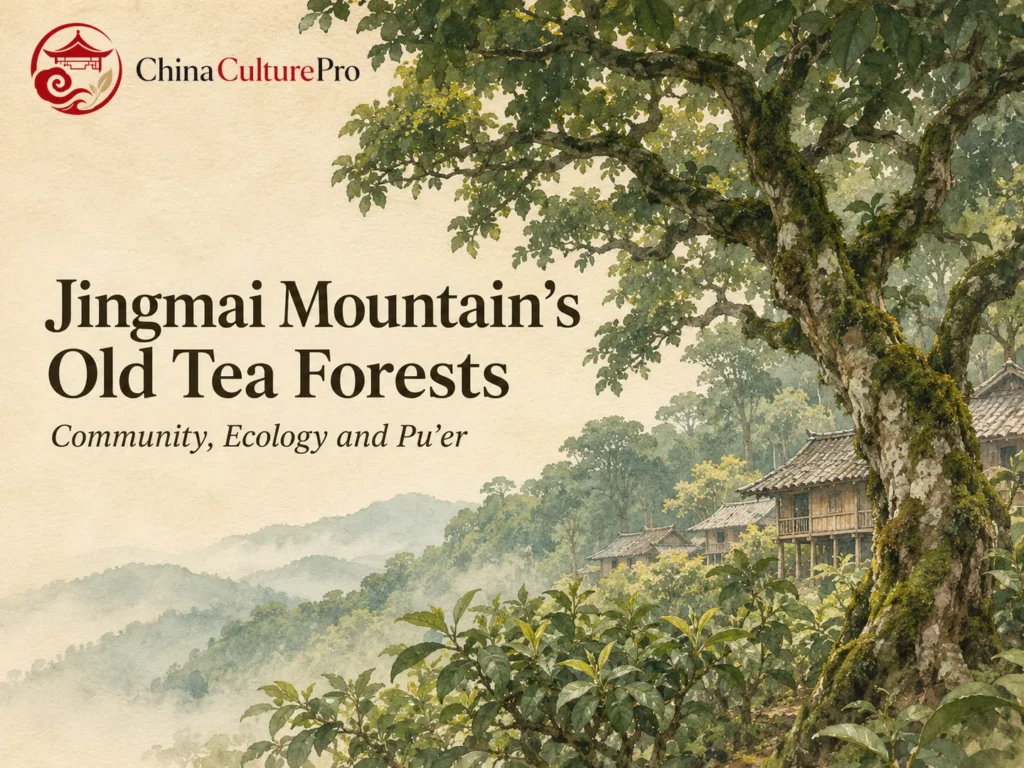

Quick Answer: What Are Jingmai Mountain’s Old Tea Forests?
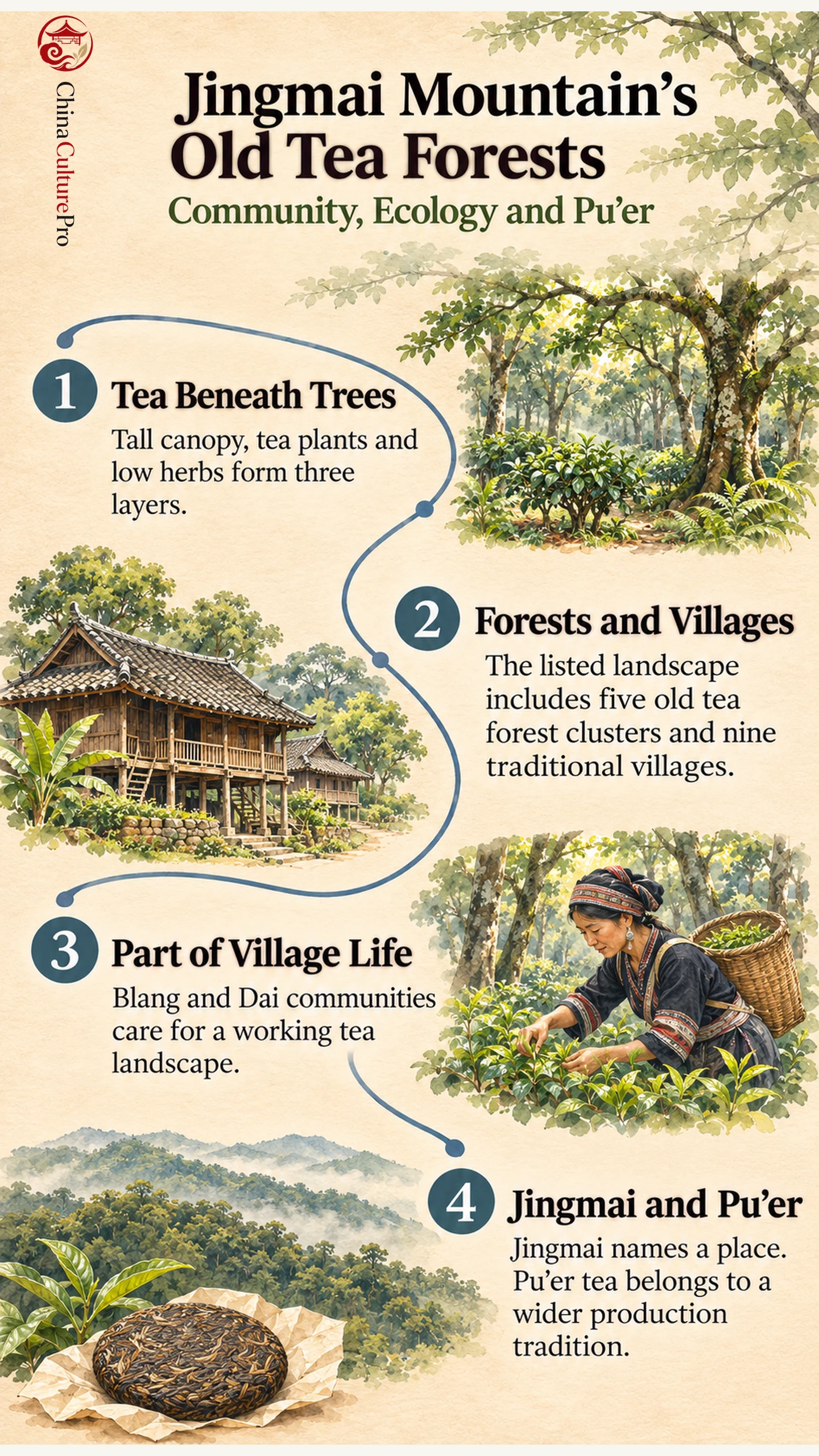
Jingmai Mountain (景迈山, Jǐngmài Shān) in Pu’er, Yunnan, is a tea-growing landscape managed by Blang and Dai communities. In its old tea forests, tea trees grow beneath taller canopy trees. UNESCO inscribed the landscape in 2023. It includes five old tea forest clusters, nine traditional villages and three protective forest belts. [1][2][3]
- How tea grows: Tall trees shade tea bushes and trees, and smaller plants form a lower layer. [2]
- Who cares for the landscape: Households, village institutions and public authorities help manage the forests and settlements. [1][2]
- What Pu’er means here: It names the city and a wider tea tradition in which Jingmai has a place. [1][4]
The listing covers the groves, nearby settlements and the practices that link them.
In one of Jingmai Mountain’s old tea groves, the tall trees above the tea are part of the growing system. This is a clue to the farming system. Its story concerns what people keep growing around the tea, which paths and houses connect to it, and how villages maintain their part of the mountain. [1][2]
What It Means to Grow Tea Beneath the Forest Canopy
Understorey cultivation (林下种茶, línxià zhòng chá) grows tea beneath taller trees. The ICOMOS assessment describes three layers: a canopy, tea trees and bushes below it, and herbs or low plants near the ground. Farmers manage what grows in each layer. Shade changes light levels, and the canopy moderates direct exposure to heavy rainfall. Different plants and fallen material form part of the growing environment. [1][2]
The old tea forest is cultivated land with a wooded structure. The property also includes other tea plantations and forest areas with different functions. A close look at the different heights of plants helps distinguish the old groves from the more open tea plots. In parts of Jingmai, protective forest belts separate tea areas and villages and help shelter them from wind. [1][2][3]
The landscape has also changed. The assessment records the development of modern tea plots in some areas in the second half of the twentieth century and later work to restore traditional growing conditions and protective forests. A younger tree in a restored area and an older tree in a grove can occupy parts of the same cultural landscape. Restoring younger plantings and caring for established groves are both part of maintaining the landscape. [1][2]
How Villages Maintain the Tea Landscape
The five old tea forest clusters sit across several mountain areas with nine traditional villages. The heritage assessment describes Nuogang, a Dai village associated with the Nuogang forest, and Wengji and Wengwa, two Blang villages associated with their shared forest cluster. Village locations reflect connections among homes, forests, and the paths people use to reach tea land. [2][3]
Some wooden houses on raised structures include space for residence, tea handling or storage. Management also extends beyond individual households. The heritage records describe local village rules and the role of religious institutions and public authorities. Those arrangements have changed over time and continue to shape decisions about cultivation and conservation. [1][2]
Tea Ancestor traditions are part of the site’s cultural history. The ICOMOS account records a Blang tradition that remembers Pa Aleng as the person who discovered tea locally. The account belongs to a living oral and religious tradition. The guide to Blang culture gives a wider view. Dai culture also helps explain the mountain’s history of shared cultivation and differing local traditions. [1][2]
How Jingmai Fits Into the Larger Pu’er Tea Tradition
Jingmai is one origin within the wider Pu’er tea landscape. The mountain describes a place, while understorey describes a way of growing tea. The terms used for Pu-erh tea also refer to a history of processing and trade that extends beyond this single mountain. When reading a tea description, check whether it is naming the growing place or explaining what happened to the leaves after harvest. [1][2][4]
UNESCO recognized the relationship among villages, forest, tea cultivation and cultural practices. Its property boundaries are more specific than the broader tea economy of 雲南. A useful comparison is the Honghe Hani Rice Terraces, where a different crop also depends on the spatial and social relationship between forest and village. Jingmai’s defining feature is tea cultivation beneath an actively managed canopy. [1][2][5]
FAQs About Jingmai Mountain’s Old Tea Forests
Where is Jingmai Mountain?
The listed landscape is around Huimin Town in Pu’er City, southwestern Yunnan. It includes several clusters of tea forest and related villages. [1][2]
Are the old tea forests wild?
People grow and care for tea beneath taller trees, while retaining several layers of vegetation. The term forest describes the structure of the cultivated landscape. [2]
When did the tea forests become a World Heritage site?
UNESCO listed the cultural landscape in 2023 under criteria that recognize living traditions and land use. [1][3]
資料來源
[1] UNESCO World Heritage Centre. Cultural Landscape of Old Tea Forests of the Jingmai Mountain in Pu’er
[2] ICOMOS. Evaluation of the Old Tea Forests of Jingmai Mountain
[3] UNESCO World Heritage Committee. Decision 45 COM 8B.9
[4] Food and Agriculture Organization. Pu’er Traditional Tea Agrosystem
[5] UNESCO World Heritage Centre. Cultural Landscape of Honghe Hani Rice Terraces