


Quick Answer: What Does Hua She Tian Zu Mean?
Hua She Tian Zu (画蛇添足, huà shé tiān zú) means to spoil a result by adding something it does not need. In Strategies of the Warring States (战国策, Zhànguó Cè), a man finishes drawing a snake first, then tries to add feet. The extra work costs him the prize.[1][2]
- Literal image: Draw a snake and add feet.[1][2]
- The mistake: An already adequate result gets worse through an unnecessary addition.[2]
- Modern use: Criticize an added line, feature or action that detracts from the whole.[2]
The phrase points to the harm caused by continuing past the point of completion.
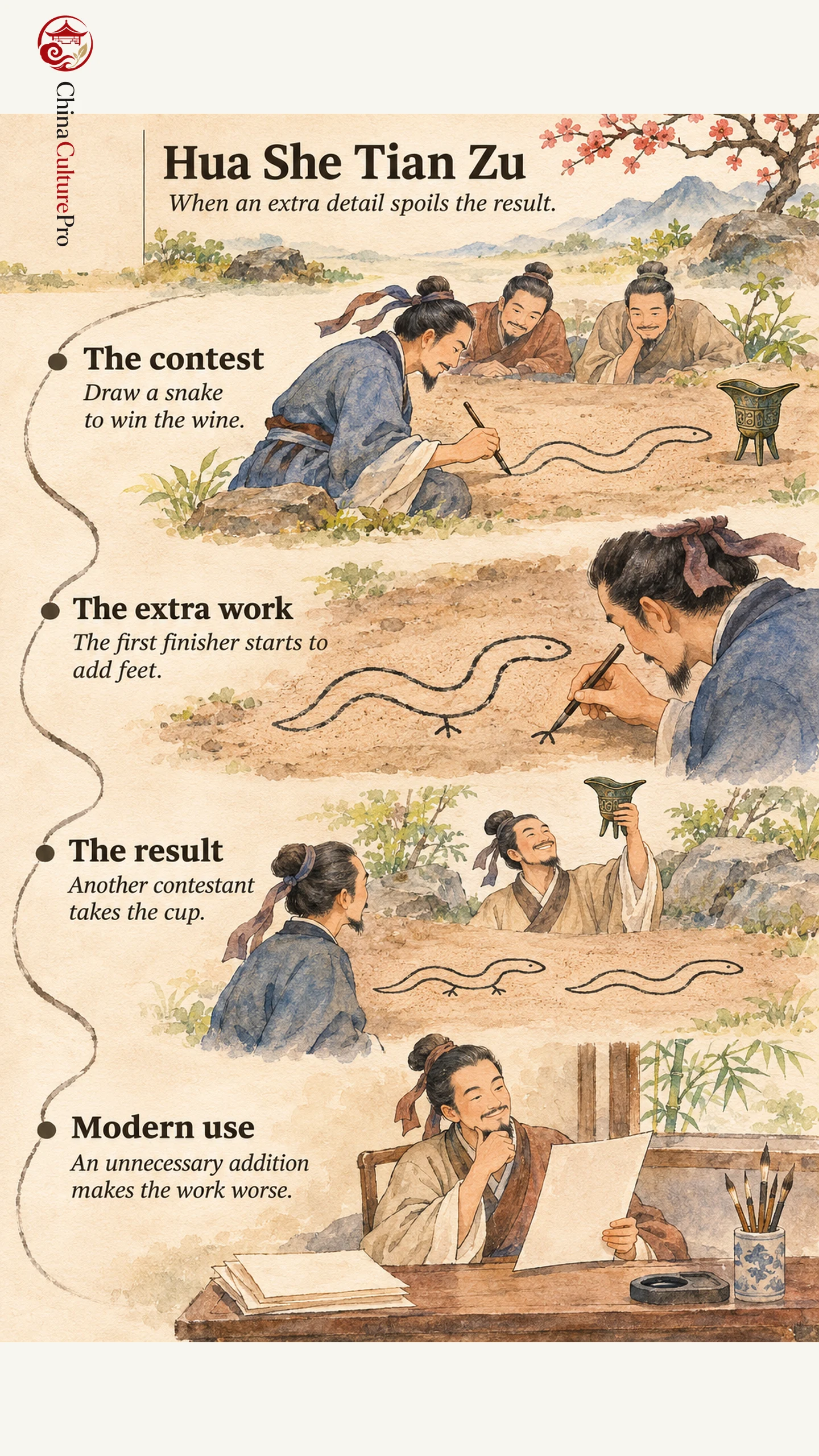
The first contestant has a finished drawing and is reaching for the wine. Then he does something the contest never asked for. The idiom is as much about knowing when to stop as it is about what a snake looks like.[1][2]
The Drawing Contest and the Lost Cup
Several people receive a serving of wine. They decide there is enough for one person and agree that whoever draws a snake on the ground first will drink it. The first to finish takes hold of the cup, but starts giving his snake feet while the others are still drawing.[1]
Another contestant finishes and takes the cup. A snake has no feet, he points out, so the added work has undermined the first drawing. The man who had been in a position to win ends up without the wine.[1][2]
Why Chen Zhen Tells the Story
The contest is a story within a conversation. Chen Zhen, speaking for Qi, tells it to Zhao Yang of Chu, who has already won recognition for his achievements. Chen Zhen asks what Zhao Yang stands to lose by pressing on after he has already earned distinction. Zhao Yang accepts the comparison and withdraws.[1]
The reward in the small story makes the larger point easy to see. The first contestant had what he needed to claim the wine. His extra work exposes him to a loss that a finished drawing would have avoided.[1][2]
How to Use Hua She Tian Zu Today
An editor might say 结尾已经很清楚了,再补一句反而画蛇添足。 The ending already makes sense, and another sentence would weaken it. The new line is a problem because it dilutes a clear ending.[2]
In a design review, the expression could describe an extra ornament that hides a useful feature. “Spoil it by adding too much” is a broad English gloss. “Gild the lily” fits decorative excess, although the Chinese phrase can imply a more tangible loss, as it does in the contest.[1][2]
How It Differs From Hua Long Dian Jing
Hua Long Dian Jing (画龙点睛, huà lóng diǎn jīng) praises an addition that brings a work to life. The snake’s feet take away from a drawing that already works. If a sentence or design element makes the main point clearer, it belongs on the dragon side of the comparison.[2][3]
FAQs About Hua She Tian Zu
Who wins the wine in the story?
The other contestant drinks the wine after finishing a snake without feet. The person who finished first loses it while attempting the unnecessary addition.[1]
Can the idiom describe editing and design?
Yes. It fits when a feature, detail or sentence damages a result that was already sufficient.[2]
What is a natural English translation?
“Spoil it by adding too much” works in many settings. Keep “draw a snake and add feet” if the reference to the story matters.[1][2]
資料來源
[1] Chinese Text Project. Strategies of the Warring States, Qi II
[2] Taiwan Ministry of Education. Idiom dictionary entry for 畫蛇添足
[3] Taiwan Ministry of Education. Idiom dictionary entry for 畫龍點睛