
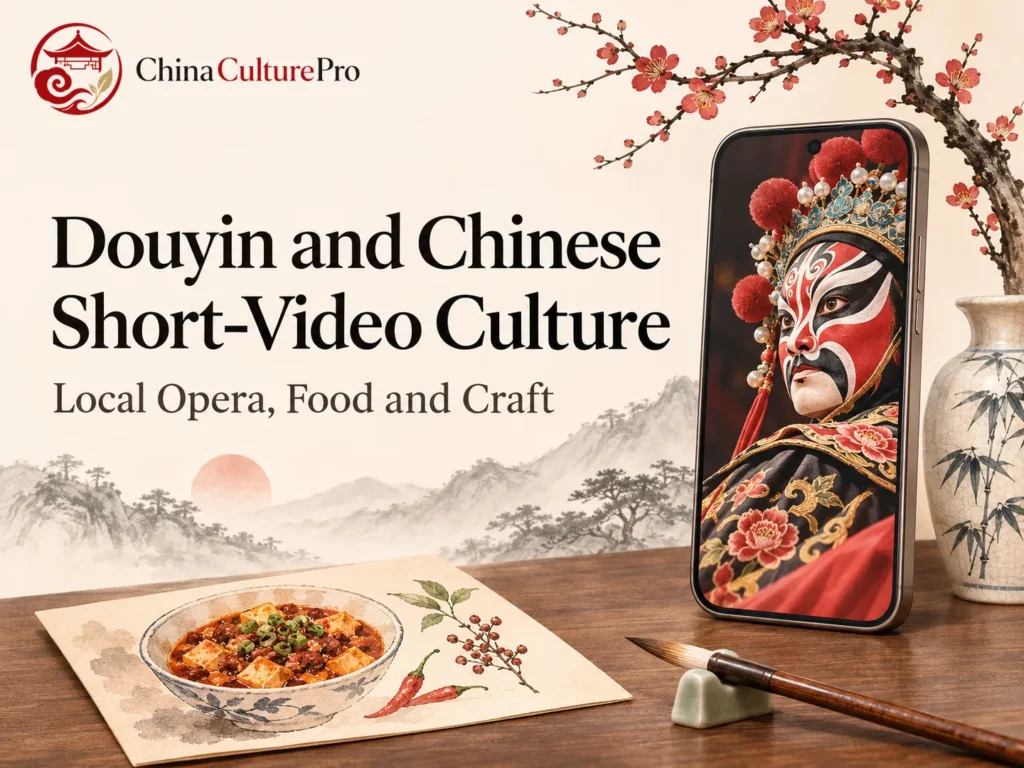

Quick Answer: What Is Douyin and Chinese Short-Video Culture?
Douyin (抖音, Dǒuyīn) is a Chinese short-video platform where a few seconds of regional opera, a hometown dish or one stage of a craft can reach people far from its original setting. Creators decide which moment to show, and viewers add local knowledge and reactions in the comments.[1][2][3][4]
- Opera: A clip can isolate a striking gesture or transformation.[1]
- Food: Local ingredients and speech can make a scene familiar to people who have moved away.[2][3]
- Craft: Close-ups reveal individual steps, while editing leaves other work off-screen.[4][5]
The clip gives you a place to start. Look for the town, practitioner or full work to recover more of the context.[1][4]

A mask can change before you have learned the character’s name. A cook can turn out a finished dish before you have seen the preparation. In each case, the short format makes one part easy to notice.[1][3][4]
What a Short Clip Keeps From a Live Performance
In Sichuan opera face changing, a performer can switch masks within a movement. That moment fits easily into a short clip. A longer view may show where the movement comes in the scene and how the music and character prepare the audience for it.[1]
The people sharing opera may include troupes, heritage institutions and individual creators. A wide shot can preserve the stage setting. A close-up can isolate the face or hands. Look for a named performer, troupe or work in the post before using an isolated clip to explain a whole genre.[1]
How Food Clips Make a Place Recognizable
A regional food video can say as much about a place as about a dish. A creator’s pronunciation, a market backdrop or a familiar way of finishing a dish may be cues for viewers who grew up nearby. Research on county-level video and culinary heritage gives examples of residents and migrants recognizing and discussing hometown scenes.[2][3]
Distinguish the visible details from the claim they are being used to make. A video shows which peppers the cook put into that pot. The history of chile peppers in Chinese food explains why the same ingredient can play different roles across regions.[2][3]
What Creators Add and What the Clip Leaves Out
For craft, a close camera angle can make a bend, cut or joint much easier to see. An edit may jump from a half-finished object to the final result, leaving the drying, fitting or repeated corrections out. Look for the moment the material changes, then check which parts of the process the maker actually shows. The guide to Chinese traditional crafts on social media gives that question a wider setting.[4][5]
Short videos are one route through Chinese popular culture. In Bilibili’s fan culture, an explanation or remix can instead grow around a shared series or character. Both examples show that the choices of the person posting shape what the next viewer encounters.[4][5]
FAQs About Douyin and Chinese Short-Video Culture
Why do some clips show only one opera technique?
A dramatic movement can make sense in a short excerpt. Understanding the plot, musical structure or role often requires a longer performance.[1]
Does a popular food clip mean the dish is eaten that way everywhere?
A clip shows one selected version or scene. A town’s food often varies across households, shops and seasons.[2][3]
Can a short video document a whole craft?
It can document a step and point to a practitioner. Longer descriptions, demonstrations or repeated views help recover preparation and context.[4][5]
資料來源
[1] Journal of Sichuan University of Arts and Science. Sichuan opera and its dissemination on Douyin
[2] International Journal of Communication. Short Video Platforms and Local Community Building in China
[3] Journal of Ethnology. Short videos featuring culinary intangible heritage
[4] Humanities and Social Sciences Communications. Narrative strategies in short videos for traditional craftsmanship
[5] Françoise Paquienseguy and Qian Guo. Douyin and the Digital Spread of Intangible Cultural Heritage