


Quick Answer: Who Is Dijun?
Dijun (帝俊, Dìjùn), also written Di Jun in English, appears in several passages of the Shan Hai Jing (山海经, Shānhǎi Jīng), the *Classic of Mountains and Seas*. He is named in stories about the origins of suns and moons, and he supplies an archer with a weapon to help the lands below.[1][2][3]
- Suns: Xihe (羲和, Xīhé), his wife in the southern chapter, gives birth to ten suns.
- Moons: Changxi (常羲, Chángxī), his wife in the western chapter, gives birth to twelve moons.
- Bow: He gives Yi (羿, Yì) a red bow and pale arrows.[3]
These details come from separate chapters. The text identifies Dijun through relationships and actions rather than a continuous biography.
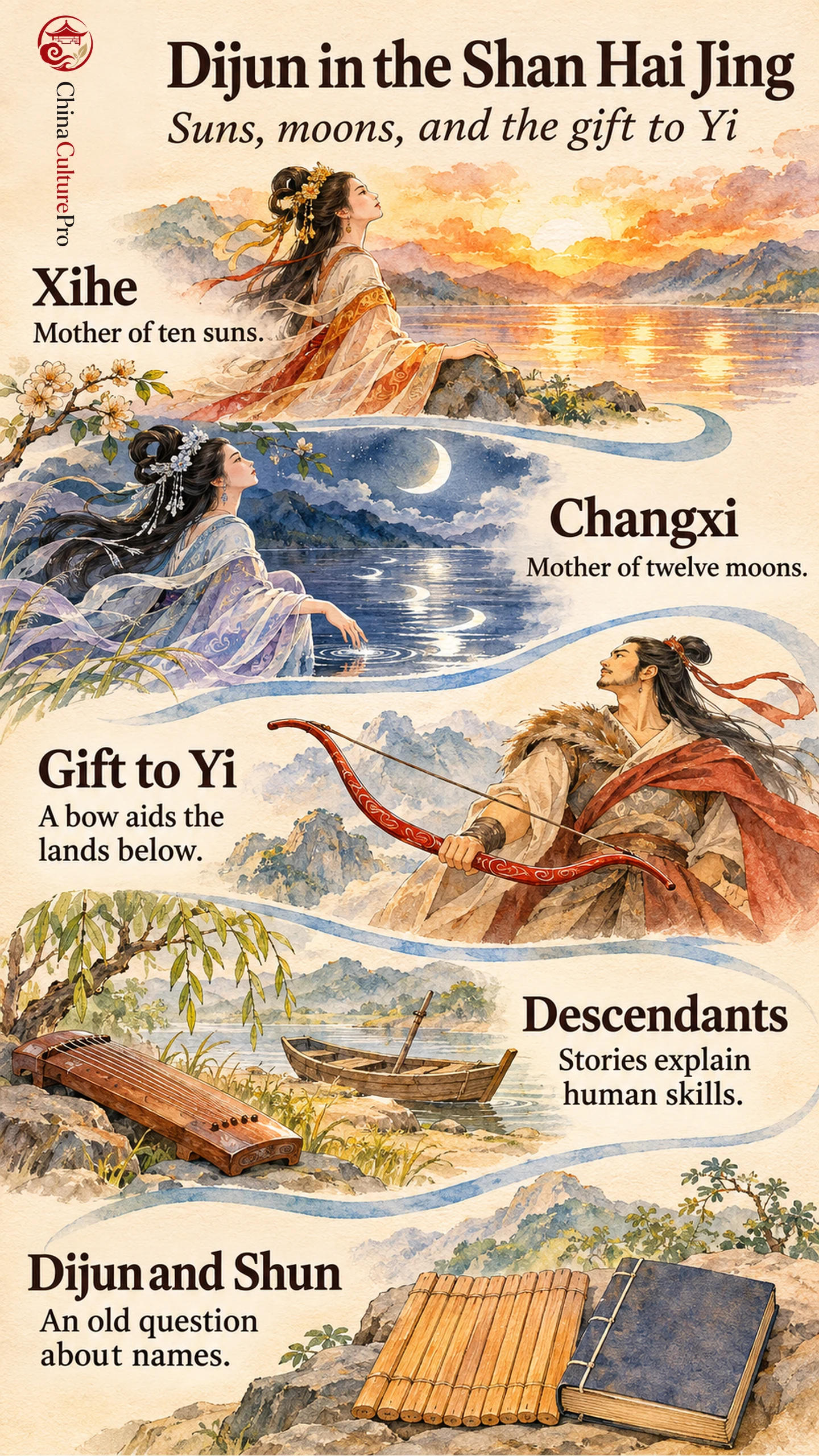
The same name appears beside a woman bathing suns, another bathing moons, and an archer receiving a gift. Each scene offers a different way to understand Dijun’s place in the book.
Xihe and the Ten Suns, Changxi and the Twelve Moons
The “Great Wilds of the South” describes a woman bathing the suns by the Sweet Waters. It identifies her as Xihe, a wife of Dijun and mother of ten suns. The text gives the action of bathing to Xihe. Dijun’s role in this passage is expressed through kinship.[1]
The “Great Wilds of the West” gives the lunar counterpart. A woman bathes the moons. She is Changxi, also named as Dijun’s wife, and she gives birth to twelve moons.[2] The two passages invite comparison through the repeated action, the shared spouse and the different numbers. They place the scenes in different parts of the book’s imagined geography.
An image of the sun with a three-legged crow brings in a related motif. The passages about bathing can be read on their own. Their focus is on the women and their celestial children, and they give no account of a battle involving those children.
What Dijun Gives Yi and What His Descendants Make
The “Within the Seas” chapter says Dijun gives Yi a red bow and pale arrows to aid the lands below. Yi then relieves many troubles on earth. The passage leaves those troubles unnamed.[3] When a retelling identifies the gift with the shooting of the suns, that connection needs evidence beyond this passage.
Other lines in the chapter connect Dijun’s descendants with skills. His son Yanlong is credited with stringed instruments, and a group of eight sons is associated with the beginnings of singing and dancing. A genealogy through his descendant Fan Yu associates the line with the invention of boats.[3] These claims explain the origin of human practices through kinship. They record the text’s imaginative account of invention.
The gift to Yi gives Dijun a direct action. The neighboring accounts put him at the head of lines that lead to skills and objects. The first attributes aid to Dijun. The second gives his descendants credit for particular inventions.
Is Dijun the Same Figure as Shun?
Some narratives attached to Dijun in the *Shan Hai Jing* appear elsewhere under the name Shun (舜, Shùn). The early commentator Guo Pu associated the names. Using recently recovered Warring States manuscripts, Adam D. Smith argues that the written forms in question can represent the same name.[4]
That argument concerns how names were written and transmitted. It gives a reason to compare the traditions, while the solar and lunar passages still belong to their particular chapters. Read the name as each text presents it and trace a particular episode before attributing it to the sage emperor of another account.
FAQs About Dijun
Is Dijun the sun god?
The southern passage connects him to the suns through Xihe. The western one gives him a comparable relationship to Changxi and the moons. Both passages describe the women doing the bathing.[1][2]
Does the bow passage say Yi shot the suns?
It says Dijun gave Yi a bow and arrows to help the lands below. It describes relief from troubles without naming the suns as his targets.[3]
What does Dijun look like?
The passages discussed here identify Dijun by name, kinship and action. They offer no shared portrait. An illustration has to interpret his appearance.
資料來源
[1] Chinese Text Project. Classic of Mountains and Seas: Great Wilds of the South
[2] Chinese Text Project. Classic of Mountains and Seas: Great Wilds of the West
[3] Chinese Text Project. Classic of Mountains and Seas: Within the Seas
[4] Adam D. Smith. Early Chinese Manuscript Writings for the Name of the Sage Emperor Shun