

Quick Answer
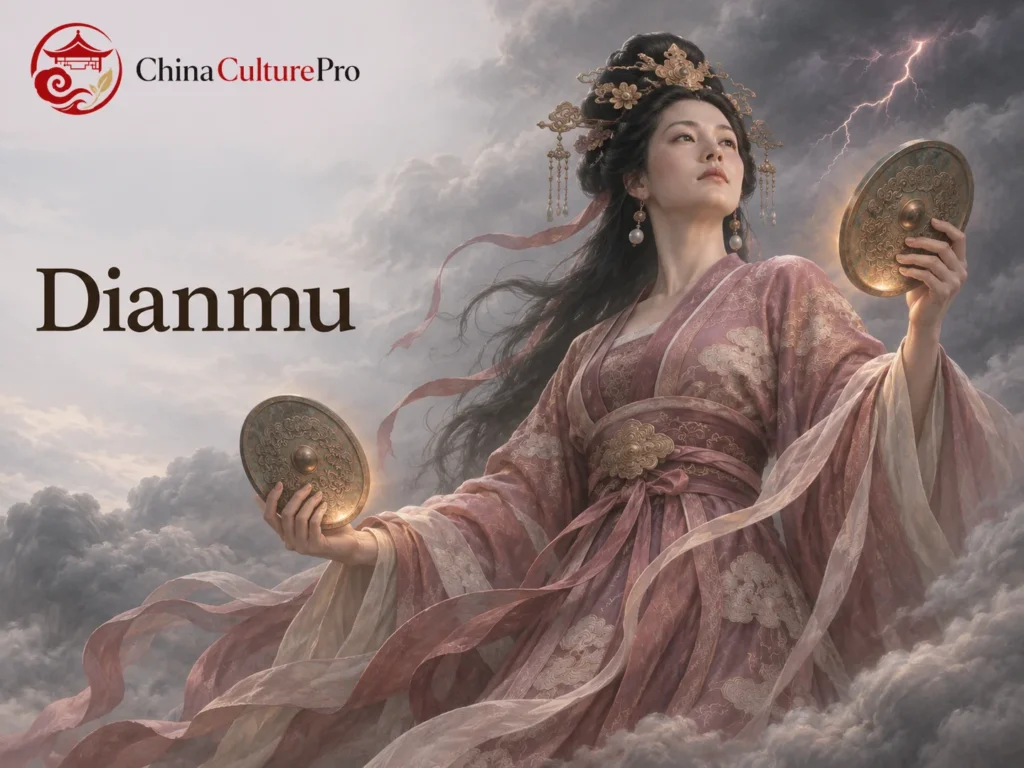
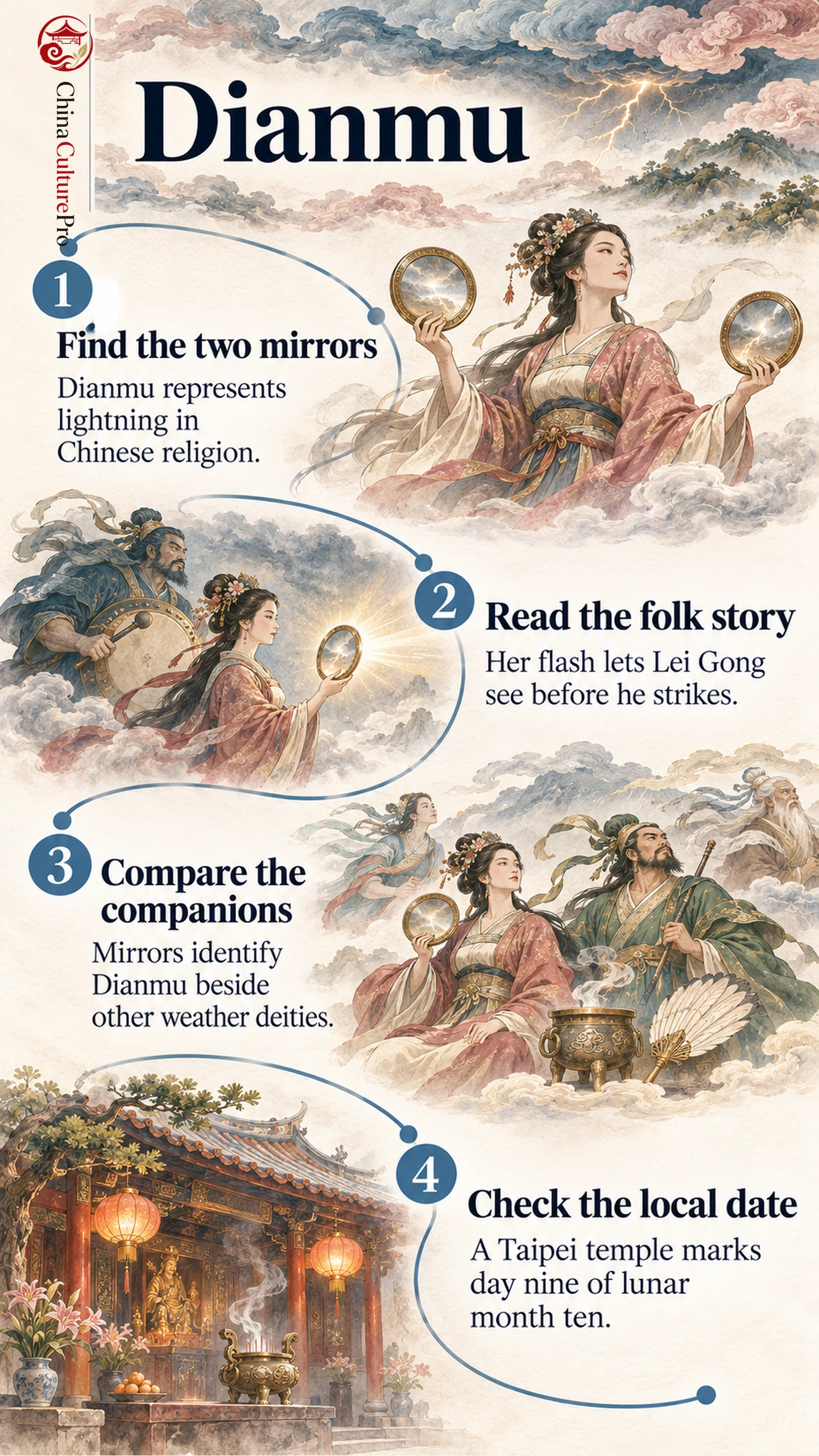
Dianmu (電母, Diànmǔ), the Mother of Lightning, is a Chinese deity associated with flashes of lightning. Artists often depict her holding a pair of mirrors. She appears with Lei Gong (雷公, Léigōng), the Duke of Thunder, in stories, prints, and paintings of weather deities.[1][2][3]
- Her attribute: Two mirrors identify Dianmu in several painted works.
- Her companion: Lei Gong represents thunder and may carry drums or an axe.
- Her place: She appears in group images and at a Taipei temple beside thunder deities.
Stories about how she uses the mirrors vary across traditions.[1][2][4]
In a Taiwanese ritual hanging, a pink-robed woman holds two mirrors near the top of the painting. Beside her, a green-robed figure holds an axe. The mirrors and the company she keeps are more useful for recognizing Dianmu than the color of her robe.[2]
Why Dianmu Holds Mirrors
A paper image titled Lei Gong and Dianmu belongs to the National Taiwan Museum. The catalogue preserves a story in which Lei Gong has poor eyesight. Dianmu shines a light before he strikes, allowing him to distinguish those he means to punish from people who have done no wrong. The flash has a purpose in the story: it makes judgment possible.[1]
The catalogue also records a tradition in which Dianmu and Lei Gong are spouses. A picture can pair them without telling that story. The two figures personify different parts of the same storm.[1][2][3]
How to Find Her in a Group of Weather Gods
In the painting For Timely Rain, traditionally attributed to Li Gonglin, Dianmu holds mirrors in both hands. Lei Gong appears in front of her with wings and three drums. The painting also includes a wind deity with a bag. The attribution is traditional, and the artist and date are uncertain.[3]
The Taiwanese ritual hanging places the mirror-bearing Dianmu and axe-bearing Lei Gong at the upper left. Across from them, the Rain Master (雨師, Yǔshī) tips a vessel and the Earl of Winds (風伯, Fēngbó) holds a long-handled fan. These objects distinguish their jobs. The wind deity’s fan in this painting and bag in For Timely Rain also show how attributes can vary between works.[2][3]
Dianmu in a Taipei Temple
Songshan Fengtian Temple lists Dianmu in its first-floor main hall, alongside figures associated with the Thunder Ancestor. The temple’s own page marks her sacred birthday on the ninth day of the tenth lunar month. That date belongs to the temple’s observance.[4]
The hall places her with Lei Gong and the Thunder Ancestor. This arrangement connects her to a group of divine officials, a pattern that also appears in other settings of Chinese folk religion.[2][4]
FAQs About Dianmu
Is Dianmu the goddess of thunder or lightning?
Dianmu is associated with lightning. Lei Gong, her frequent companion, is associated with thunder.[1][4]
Is Dianmu always depicted with Lei Gong?
The works discussed here often pair them. A depiction of Dianmu may also appear within a larger weather assembly or as an individual temple image.[2][3][4]
What is the easiest clue to Dianmu in a painting?
Look for two mirrors, one in each hand, then check the surrounding figures or the catalogue description. The mirrors appear in both the Taiwanese hanging and For Timely Rain.[2][3]
資料來源
[1] National Taiwan Museum. Lei Gong and Dianmu, AH001338-144
[2] Taiwan National Center for Traditional Arts. Ritual hanging with Dianmu and the Dragon Kings, 11201002121
[3] National Palace Museum. The ritual meaning of For Timely Rain, traditionally attributed to Li Gonglin
[4] Songshan Fengtian Temple. Dianmu in the first-floor main hall