


Quick Answer: What Is Chushu?
Chushu (处暑, Chǔshǔ), or End of Heat, is the fifteenth Chinese solar term and the second of traditional autumn. It begins when the sun reaches 150° of ecliptic longitude. In Hong Kong, that falls on August 23 in both 2026 and 2027. [1][2][3][4]
- Season: The name points to summer heat easing. [4]
- Weather: Some areas cool earlier than others. A late hot spell can still follow. [4][5]
- Custom: Duck dishes are associated with Chushu in some accounts. [5]
Chushu is a calendar marker. Local temperatures and event dates follow their own patterns.
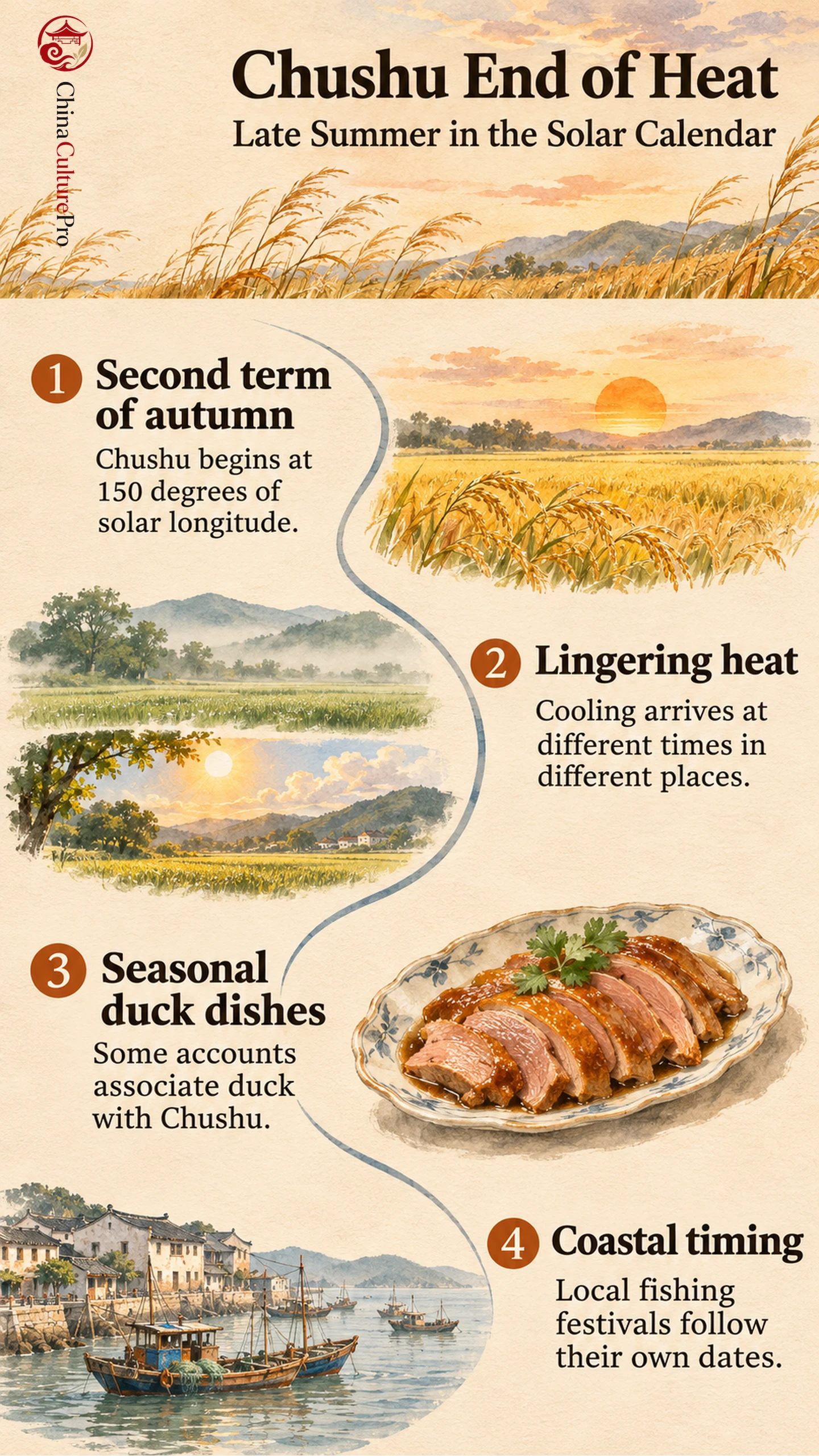
In late August, the Chinese calendar says the heat is ending. In the middle and lower Yangtze, afternoons can still feel like summer. The name Chushu describes a seasonal change that becomes noticeable at different times across China. [2][6][7]
Where Chushu Falls in the Solar Calendar
The 24 solar terms are spaced 15 degrees apart along the sun’s apparent path. Chushu follows the Start of Autumn (立秋, Lìqiū) at 135° and precedes White Dew (白露, Báilù) at 165°. The Hong Kong Observatory records the start of the term at 10:19 a.m. on August 23, 2026, and at 4:14 p.m. on August 23, 2027, both Hong Kong time. [1][2][3]
The astronomical date is the start of the term. Seasonal writing also uses Chushu for the roughly two weeks until White Dew. Its Gregorian date follows the sun’s position. Its day number in the 中國陰陽合曆 may vary. [1][2][3]
What End of Heat Means for Local Weather
Chushu takes its name from the gradual retreat of summer heat. China Weather Network describes cooler mornings and evenings in many northern areas around this period. In the middle and lower Yangtze, the same period can bring spells of late-season heat. The expression autumn tiger (秋老虎, qiūlǎohǔ) refers to a spell of late heat after the traditional autumn season has begun. [4][5]
The autumn tiger saying preserves a distinction people notice in daily life. Nights may feel cooler even when midday heat persists. The name of the term and the temperature on a given day describe different things. [1][4][5]
Duck Dishes and the Coastal Fishing Calendar
Seasonal accounts mention serving duck at Chushu. China Weather Network records a saying about giving a duck to another household, associating the gift with a wish for well-being. The gift expresses a seasonal wish. How the duck is cooked and whether it appears on the table depend on local and household practice. [5]
On the Zhejiang coast, a fishing festival may celebrate the fleet’s return to sea after a seasonal closure. The national culture ministry recorded the 2026 Xiangshan festival for September 10 through 20, and the maritime authority dated its departure ceremony to September 16. The festival dates describe a local event several weeks after the solar term. For another edition, look for the announced dates at Shipu. [6][7]
FAQs About Chushu
Is Chushu always on August 23?
August 23 is the date for 2026 and 2027 in Hong Kong. The term begins when the sun reaches 150°, so use an almanac for the year and time zone you need. [1][2][3]
Is Chushu the first day of autumn?
The Start of Autumn comes first in the solar-term sequence. Chushu is the next term, around two weeks later. [1][4]
資料來源
[1] Hong Kong Observatory. The 24 Solar Terms
[2] Hong Kong Observatory. 24 Solar Terms in 2026
[3] 香港天文台. 24 Solar Terms in 2027
[4] China Weather Network. Chushu and Late Heat
[5] China Weather Network. Chushu Seasonal Food and Weather
[6] China Ministry of Culture and Tourism. 2026 Xiangshan Fishing Festival Filing
[7] Zhejiang Maritime Safety Administration. Shipu Harbour Notice for the 2026 Fishing Festival