


Quick Answer: What Did Traditional Chinese Sails Look Like?
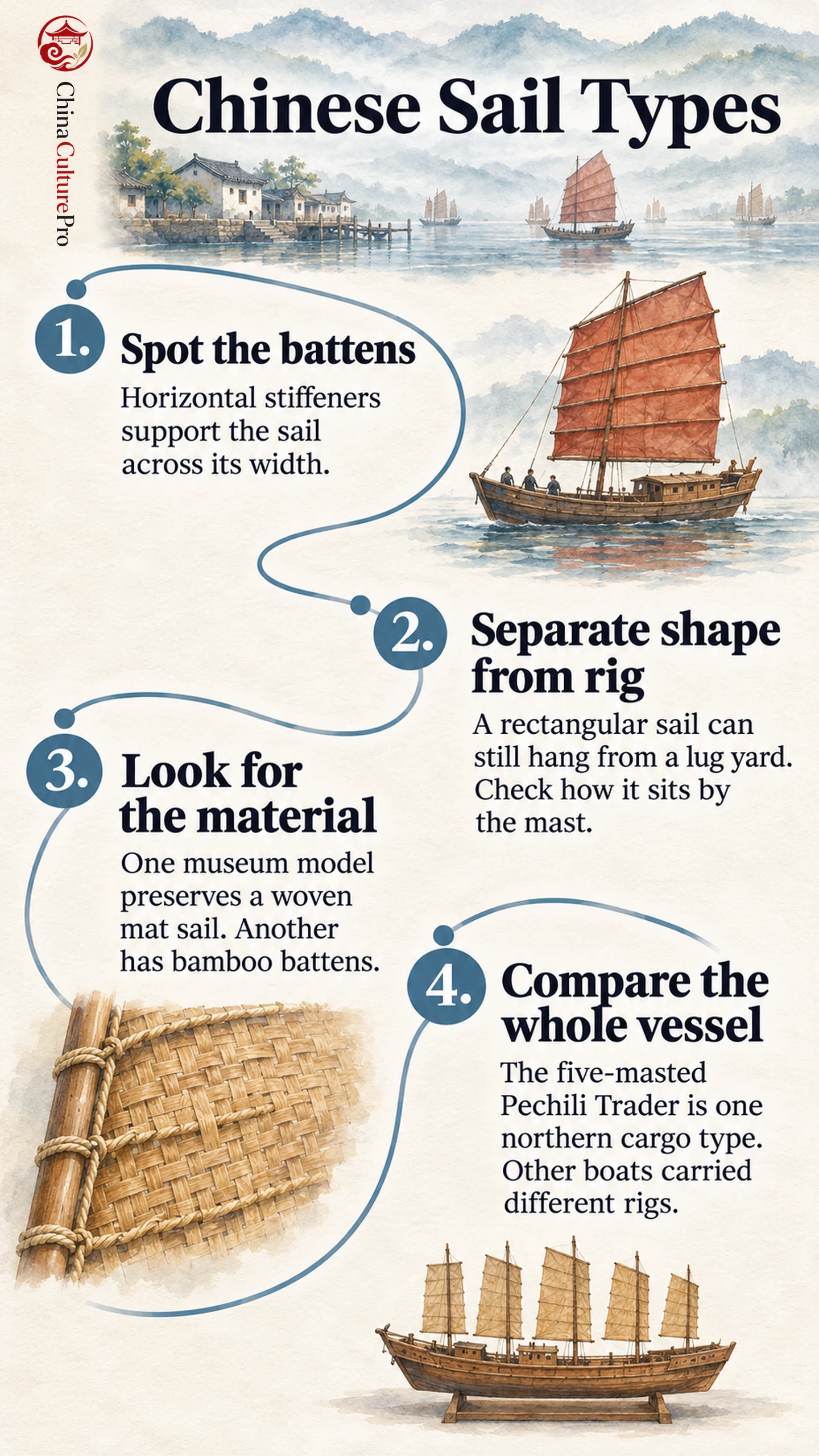
On many traditional Chinese sailing ships (帆船, fānchuán), horizontal battens divide a sail into distinct panels. This is a familiar feature of the rig associated with Chinese junks. The number of sails, their outlines and their materials vary across surviving models and records.[1][2][3][4]
- Sail support: Battens stiffen the sail and help it hold its shape.[1][2]
- Sail material: Woven matting survives on some models. Bamboo in a batten and woven material in a panel describe different parts of a sail.[2][3]
- Sail arrangement: A documented northern cargo model carries five masts, while other museum models represent boats built for different purposes.[1][2]
Use the outline and the mast together to identify a rig.[1][2]
A Chinese sailing vessel in a painting may be recognizable from a distance. Naming its sails takes a closer look. Begin by tracing the horizontal strips across the fabric, then check how the sail sits against the mast. A model or painting may preserve one of those clues more clearly than the other.[1][2][5]
What Identifies a Battened Lug Sail
Battens are slender stiffeners that extend across the sail. On the Northern Chinese Pechili Trader model, bamboo battens run horizontally across near-rectangular sails. The catalogue describes the arrangement as a lug rig. That term refers to how the sail hangs from a yard supported by the mast. “Battened” describes the stiffening of the sail itself. Both features can be present on one sail.[1][2]
Why do the lines matter? They help support the sail’s shape across its width. On a photograph of a model, several regularly spaced lines from front to back can help identify the battened type. Check the edges where possible. Some lines in an image may be ropes behind the sail or seams across its surface. The mast and upper yard supply a second clue.[1][2]
Rigging is only one part of a ship’s design. Features such as Chinese ship bulkheads 及 sternpost rudders answer separate questions about how the vessel was built and steered.[4]
How Shape and Material Vary
Some battened sails look close to rectangles, especially when their top and bottom edges run in similar directions. Others look more strongly sloped. Perspective and the angle of the sail can alter that impression. The description of the northern model is useful because it identifies the sail shape and the lug arrangement separately. A rectangular outline alone is weak evidence for the rig.[2][5]
Look for material evidence at the scale the source can support. A woven matting sail from a Chinese cargo-junk model made before 1863 survives as a separate collection object. Its square outline and woven texture can be examined directly. The catalogue identifies the model’s sail as woven matting. It does not provide a recipe for full-size sails or establish what every vessel carried.[3]
In the Pechili Trader model, bamboo is documented in the battens. In a distant painting, the same strips may be visible without any sign of their material. A label that identifies the material of the supports may leave the material of the sail panel unspecified.[2][3][5]
What Northern and Southern Boat Models Show
The Pechili Trader model represents a northern cargo type and was built from measurements taken at Weihaiwei. It has five masts, each set at an angle, and near-rectangular lug sails. Additional sails were sometimes set on this type. The five-mast silhouette belongs to the vessel represented in the record. Chinese sailing craft also included smaller cargo boats and vessels adapted to coastal and river settings.[1][2][4]
Another cargo-junk model comes from the South China Sea and is thought to be from Hong Kong. Its catalogue discussion also highlights battens. Similar support across sails can appear on vessels associated with different waters and uses. Conversely, the same port can hold more than one kind of boat. When comparing two models, compare the function and provenance as well as the mast count.[1][2][4]
Cargo routes supply another layer of context. The Maritime Silk Road 及 Chinese porcelain export routes help explain what coastal and ocean-going vessels carried and which ports they connected.[4]
How to Read a Sail in a Painting or Model
A historical painting may capture a sail in use, while a model often lets you look closely at the rig from more than one angle. The 1850 painting Chinese Junks shows a vessel off a mountainous coast. Its association with George Chinnery is an attribution. Treat the image as a ship portrait with its own perspective and purpose, and use a measured or well-catalogued model to check details the painting leaves ambiguous.[2][5]
Three details are worth comparing across the records: the direction of the visible battens, the attachment of the upper yard, and the number and position of the masts. A label may establish the model’s date or the vessel type it represents. Check which of those dates or descriptions you are citing, especially when the original ship and the model belong to different periods.[1][2][3][5]
FAQs About Chinese Sail Types
Was every Chinese junk rigged the same way?
Traditional Chinese vessels varied with region, size and purpose. Battened sails recur in many examples, while the number, proportions and arrangement of the sails vary.[1][2][4]
Were traditional Chinese sails always made of bamboo?
Bamboo served as a stiffener in documented examples. A catalogue may identify a sail panel as woven matting separately from the supports. Check the description of the particular sail and component.[2][3]
Does a rectangular outline make a sail square-rigged?
A sail can look rectangular and still be lug-rigged. Look at how the sail and its yard sit in relation to the mast. The northern Pechili Trader is a documented rectangular-looking example of a lug rig.[2]
資料來源
[1] Burke Museum. Model Chinese Junks Sail On
[2] Royal Museums Greenwich. Cargo Vessel Model: Pechili Trader
[3] Royal Museums Greenwich. Woven Matting Sail From a Chinese Junk Model
[4] Drassana. Masts Like a Forest: Chinese Shipbuilding From the Zheng War to the Opium War
[5] Royal Museums Greenwich. Chinese Junks, 1850