
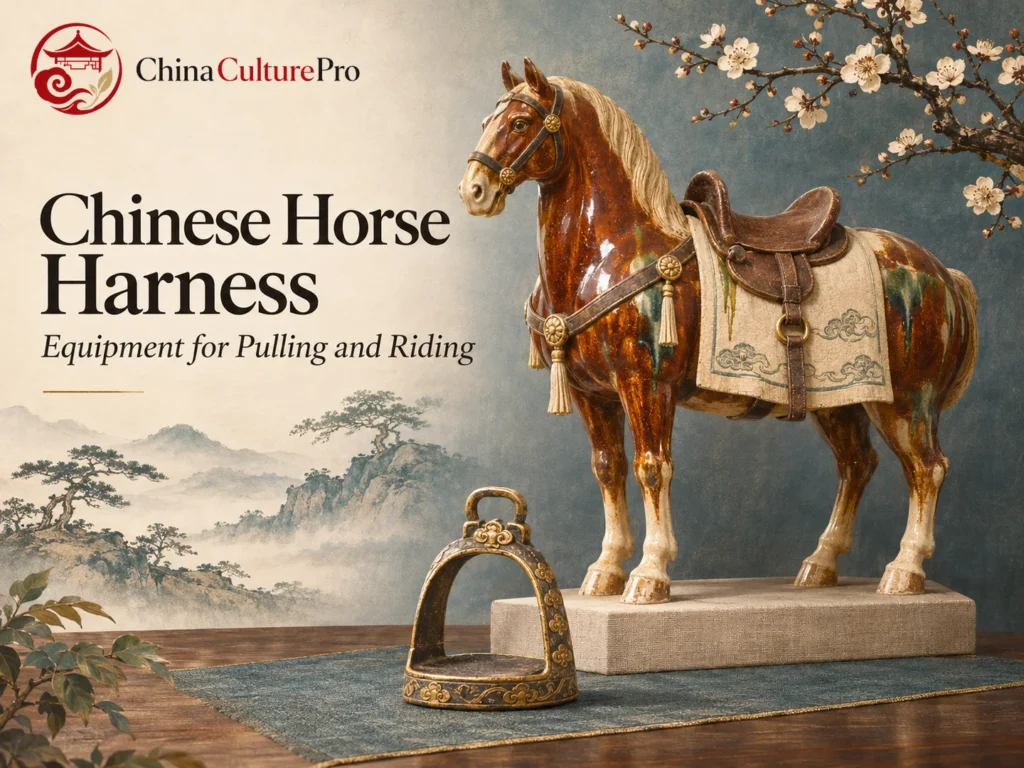

Quick Answer: What Did Chinese Horse Harness Do?
Historical Chinese horse gear (马具, mǎjù) served several jobs. A harness transferred a horse’s pull to a vehicle. Riding tack included a saddle (马鞍, mǎ’ān) to support the rider and, in later examples, stirrups (马镫, mǎdèng) for the feet. Bridles were used with both ridden and driven horses.[2][3][6]
- Qin bronze chariot models preserve the arrangement of a horse team and its vehicle.[1]
- A dated leather saddle survives from the cemetery at Yanghai in present-day Xinjiang.[3]
- Northern Yan stirrups and Tang figures document different parts of riding history.[4][5]
To identify a piece of equipment, start with its place on the animal or its relationship to the vehicle.

A horse figure can show a rider, or it can show where traces and reins run back to a carriage. The equipment depends on the job. A surviving metal fitting often makes more sense with that larger arrangement in view.
Pulling a Vehicle: The Qin Models
The First Emperor’s mausoleum included two painted bronze chariot models with horses. On the models, the relationship between the horses and the vehicle is preserved as a whole. This makes a different kind of record from a loose fitting found without a wooden frame or a preserved strap.[1][2]
The imperial burial setting matters. The chariots, like the nearby Terracotta Army, show what the builders represented in the mausoleum. A bronze model can preserve arrangements of objects that would normally use wood, leather or other materials in life.
Riding: A Saddle from Yanghai
At Yanghai in the Turfan Basin, excavators recovered a soft leather saddle from a woman’s burial. Direct radiocarbon dating put it in a range of 727–396 BCE. The range dates the surviving leather.[3]
Other finds in the Altai and nearby regions show several stages and forms of saddle development. The evidence covers communities and landscapes also relevant to the wider history of overland connections.[6]
What the Northern Yan Stirrups Preserve
The tomb of Feng Sufu at Beipiao in Liaoning yielded early Northern Yan stirrups with a wooden core and gilt metal covering. They are evidence of an actual material combination. When photographs show only the gold-colored exterior, the catalog description supplies information about the underlying wood.[4]
A dated object establishes that a form existed in a particular context. Evidence for where it originated or how widely it was used needs comparison with other finds.
Reading a Tang Horse Figure
An early eighth-century glazed horse and rider at the Met preserves details of the saddle blanket in paint and clay. Such a figure records the appearance of equipment and clothing in funerary art.[5] In other settings, horse coverings could display rank or ceremony, as the surviving examples in Chinese armor history show.
FAQs About Chinese Horse Harness
Is a saddle part of a pulling harness?
A saddle supports a rider. A pulling harness transfers the horse’s effort to a vehicle.[2][3]
What makes the Yanghai saddle useful evidence?
Leather survives on the object itself, and researchers directly radiocarbon-dated it.[3]
Can a burial figure show how an object looked in use?
It can show placement and appearance. The underlying material may be made clearer by a surviving object or by the original burial context.[1][4][5]
資料來源
[1] Emperor Qinshihuang’s Mausoleum Site Museum. Bronze chariot and horse pit
[2] Sino-Platonic Papers. From Chariot to Carriage
[3] Archaeological Research in Asia. Directly dated saddle from a female burial in northwest China
[4] Shenzhen Museum. Northern Yan stirrup from the tomb of Feng Sufu
[5] The Metropolitan Museum of Art. Tang horse and rider
[6] Antiquity. The origins of saddles and riding technology in East Asia