
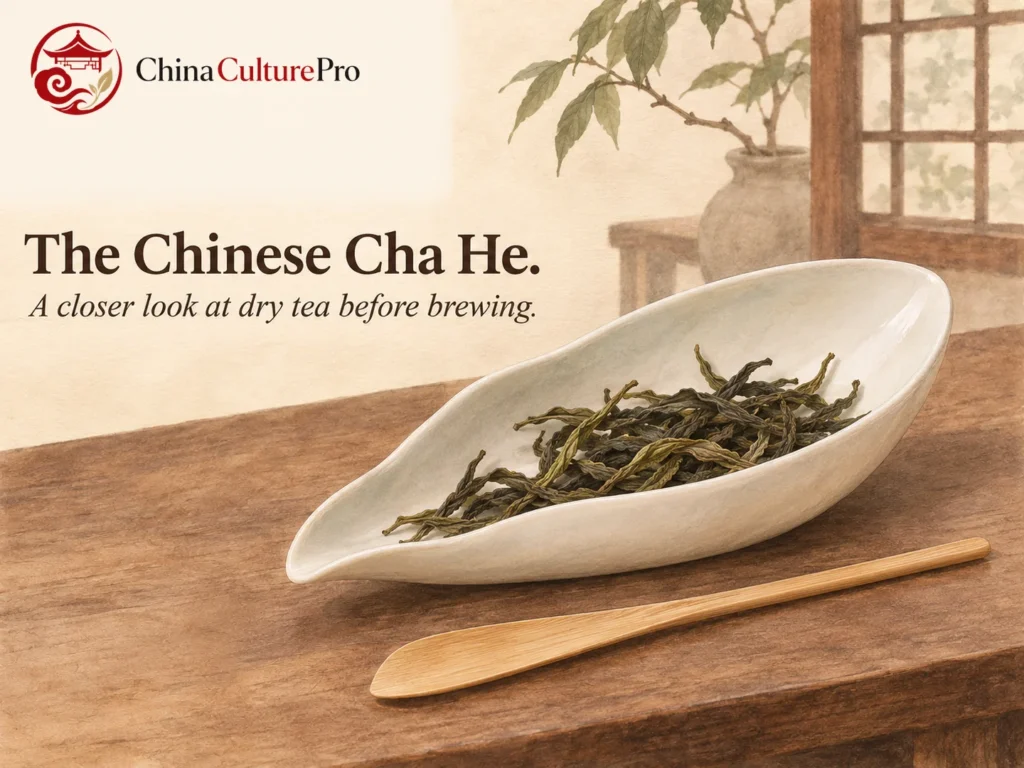

Quick Answer: What Is a Cha He?
A cha he(茶荷,cháhé)is a dish for presenting, sorting and portioning tea leaves before brewing. The English name “tea lotus” also appears in contemporary teaware terminology.[1]
- Contents: Dry leaves awaiting preparation, rather than a finished serving of tea.
- Purpose: A place to inspect the portion and introduce the tea to guests.
- Use: The leaves move from the dish into the brewing vessel when ready.
It is an accessory, not a tea variety or a brewing vessel. Its value depends on whether you want a separate moment for looking at the leaves and handling them conveniently.
Before the kettle reaches the table, a small dish of leaves may already be making its way around the guests. This is the cha he’s moment: a chance to see the tea before water changes it. It displays the portion and helps it reach the pot.
Shape and Materials: A Dish for Dry Leaves
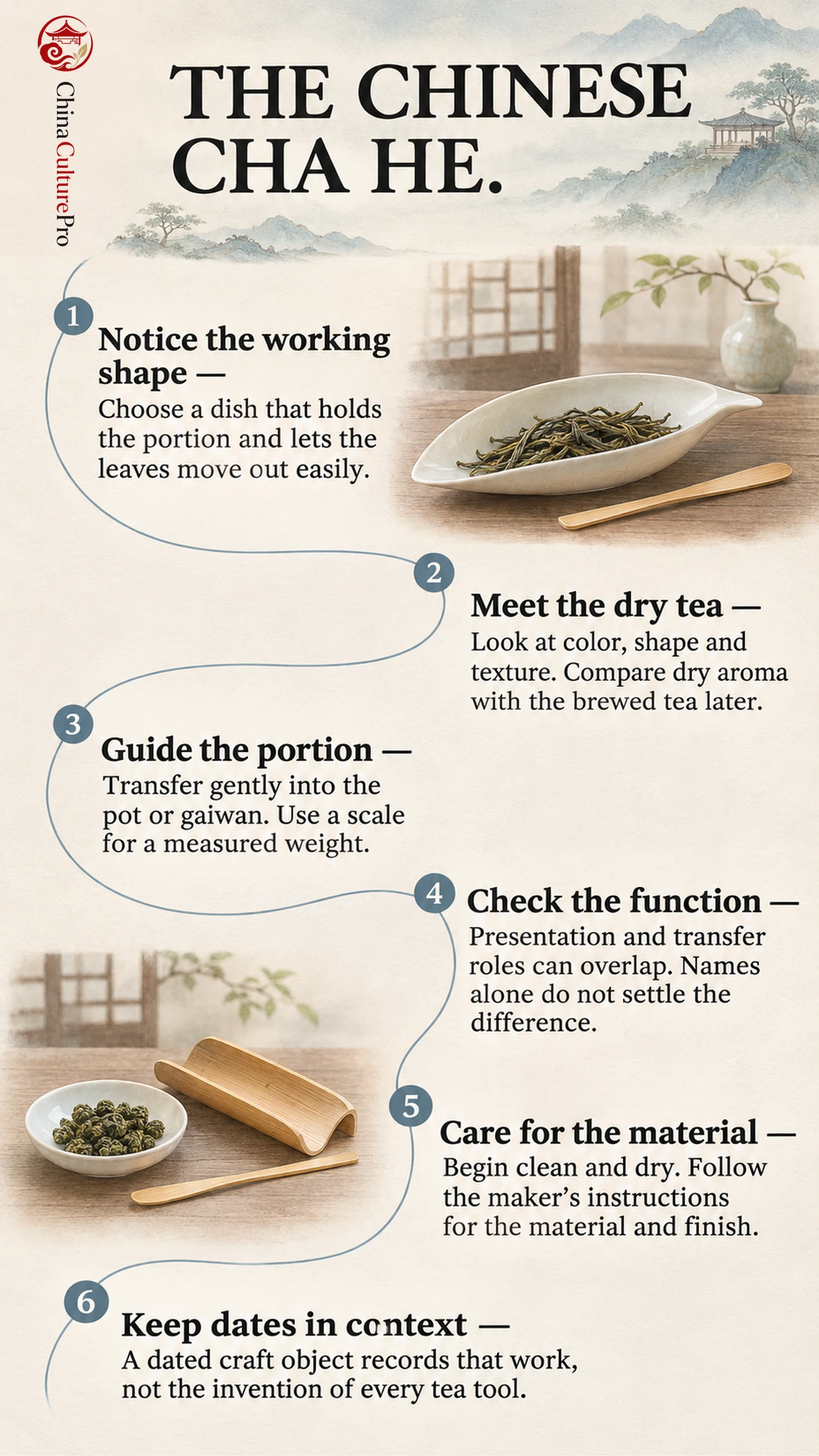
A cha he can have a leaf-like outline or a shaped edge; this is a design choice, not a requirement for every example. Ceramic, porcelain and wooden versions appear in contemporary practice.[2] Look at the working surface as well as the silhouette: can it hold your portion without the leaves constantly falling over the sides?
Material names alone can be misleading. A contemporary craft example cataloged in Taichung combines ceramic, silver, ebony, gold leaf and lacquer.[3] That is an individual artwork, not a standard construction for all cha he. It does demonstrate why care instructions for one plain porcelain dish should not automatically be applied to every decorated or composite object.
For a first vessel, prioritize comfortable handling and an unobstructed surface. A complicated ornament may be attractive, yet the tea still needs somewhere to sit and a clear route out.
Looking and Smelling Before Brewing
Dry-leaf appreciation gives guests something specific to notice. Look at color, size, shape and texture: are the leaves tightly rolled, stretched into strips or visibly broken? A tea server’s account describes passing a presentation vessel among guests for this inspection, then returning it to the brewer. Smelling the dry leaves adds another point of comparison with the aroma after brewing.[4]
Try using a few ordinary words before reaching for elaborate tasting language. You might notice that the leaves look compact or uneven, or that their aroma seems faint or pronounced. The Chinese tea aroma vocabulary guide can help you develop those observations.
Treat this as an introduction, not a complete quality assessment. The brewed tea still needs to be smelled and tasted; a description of dry leaves does not establish a garden, harvest date or finished flavor.
Moving the Leaves into the Brewing Vessel
After inspection, the leaves need to reach the teapot or gaiwan(盖碗,gàiwǎn), the lidded brewing bowl. A small paddle or scoop can guide them from the presentation dish.[2] For the next stage, our gaiwan versus teapot guide explains the brewing-vessel choice.
For convenient handling, bring the cha he close to the opening before tipping it. If a leaf catches on the edge, guide it rather than forcing the entire portion through at once. Long leaves and tightly rolled leaves do not occupy space in the same way, so a dish that suits one portion may feel awkward with another.
If you want a measured weight, use a scale and account for the empty vessel. A cha he organizes the portion; its outline does not turn a visual estimate into a calibrated measurement. Decide the amount for the tea and brewing vessel separately.
Cha He, Cha Ze and Other Tea Tools
Cha ze(茶则,cházé)is another name worth recognizing. A museum collection describes a bamboo tea-scoop-and-cha-ze pair in which the latter receives and gathers leaves before they enter the pot. Its angled opening helps with transfer.[5] That overlaps with jobs often assigned to a cha he.
The following distinctions describe useful working roles, rather than a universal rule for every shop label.
| 茶具 | Working role | 要留意甚麼 |
|---|---|---|
| Cha he | Display and portion dry leaves | Enough room to inspect the tea |
| Cha ze | Measure, gather or transfer leaves | Shape and actual use, not just the label |
| Small tea scoop or paddle | Move leaves between containers | Whether it can guide leaves gently |
| Teapot or gaiwan | Hold leaves and water for brewing | A suitable brewing vessel, rather than a display dish |
A single object may cover more than one role. You do not need to buy two nearly identical dishes simply because their names differ. Ask what additional task the second object would perform.
Keeping the Vessel Clean and Dry
Tea can absorb moisture and outside odors, both relevant to preserving its quality.[6] As a practical precaution, start with a clean, dry presentation vessel and keep it away from steam, splashed tea and strongly scented objects. An open inspection dish also cannot do the job of protective packaging: return unused stock to its proper container rather than leaving it displayed indefinitely. See how to store Chinese tea for that separate task.
Follow the maker’s cleaning instructions for the actual material and finish. Do not assume that wood, bamboo, lacquer and glazed porcelain share the same soaking, dishwasher or heat tolerance. Remove stray leaves after the session and let the cleaned vessel dry before putting it away.
What the Records Tell Us About Its History
The available records show continuing craft and tea-service practice, rather than one established invention story. The museum’s bamboo scoop-and-cha-ze pair is dated 1998 and attributed to Peng Dingsong. Its folded and wrapped construction and asymmetrical shape are documented features of that work.[5] The date belongs to this particular object; it does not date the invention of the cha he.
Contemporary practice is also adaptable. A tea server describes using ordinary porcelain spoons and small dishes for presentation, alongside dedicated utensils.[4] For a beginner, this offers a sensible starting point: try a suitable clean, dry dish you already own, then decide whether a purpose-made shape would improve your own handling or presentation.
FAQs About the Cha He
Is a cha he essential for making tea?
No. It provides a separate place for inspection and transfer; a suitable small dish can serve that purpose.
Does a cha he measure tea accurately?
Not by itself. Use a scale when you need a measured weight.
Should you pour hot water into a cha he?
Its usual job is holding dry leaves. Do the brewing in the appropriate pot or bowl, and follow material-specific care instructions.
Are cha he and cha ze always different objects?
No. Their functions and names can overlap. Check the object’s shape and intended use.
資料來源
[1] China National Light Industry Council. T/CNLIC 0210—2025: Titanium tea set, terminology entry 3.15
[2] Liao Chang Hsing Tea. An introduction to cha he
[3] Fengyuan District Office, Taichung. Artist profile: Chen Gaodeng, including a mixed-material cha he
[4] AgriHarvest, Xiaoling. A discussion of cha ze and cha he
[5] National Taiwan Craft Research and Development Institute. Tea scoop and cha ze set
[6] Tea and Beverage Research Station. Tea packaging and storage