
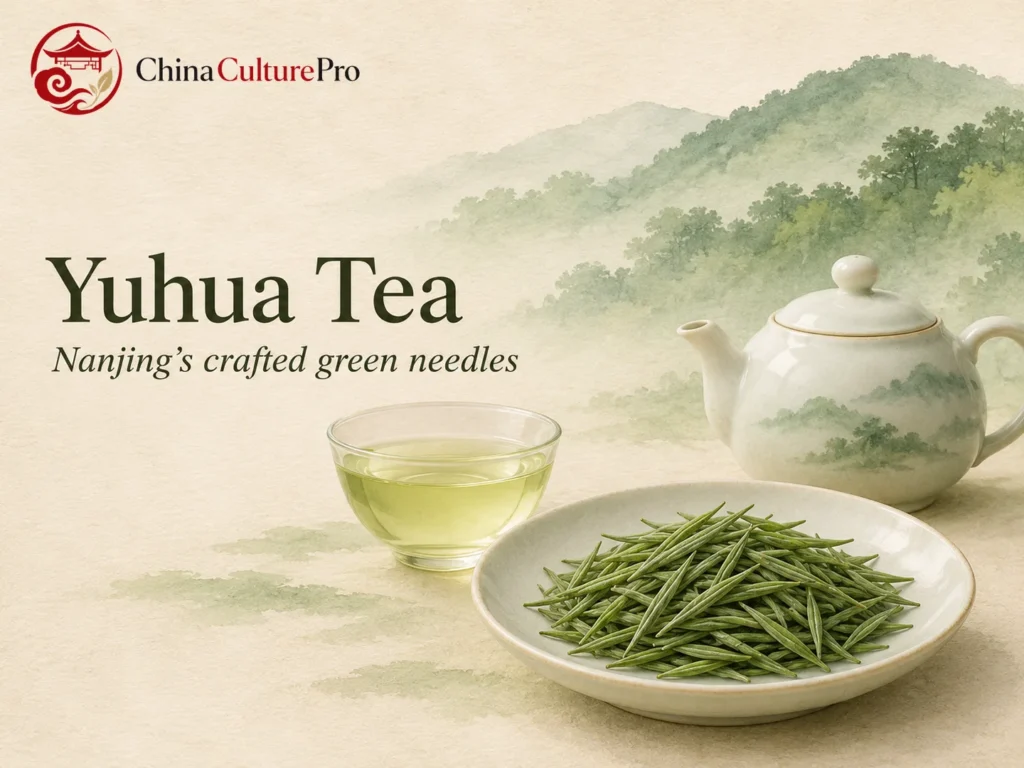

Quick Answer: What Is Yuhua Tea?
Yuhua tea(雨花茶,yǔhuā chá) usually means Nanjing’s fine, pine-needle-shaped green tea, associated with the Zhongshan and Yuhuatai areas.[1]
- 産地: The classic tea comes from Nanjing, Jiangsu.
- History: Its modern name and finished form date to 1959.[2]
- Making: Careful rolling, shaping and drying produce the tight, round, straight strands.[1]
- Character: Elegant fragrance and a fresh, mellow taste are characteristic descriptions.[1]
This guide focuses on the classic green style; read the tea type on a modern packet.
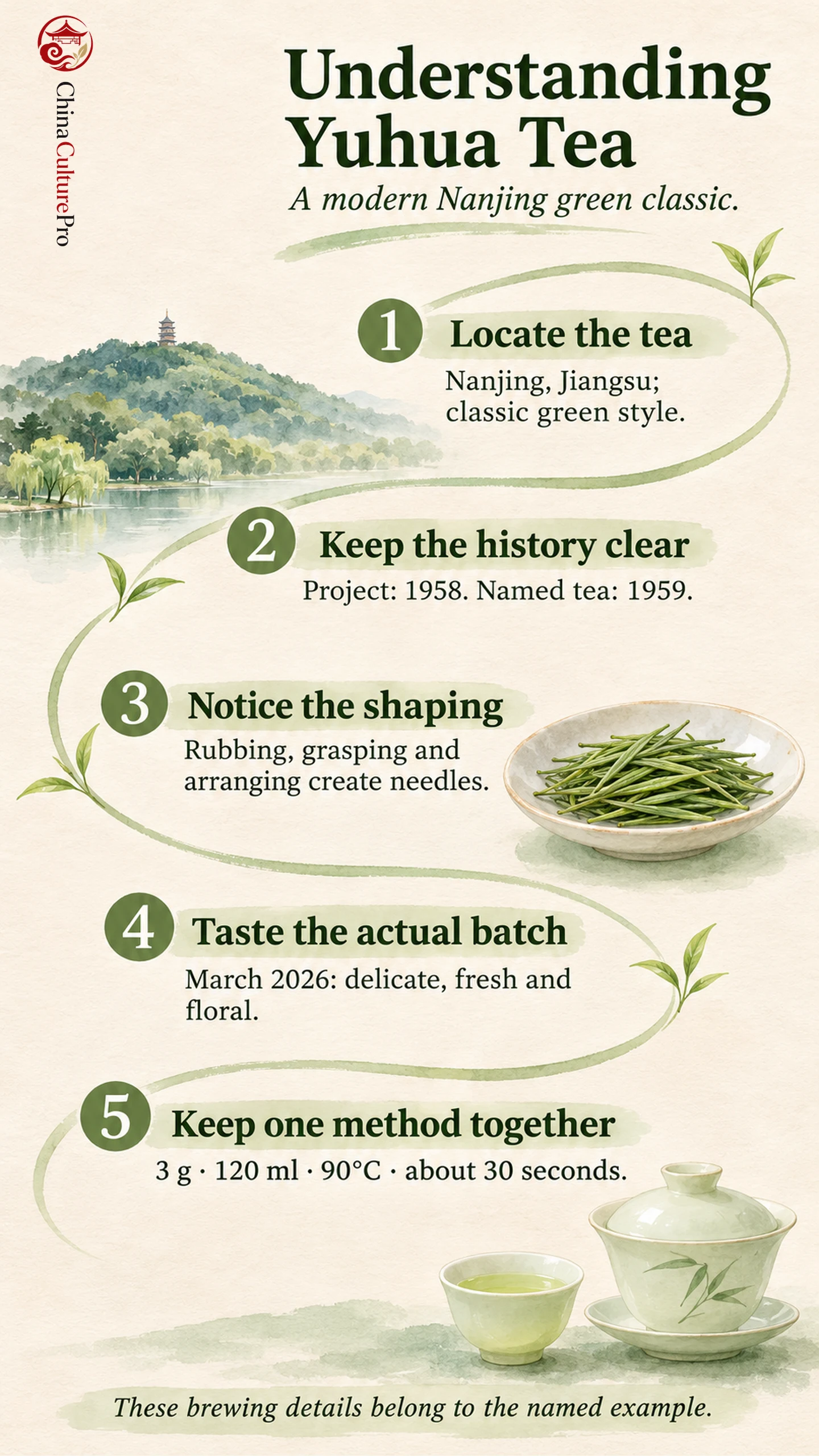
The compact needles invite a closer look: how does skilled shaping connect a green tea with Nanjing’s modern history?
Nanjing Origins and the Modern Name
Nanjing’s tea-growing past is older than the modern Yuhua product. A project begun in 1958 brought skilled tea makers together at Zhongshan. The needle-shaped tea was completed and named in 1959, as a tribute for the tenth anniversary of the People’s Republic of China and a commemoration of revolutionary martyrs.[2]
Older local tea-growing traditions should be distinguished from the development of this named product.
The tea-making technique entered China’s national intangible-cultural-heritage list in 2021 as an extension project. This designation recognizes the craft, rather than certifying the taste of every retail packet.[1]
How the Pine-Needle Shape Is Made
A local description of first-grade material specifies a bud with one leaf, matched for tenderness and length. That is a grade-specific plucking description; it does not mean every packet contains only isolated buds.[2]
The documented sequence includes picking, spreading, fixing, rolling, initial drying, shaping, final drying, refining and baking. The shaping work combines rubbing, grasping and arranging the strands. Later sorting separates the leaves by thickness, length and weight. The result is a compact, straight tea with pointed tips and a green sheen, rather than an ingredient taken from a pine tree.[1]
Needle shape alone cannot identify the origin: Yongchuan Xiuya(永川秀芽,yǒngchuān xiùyá) is another needle-shaped green tea. Check the growing place and producer alongside the appearance.
What Yuhua Tea Tastes Like
For a concrete example, a Nanjing batch picked on March 19, 2026 is described as light and delicate, with an oily texture, cucumber-like freshness and floral undertones. Those are tasting comparisons for a particular tea, rather than cucumber or flowers added to the leaves.[3]
Check the actual harvest date when comparing spring-harvest labels. Record the fragrance, texture and aftertaste separately instead of judging the whole tea by the appearance of its dry needles.
How to Brew the March 2026 Example
The batch’s preparation panel specifies a small-vessel method. Keep its leaf weight, water volume and short infusion together.[3]
- Warm a gaiwan or small teapot with hot water, then empty it.
- Add 3 g of leaves and 120 ml of water at 90°C.
- Infuse for about 30 seconds, then pour the liquor into a pitcher or cups.[3]
Use this as a batch-specific first trial. Keep the brewing water consistent, and change one parameter at a time if you want a lighter or fuller cup.
FAQs About Yuhua Tea
Is Yuhua Tea Scented with Flowers?
The classic green tea is not defined by added flowers. A floral tasting note is different from a scented blend; check the actual ingredients.
Does Yuhua Always Mean Green Tea?
The classic style is green, but contemporary Nanjing accounts also describe black Yuhua products. Read the tea category on the packet.[2]
Does a Needle Shape Prove Nanjing Origin?
No. Other regional green teas also have slender needle forms. Appearance is one clue, not a complete origin record.
出典
[1] China Intangible Cultural Heritage Network. 绿茶制作技艺(雨花茶制作技艺)
[2] Nanjing Local Chronicles Office. 南京记忆:悠悠茶韵悟匠心
[3] Sazen Tea. Nanjing Yu Hua Cha