


Quick Answer: What Water Should You Use for Chinese Tea?
Start with water suitable for drinking, then compare how it tastes with your tea. A mineral number alone cannot choose the cup you will prefer.
- Hardness: mainly describes dissolved calcium and magnesium.[1]
- Alkalinity: describes resistance to acidification, rather than simply the pH.[2]
- TDS: sums dissolved material; it does not identify each mineral.[3]
- Filtration: check the device’s specific removal claims.[5]
Use water information and a controlled tasting comparison, rather than one supposedly ideal TDS target.
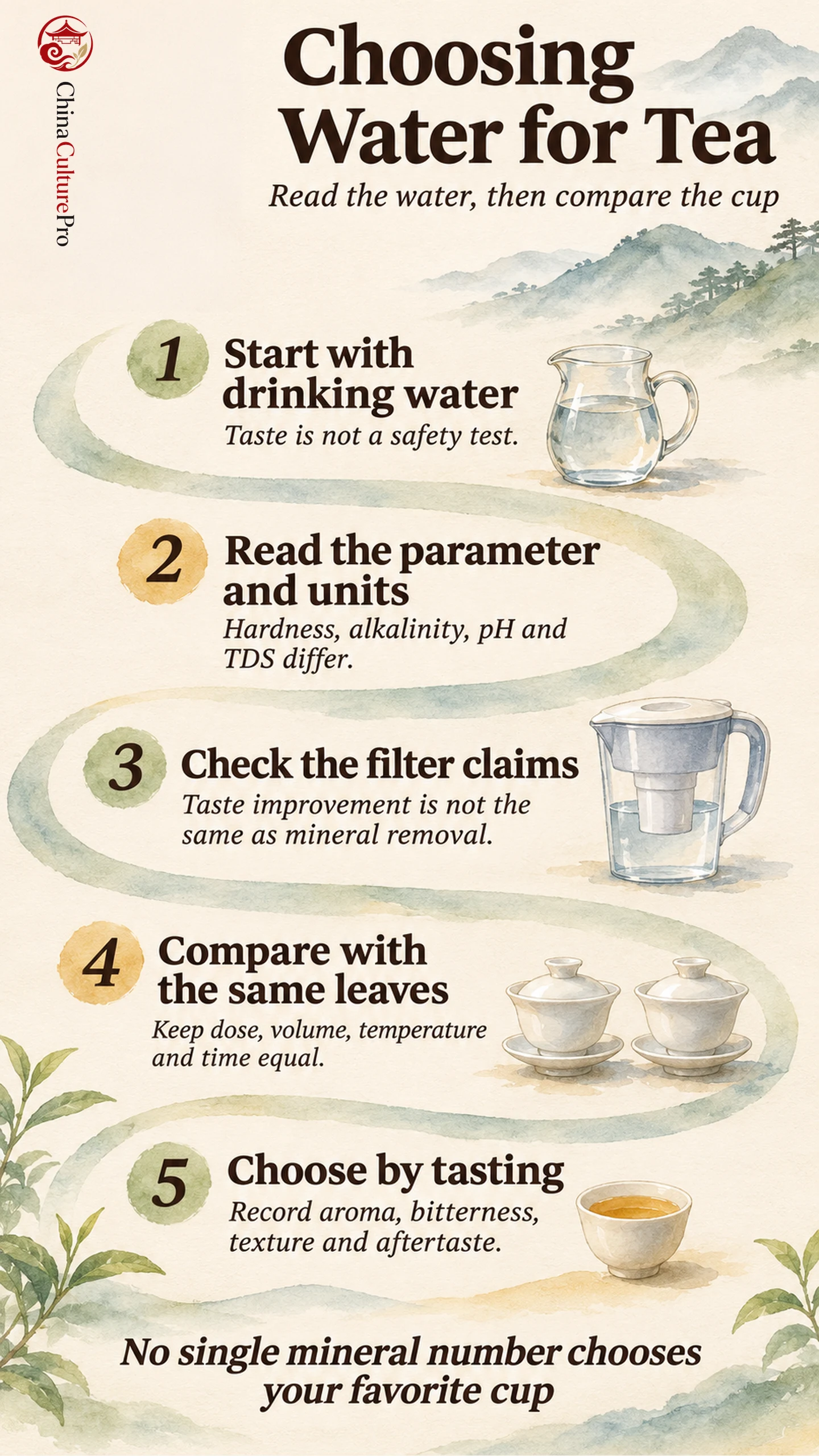
Try changing only the brewing water before changing your leaves or teapot. Keep safety checks separate from the question of which cup tastes best.
Hardness, Alkalinity, pH and TDS
These terms describe related but different properties. Read the parameter and its units before comparing a water report with a bottled-water label.
| 用語 | 意味 | Reading the information |
|---|---|---|
| Hardness | Mainly the contribution of dissolved calcium and magnesium. | Often reported as mg/L of calcium carbonate equivalent; this is not the same number as TDS.[1] |
| Alkalinity | The water’s capacity to neutralize acid, associated with substances such as bicarbonate. | A buffering property, not a synonym for a high pH.[2] |
| pH | A measure related to hydrogen-ion concentration and acidity. | Describes acidity at measurement, rather than the capacity to resist a change.[3] |
| Total dissolved solids | The combined dissolved minerals, metals and salts. | A total does not tell you the amounts of individual constituents.[3] |
For example, “100 mg/L” is incomplete information unless you know what was measured. A hardness result expressed as calcium carbonate equivalent and a TDS result do not become interchangeable because they share units.
How Water Changes the Taste of Tea
In one controlled study, researchers brewed green and black tea with tap, bottled and deionized waters while matching the other brewing conditions. Water had a stronger sensory effect on the green tea. More purified waters extracted more bitter catechins, while consumers preferred the less bitter green tea brewed with that study’s tap water.[4]
Greater extraction did not produce the preferred cup in this experiment. The result does not rank every tap supply or all Chinese teas.[4]
When tasting, compare aroma, bitterness, texture and aftertaste rather than ranking the cups by color alone.
Tap, Filtered and Bottled Water
If your tap water is suitable for drinking, it can be a practical starting point. Consult your water supplier’s report when available. Taste and smell are not reliable tests for harmful germs or chemicals; a pleasant cup cannot establish that an unknown spring is safe.[5]
An ordinary activated-carbon filter can improve taste and odor without removing dissolved minerals. Reverse osmosis is a different treatment and can reduce minerals, including calcium. Neither the word “filtered” nor the presence of a filter tells you everything it removes: check the specific system’s certified claims.[6]
For bottled water, compare the composition information rather than relying on “spring,” “mineral” or “premium.” Follow a home filter’s maintenance and replacement instructions.[5]
A Simple Two-Water Tea Comparison
Use two waters already suitable for drinking. This is a tasting exercise, not a safety test. Your tea’s published brewing method supplies the leaf amount, water volume, temperature and time.
- Choose one tea and two clean, matching brewing vessels. Label the waters A and B without ranking them.
- Weigh equal portions of the same leaves and measure the same water volume for each.
- Brew both at the same measured temperature for the same time, then separate the liquor from the leaves.
- Taste at a similar drinking temperature. Record aroma, bitterness, mouthfeel and aftertaste before choosing a favorite.
- Repeat the comparison once before changing another variable, such as leaf dose or infusion time.
Keep other habits consistent too. Changing rinsing or the brewing vessel at the same time makes the comparison harder to interpret. A method for a specific roasted Tieguanyin(铁观音,tiěguānyīn)batch is one possible starting point.
FAQs About Water for Chinese Tea
Is Low TDS Always Better for Tea?
No. The study’s consumers preferred its less bitter tap-water green tea.[4]
Does a Carbon Filter Remove Hardness?
Do not assume it does. Ordinary carbon filtration can improve taste without removing dissolved minerals; check whether your particular system also includes a softening treatment.[6]
Is Spring Water Automatically the Best Choice?
No. Compare the actual water with your tea. A source description alone does not select a flavor you will prefer.
Can Taste Tell Me Whether Water Is Safe?
No. Harmful substances may not change taste, smell or appearance, and a TDS total is not a safety certificate. Use local water-quality information or appropriate testing.[5]
出典
[1] U.S. Geological Survey. Hardness of Water
[2] U.S. Geological Survey. Alkalinity and Water
[3] Montana State University Extension Water Quality. Alkalinity, pH, and Total Dissolved Solids
[4] Melanie Franks and colleagues. The Influence of Water Composition on Flavor and Nutrient Extraction in Green and Black Tea
[5] Centers for Disease Control and Prevention. About Choosing Home Water Filters
[6] U.S. Environmental Protection Agency. WaterSense Guide to Selecting Water Treatment Systems