


Quick Answer: What Is Emei Xueya Tea?
Emei Xueya(峨眉雪芽,Éméi xuěyá), often translated as Emei Snow Buds, is an Emei-associated tea name with a familiar green-tea profile and broader modern commercial uses.
- Place: Its cultural and production setting is the Emei area of Sichuan.
- Green-tea profile: Tender leaf is heated, shaped and dried, producing a fresh aromatic cup.
- Label check: The modern name can appear across different tea categories and product lines.
“Snow buds” does not mean that the finished tea is white tea, contains snow or has one universal picking grade. Check the actual product rather than relying on the name alone.
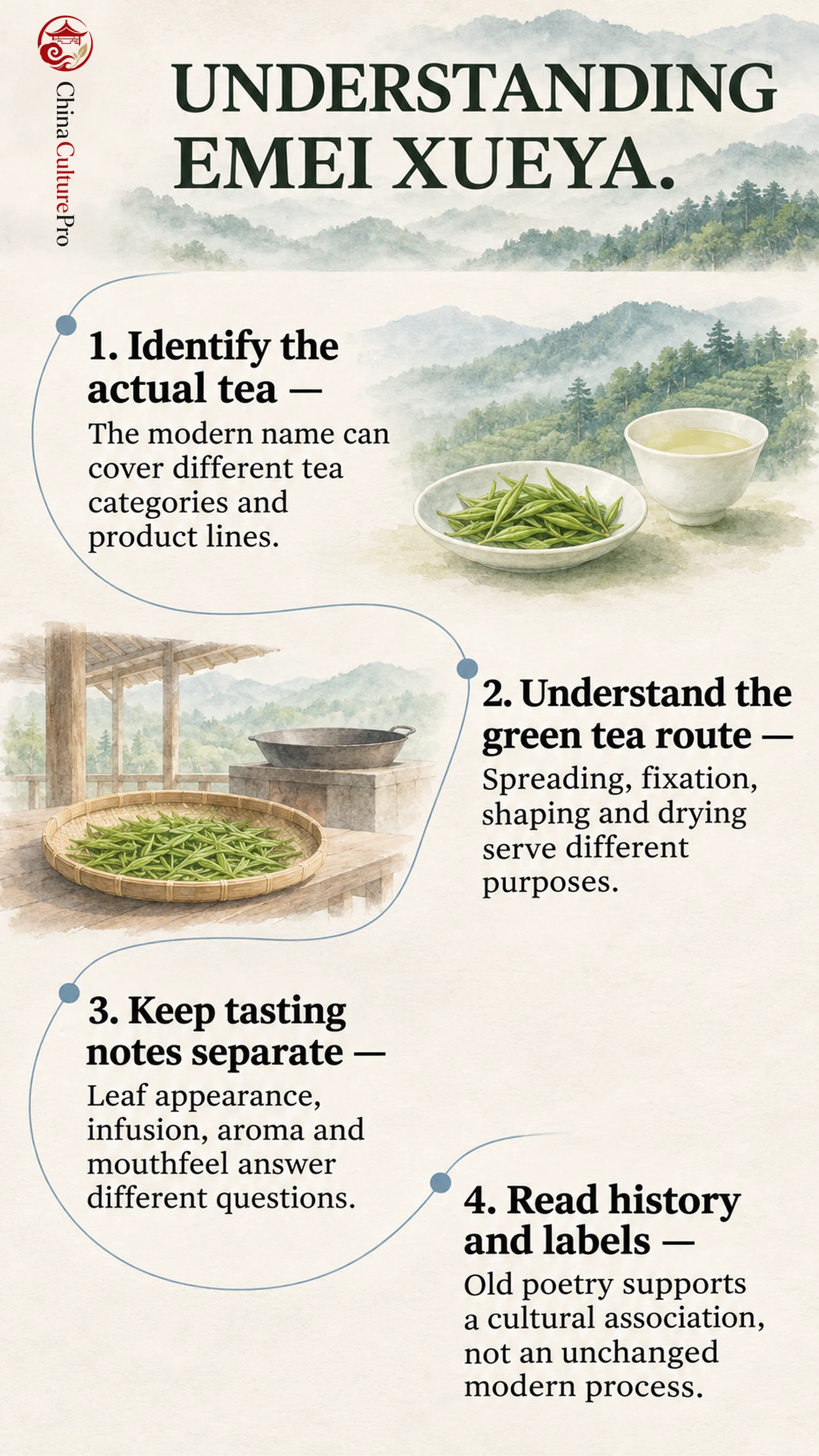
Tender green buds in a cup create an inviting picture of spring. With Emei Xueya, that picture sits alongside an old literary name and a modern range of products. Keeping those layers separate helps you understand the green tea’s processing and flavor without assuming that every package has exactly the same contents or history.
An Emei Tea Name and a Modern Product Range
Emei Xueya is closely associated with the Emei area, but the modern commercial name does not specify one tea category. A producer’s 2026 corporate disclosure describes green, black and flower-tea lines, as well as organic and non-organic products.[1]
This matters when interpreting an English guide. A description of a delicate green tea should not be applied automatically to a black tea or a flower-scented product carrying the same broader name. Likewise, a general account of a tea garden cannot establish the certified status of every item sold under that name.
For the rest of this article, the focus is the green-tea expression documented in modern production visits. Read the packet’s category and ingredients first, then its picking and processing information. Those details identify the product you have more reliably than an attractive translation.
From Tender Leaf to Finished Green Tea
A firsthand 2019 account describes picking single buds and bud-and-leaf material at an Emei production base. The visitor watched a hand-making demonstration that proceeded from spreading the fresh leaf to fixation, arranging and shaping it, then final pan drying.[2]
Those observations explain a particular demonstration; they do not establish that all current products use identical plucking material or are made entirely by hand. Tea picking and grade descriptions need to be read at product level.
The operations also have different purposes. In green-tea manufacture, fixation uses heat to reduce enzyme activity. Subsequent leaf working changes shape, while drying removes further moisture.[3] Heating is therefore more than a vague finishing touch added to a harvested bud.
The distinction in tea fixation helps explain why a green tea can retain a fresh character after manufacture. It does not mean that the product is chemically unchanged or that its appearance will remain fixed forever.
What the Green Tea Looks and Tastes Like
The same visitor described the brewed green tea as fresh and fragrant, with a bright tender-green infusion and a sweet, mellow, refreshing taste.[2] These are useful observations of the tea served during that visit, rather than a guarantee for every harvest or product.
Describe the dry leaf, infusion and mouthfeel separately. A neat bud shape concerns appearance; a fresh aroma concerns smell; a mellow impression concerns the cup’s balance and texture. One cannot serve as proof of all the others.
Use tea-aroma vocabulary to record your impressions without forcing the cup into an exact flower or nut comparison. A sensory analogy is not an ingredient declaration, and a pleasant aroma alone cannot verify where a tea was grown.
When comparing products, keep the preparation reasonably consistent and note any stated differences in picking or finishing. Otherwise, a contrast caused by the particular product or preparation can be mistaken for a defining feature of the name.
Historical Snow Buds and Today’s Labels
There is a genuine literary connection. A local gazetteer’s collected verse preserves lines attributed to the Song poet Lu You, referring to snow buds obtained from Emei and comparing them with spring tea from Guzhu.[4] The passage is evidence of an older Emei tea association.
The poem does not identify a present cultivar, factory process, certification or packet’s contents.
Modern cultural learning continues around production. A university account records students visiting an Emei Xueya base and learning about picking, fixation, rolling and drying.[5] Such visits document contemporary teaching and practice, rather than an unchanged procedure extending back to the Song dynasty.
For today’s label, separate four questions: what tea category is inside, what leaf or picking description is given, what growing origin is documented, and what certification applies to that particular product. An organic claim needs the relevant certification information; the word “snow” does not supply it.
The guide to tea authenticity and traceability can help you assess those claims. Historical poetry adds cultural context, while product documentation answers the practical questions about the tea you will drink.
FAQs About Emei Xueya Tea
Is Emei Xueya a white tea because its name means snow buds?
No. The name alone does not identify the processing category; this article focuses on its green-tea expression.
Is every Emei Xueya product organic?
No. Modern production information includes both organic and non-organic product lines.
Does an old poem prove today’s tea is made identically?
No. It supports a literary tea association, not an unchanged modern recipe or supply chain.
Does the name guarantee one leaf shape or picking grade?
No. Check the particular product’s picking description, leaf style and processing information.
出典
[1] Emei Shan Tourism Co., Ltd. 2026 interim report: tea business description
[2] Xumei Zhang, People’s Daily Overseas Edition. A spring visit to taste Emei Xueya, 2019
[3] Tea and Beverage Research Station. Tea classification and processing
[4] Emei County Supplementary Gazetteer, volume nine, digital text. Collected verse including Lu You’s Emei snow-bud lines
[5] Sichuan University, College of Literature and Journalism. Student cultural-learning visit including tea production