


Quick Answer: What Is Yongchun Fo Shou?
Yongchun Fo Shou(永春佛手,yǒngchūn fóshǒu) is a Fujian oolong associated with the Fo Shou(佛手,fóshǒu) large-leaf tea cultivar.
- 産地: Yongchun is the regional name; the cultivar also grows in other tea regions.[1]
- Leaf: The plant has broad, thick leaves compared with the leaves of Buddha’s-hand citron.[1]
- Making: Withering and alternating resting and shaking precede fixing, rolling and drying.[2]
- Flavor: Season, grade and finishing can produce different aromatic profiles.[3][4]
The tea’s name does not mean that citron fruit is an ingredient.
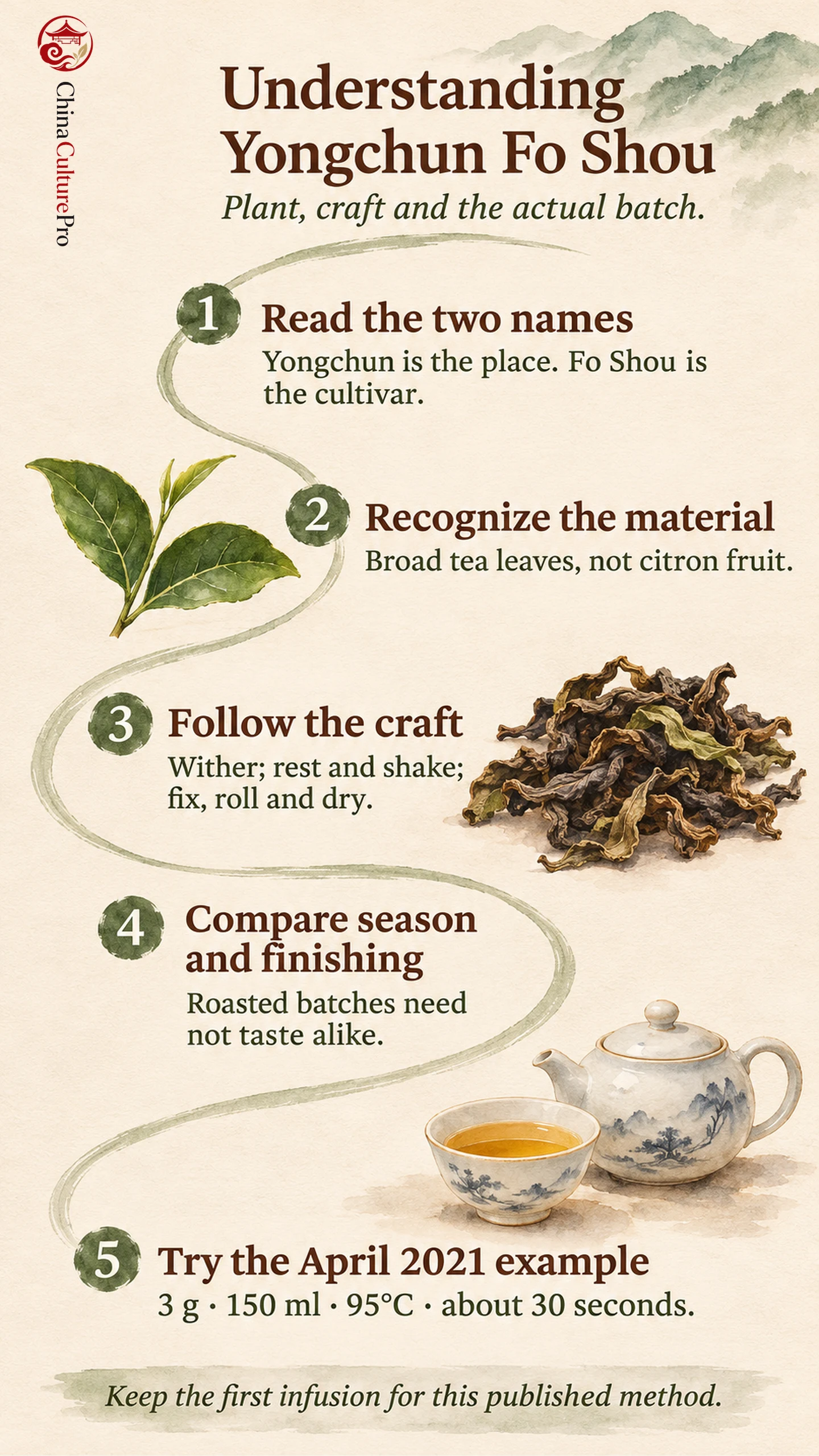
The large leaf is only one clue: harvest, shaping and roasting also change what reaches the cup.
Fo Shou Is a Tea Plant, Not a Citrus Ingredient
Fo Shou is a clonal, large-leaf shrub cultivar. Its broad, substantial leaves and the fragrance associated with the finished tea help explain the citrus comparison. The cultivar received Fujian approval in 1985 and is grown beyond Yongchun, including other parts of Fujian. A cultivar name therefore cannot establish a packet’s precise origin.[1]
Use cultivar versus tea type to separate the plant from the finished oolong. Then check origin details for the actual growing location.
Yongchun’s craft has a documented modern heritage designation: its tea-making technique entered Fujian’s provincial intangible-cultural-heritage list in November 2010. That recognition concerns a specific local practice; it does not prove every origin story told about the tea.[5]
How the Leaves Become Yongchun Oolong
A July 2026 field record describes harvesting open shoots with a bud and three or four leaves. Withering softens the material. Resting and shaking then alternate during flavor development, followed by heat fixing. After cooling, rolling compacts the leaves into strands; staged drying finishes them, with cooling and sorting before the finished tea is ready.[2]
Flavor Changes with Season and Finishing
Research comparing Yongchun Fo Shou seasons and grades found differences in taste-related compounds and aroma profiles. Floral and herbal notes were among the sensory features studied. That supports checking the harvest and grade together, rather than promising that every sample has one fixed citrus taste.[3]
A separate April 2021 Yongchun example is charcoal-roasted, with dark-brown leaves and a full-bodied profile described through fruitiness, mineral impressions and sweet, slightly smoky notes. Those notes describe this roasted batch.[4]
How to Brew a Roasted Example
For the April 2021 example above, the published preparation uses a small gaiwan or teapot and keeps the first infusion for drinking.[4]
- Warm the vessel with hot water, then empty it.
- Add 3 g of tea and 150 ml of water at 95°C.
- Infuse for about 30 seconds, then pour into a pitcher or cups, separating the liquor from the leaves.[4]
Compare tea-rinsing choices with the actual batch directions. Keep your water consistent as you adjust later infusions to taste.
FAQs About Yongchun Fo Shou
Is Fo Shou a Citrus Herbal Tea?
No. This article concerns tea leaves made as oolong. Check the ingredient list separately if a seller offers a citrus-added blend.
Must Yongchun Fo Shou Be Lightly Roasted?
No. Roasted examples also exist. Ask how the actual tea was finished instead of treating a regional name as a roast specification.
Does the First Infusion Have to Be Discarded?
No. The roasted example’s published method explicitly keeps it. A preliminary rinse is a separate brewing choice.
出典
[1] Yongchun County Agriculture and Rural Affairs Bureau. 佛手茶品种及名称的由来是什么?
[2] Fujian Agriculture and Forestry University. 采佛手鲜叶,承传统工艺,品一缕茶香
[3] Anru Zheng and colleagues. Key compounds responsible for the flavor diversity of Yongchun Foshou oolong tea of different grades and in different seasons
[4] Sazen Tea. Yong Chun Lao Cong Fo Shou 2021
[5] Quanzhou Municipal Government. 永春佛手