


Quick Answer: What Are Hanfu Revival Communities?
漢服 (汉服, hànfú) revival communities are groups of people who wear, study or reinterpret styles of historical Han Chinese dress. The organized revival gained visibility in the early 2000s, when enthusiasts connected online.[2]
- Participants may reconstruct historical styles or adapt them for modern wear.[1]
- The horse-face skirt (马面裙, mǎmiànqún) shows how an identifiable historical garment can inspire current fashion.[4][5]
- Xitang in Zhejiang and a Berlin carnival provide documented examples of public participation.[6][7]
A photograph shows how a person dressed on one occasion. The group’s purpose and the evidence for the garment’s date come from different sources.
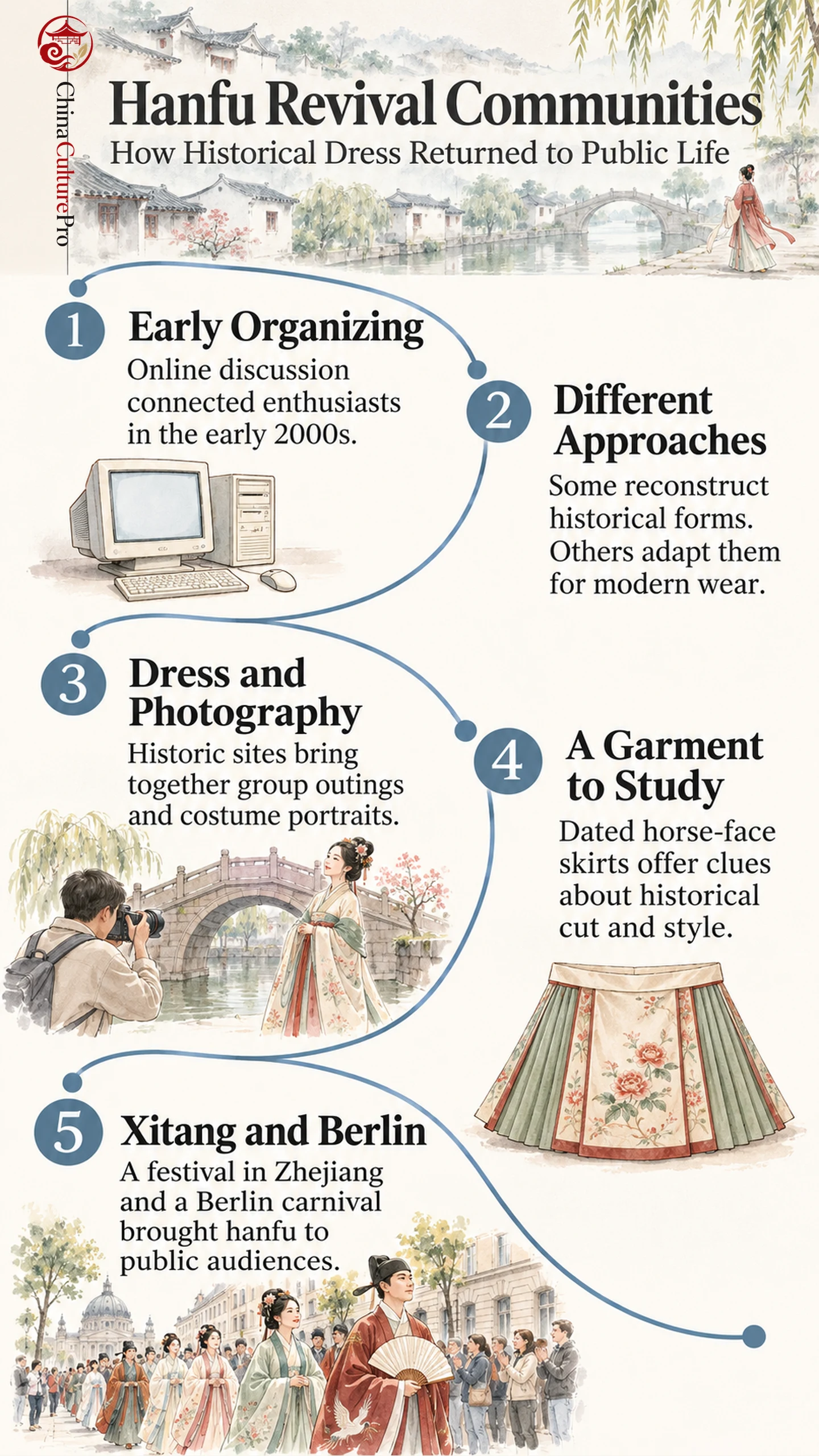
A photograph taken in a historic setting can make a newly sewn outfit look much older. An outfit chosen for a portrait, a pattern reconstructed from a museum object and a costume rehearsed for a parade each tells a different part of the revival’s story.
How the Revival Took Shape
The hanfu revival movement (汉服运动, hànfú yùndòng) developed in the early 2000s. An ethnography traces urban organizing from 2001, while a Shanghai study dates its more visible revival activity to 2003. Early online discussion helped connect people interested in clothing and a broader revival of customs.[1][2][3] These dates describe the modern movement’s emergence. Older garments, paintings and written descriptions belong to the much longer history of traditional Chinese clothing.
Some early advocates saw dress as a way to articulate Han ethnic identity and restore social rituals. Later interviews describe a broader range of views on dress and identity.[2][3]
Revival communities form one part of modern Chinese culture, with participants whose interests extend from historical research to fashion and performance.
What Hanfu Groups Do
Shanghai groups often met at historic sites where interviewees felt comfortable wearing hanfu. Preferences varied from historical formality to flexible combinations.[1]
Professional photography and rentals create a separate way to participate. At scenic sites, visitors can borrow an outfit, have their hair styled and commission pictures for social media.[2] An outing may bring longtime participants and first-time wearers into the same place. The guide to hanfu styles explains garment categories, while the hanfu wearing guide helps identify which pieces belong to an outfit.
How Historical Garments Inform Modern Dress
The horse-face skirt makes the difference between a historical object and a modern interpretation easy to see. A flat rectangular panel can be visible from the front while folds give the sides volume. Tsinghua’s exhibition brought together skirts and tops from the Ming and Qing dynasties and the early twentieth century and discussed their influence on current designers.[4] The same skirt name can therefore apply across several periods.
An early twentieth-century wedding ensemble in the Metropolitan Museum of Art pairs a pleated skirt derived from the type with a jacket shaped like an official robe. The museum records European two-piece fashion among the influences on that particular ensemble.[5] For a modern outfit described as a reconstruction, check the date and catalogued features of the proposed model and then compare the silhouette, fabric and companion pieces. These choices reveal how clothing gets reinterpreted across the history of Chinese dress. Museums also reinterpret historical objects through collection-inspired merchandise.
From Xitang to Berlin
The 2024 Xitang Hanfu Culture Week in Jiaxing drew international participants to a programme that included a float parade and performances. The Zhejiang event placed dress within a public celebration in a historic town.[6]
In Berlin, a group begun by Chinese students in 2018 organized a hanfu presentation for the 2024 Carnival of Cultures. Its programme featured a group performing as the Twelve Flower Goddesses. In the ethnographic account, the group made the flower figures the focus of its street performance.[7] The Berlin and Xitang examples show how organizers adapt clothing and performance to the setting and the audience.
FAQs About Hanfu Revival Communities
When did the modern revival begin?
Organized activity took shape in the early 2000s. Research on Shanghai uses 2003 as a marker for the revival’s more visible activities.[1][3]
Do participants always wear exact historical reconstructions?
Shanghai fieldwork describes a range of approaches, including some wearers who prioritize historical form and others who accept more flexible combinations.[1]
How can I check whether a garment matches a particular period?
Look for a dated museum object or visual record, then compare the garment’s shape, details and the pieces worn with it.[4][5]
出典
[1] Tang Tianyue and Abe Yasuhisa. Hanfu Revival Inspired Activities and Their Venues in Shanghai, China
[2] Mark Davis, Jian Xiao and Linlin Wei. Soft nationalism in China: The case of Hanfu style
[3] Kevin Carrico. The Great Han
[4] Tsinghua University Art Museum. Splendour of Skirts
[5] The Metropolitan Museum of Art. Woman’s wedding jacket and skirt
[6] Zhejiang provincial portal. Xitang Hanfu Culture Week concludes in Jiaxing
[7] Hanyu Jiang. Hanfu as invented tradition: presenting cultural identity among overseas Chinese