

Quick Answer: How Did Chinese Clothing Change?
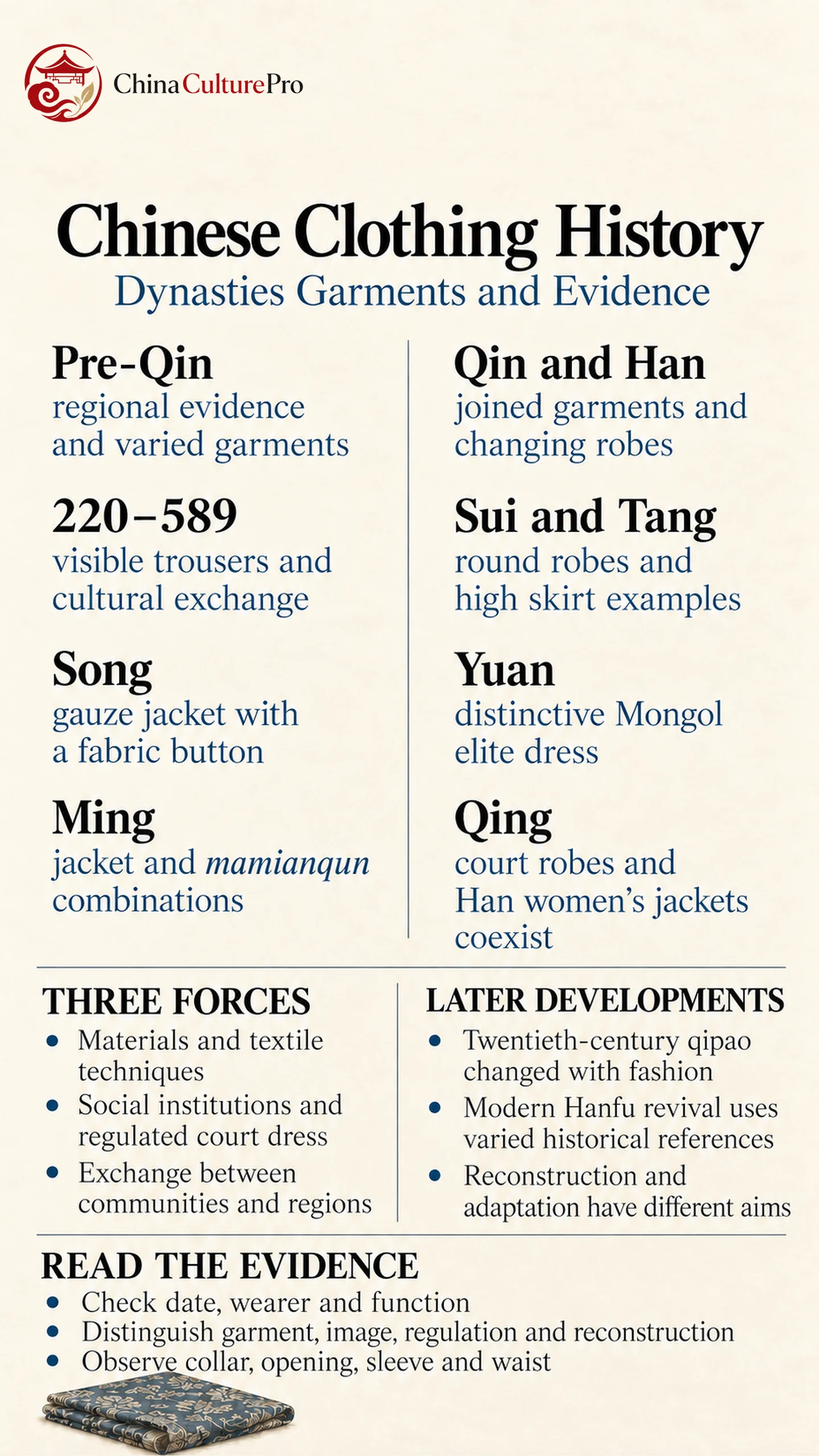
Chinese clothing changed through shifts in garment construction, textile production, social institutions and exchange between communities. A dynasty gives a useful date range, but it does not identify one outfit worn by everyone.
- Structure: Separate upper and lower garments, joined robes, jackets and trousers coexisted in changing combinations.
- Context: Court ceremony, work, gender, region and community affected what people wore.
- Evidence: Surviving clothes, excavated figures, paintings and written regulations answer different questions about dress.
The guide below follows selected examples from early imperial clothing to Qing dress, then distinguishes twentieth-century fashion and modern revival from their historical references.
A narrow-sleeved robe, a layered skirt ensemble and an embroidered court garment belong to different moments and settings in Chinese history. Their differences reveal more than changing taste. This guide places traditional Chinese clothing in sequence while keeping the wearer, function and surviving evidence in view.
A Chronological Guide to Chinese Dress
The periods below are reference points, not a complete list of every contemporary state or clothing tradition. Some political periods overlap. The examples identify documented structures and contexts rather than a compulsory costume for each age.
| 時代 | Garment or evidence to recognize | What the example establishes |
|---|---|---|
| Eastern Zhou and pre-Qin, before 221 BCE | Excavated clothing, ornaments and representations studied alongside texts | Early dress developed through regional variety. Archaeological research considers upper and lower garments, footwear, headwear, fibers and decoration together.[1] |
| Qin and Han, 221 BCE–220 CE | Shenyi(深衣,shēnyī), joining upper and lower sections | Connected garments were important, alongside changing robe forms and shorter upper garments. A long robe is not automatically one unchanged pattern throughout the period.[2] |
| Three Kingdoms, Jin and Northern and Southern Dynasties, 220–589 | Upper garments worn with visible trousers | Northern Dynasties figures show combinations with broad sleeves and roomy trousers. The proportions reflect exchanges between northern and southern dress traditions.[3] |
| Sui and Tang, 581–907 | Yuanlingpao(圆领袍,yuánlǐng páo), or round-collared robes | A male pottery figure shows the round-collared form.[4] A separate female figure wears a green narrow-sleeved top, a blue skirt tied high and a shoulder drape.[12] |
| 宋、960〜1279年 | A gauze jacket tentatively identified as a beizi(褙子,bèizi) | Its parallel front, narrow sleeves, side vents and fabric button offer concrete details beyond a generalized image of plain Song clothing.[5] |
| 元、1271〜1368年 | Mongol elite ceremonial dress and robes with defined waists | Court and elite clothing included distinctive headdresses, voluminous women’s robes and richly ornamented men’s garments. These examples do not describe every community in Yuan China.[6] |
| Ming, 1368–1644 | Jackets paired with the mamianqun(马面裙,mǎmiànqún) | Excavated skirts and associated clothing show flat overlapping panels, side pleats and jacket-and-skirt combinations. Examples occur across different social ranks.[7] |
| Qing, seventeenth to early twentieth century | A court chaofu(朝服,cháofú)and a Han woman’s jacket | A nineteenth-century robe of state preserves narrow sleeves and horse-hoof-shaped cuffs.[8] A separate 1880s embroidered jacket documents Han women’s dress within the same dynasty.[9] |
For the construction behind the names, the Hanfu(汉服,hànfú)styles guide separates ensemble names from individual garments. The mamianqun article examines the skirt’s panels and pleats more closely. Manchu clothing provides a fuller setting for the Qing court forms.
What Drove Changes in Clothing?
Material and technique shaped what could be made. Early dress research follows silk alongside plant fibers such as hemp and ramie; the available evidence also examines weaving, decoration and garment assembly.[1] A fiber name, a woven pattern and an embroidered surface describe different aspects of the same object. The distinction matters when comparing Chinese silk clothing with the techniques of Chinese embroidery.
Institutions gave clothing social meanings beyond its physical form. Qing court regulations formalized garment types, colors and decoration in 1759. A particular dark-blue robe’s dragons and other features can therefore help locate the wearer within an official hierarchy.[8] This is evidence about regulated court clothing; it is not a rule that every Qing resident wore that robe or followed its complete decorative scheme.
Exchange also changed patterns and wearing habits. The Northern Dynasties trouser ensembles demonstrate interaction rather than an isolated, unaltered tradition. Their wider sleeves and trouser legs combined different clothing influences.[3] Yuan elite garments similarly belong within networks extending across the Mongol Empire, where textiles, craftspeople and styles moved between regions.[6] Political succession did not erase these connections overnight.
From Imperial Dress to Modern Wardrobes
The familiar fitted qipao(旗袍,qípáo), also called cheongsam in English usage, belongs to a history of changing twentieth-century fashion. Museum ensembles trace movement from loose late-Qing garments toward 1930s silhouettes and later Hong Kong styles, with Shanghai, Hong Kong and Chinese American communities all part of the story.[10] The qipao and cheongsam guide follows these developments without presenting one modern cut as an unchanged imperial garment.
Hanfu in contemporary use gathers historically referenced Han Chinese dress forms within a modern revival. It is not limited to the clothing of the Han dynasty. Research on wearers in Shanghai records differing relationships to historical fidelity, showing that reconstruction and contemporary adaptation can have distinct priorities.[11] That local study does not establish one nationwide way of dressing.
The Hanfu overview examines this revival, while Hanfu versus qipao compares their histories and construction. Both are relevant to modern Chinese dress, but their development cannot be collapsed into one uninterrupted garment lineage.
How to Read Historical Clothing Evidence
Ask what kind of evidence you are looking at before identifying an outfit. An excavated textile can preserve seams and materials. A figure or portrait shows a representation of wearing, which may omit hidden closures. A written regulation describes what a specified group was supposed to wear; it does not automatically document everyone’s daily practice.
Check the date of the object and the date of the scene it depicts. A later copy of a painting is different evidence from a surviving garment made in the period shown. For a reconstruction, look for the source object or image, the inferred details and the changes made for the current wearer.
Then describe observable features before assigning a label: collar, opening, sleeve, waist, lower garment and ornament. A precise description such as “a parallel-front gauze jacket with a fabric button” is useful even when the historical name remains qualified.[5] Use the dynasty name to place those observed details in time.
FAQs About Chinese Clothing History
Was Hanfu worn only during the Han dynasty?
No. Contemporary Hanfu refers to a wider range of Han Chinese historical clothing references and revivals. A Han-dynasty garment is one chronological part of that broader discussion.
Did everyone wear the same clothing in each dynasty?
No. Community, location, status, occupation and occasion created differences within the same period. Court clothing is particularly unsuitable as a substitute for the wardrobe of the whole population.
Is a modern Tang suit Tang-dynasty clothing?
The modern short jacket commonly called a Tang suit is a different subject from a reconstructed Tang-period outfit. Its English name alone does not date the jacket’s pattern to that dynasty.
Can a drama costume identify an exact historical outfit?
It can suggest a reference, but it is also designed for performance. Check the garment against dated objects, images or construction research before treating the screen version as historical evidence.
出典
[1] Wang Fang; National Museum of China. The Formation of Hanfu: Published Overview and Preface
[2] National Museum of China. Ancient China: Qin and Han Clothing
[3] National Museum of China. Upper Garments and Trousers
[4] National Museum of China. Male Pottery Figure
[5] China National Silk Museum. Luo Gauze Unlined Jacket
[6] The Metropolitan Museum of Art. The World of Khubilai Khan
[7] Yichang Museum. Ming-Dynasty Mamianqun and Jacket Ensembles
[8] The Metropolitan Museum of Art. Robe of State
[9] Cleveland Museum of Art. Han Woman’s Jacket
[10] Los Angeles County Museum of Art. Fashioning Chinese Women: Empire to Modernity
[11] Tianyue Tang and Yasuhisa Abe. Hanfu Wearing Practices in Shanghai
[12] Zhao Yong; National Museum of China. Tang Women in Chang’an: A Sancai Figure