

Quick Answer: Who Was the Agronomist Wang Zhen?
Wang Zhen (王祯, Wáng Zhēn) was a Yuan-period county official and writer on agriculture. His Nong Shu (农书, Nóngshū), completed in 1313, brings together agricultural practice, crops and illustrated implements. He also left an account of printing with individually reusable wooden characters.[1][2][4]
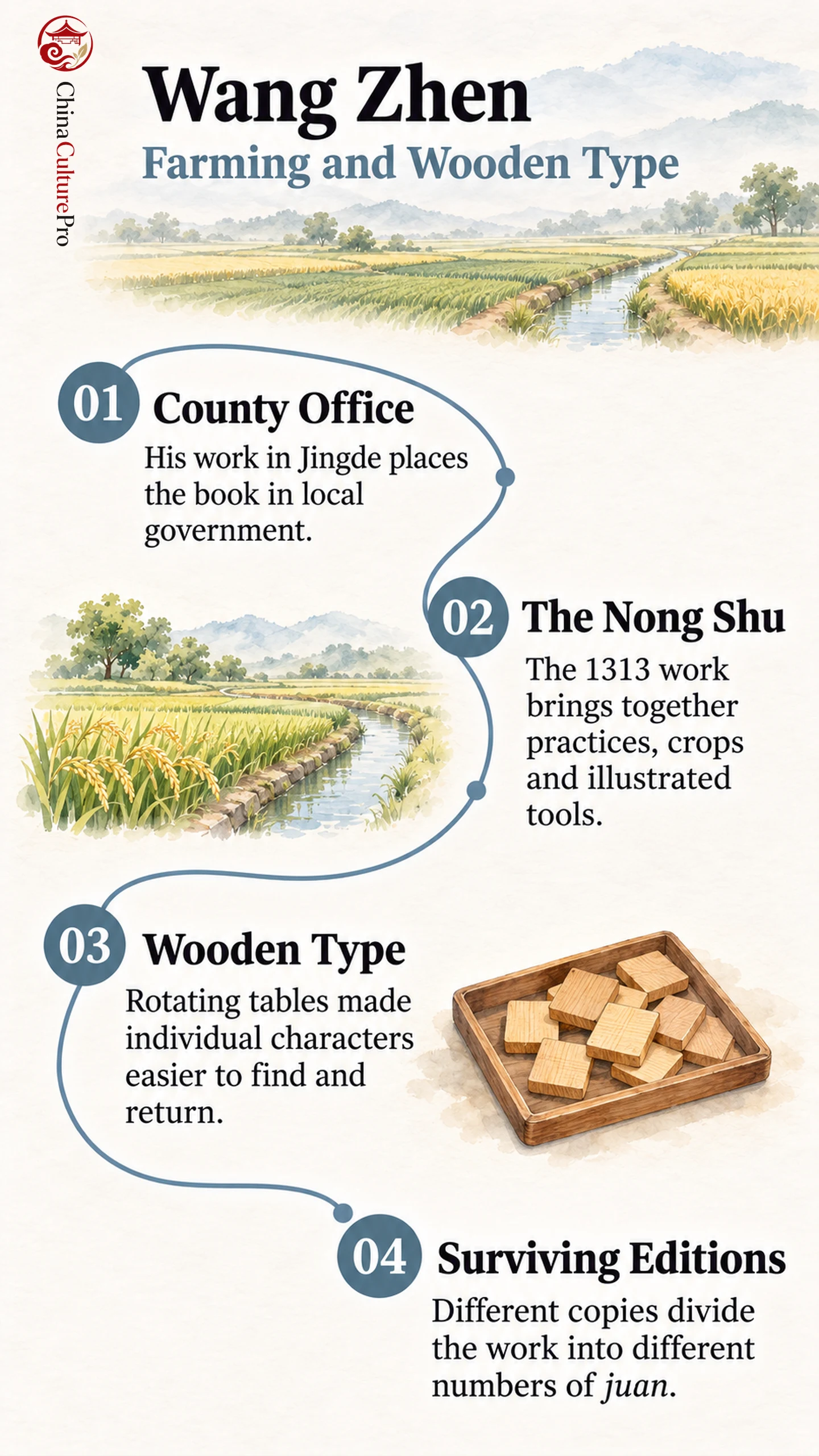
- Life: His county appointments help place the work in local administration.
- Book: The diagrams show tools for different jobs, from cultivation to processing.
- Printing: The rotating type table made it easier to locate and return individual characters.
The work, the printing method and the surviving editions have separate histories.
Wang Zhen had two problems of organization. A farming book needed to show readers which tool did which job. A printer needed to find a character among thousands of pieces of type. Both problems help explain what makes his writings distinctive.
A County Official Writing About Agriculture
Wang served as a county official under the Yuan Dynasty. Records of his appointment in Jingde (旌德, Jīngdé), in present-day Anhui, place him in local government in the 1290s. The county also figures in his account of printing a local gazetteer. His surviving record is clearer on these activities than on an exact span for his life.[1][4]
The Nong Shu can be read in that administrative setting. Its discussion of farming drew on earlier texts and practical knowledge. It organized material so an official or other reader could compare crops, work processes and equipment, including techniques that might be unfamiliar in a particular district.[2][6]
How the Nong Shu Organizes Agricultural Knowledge
The received work has three main components. The Nong Sang Tong Jue (农桑通诀, Nóngsāng Tōngjué) covers general agricultural and silkworm-raising practices. The Baigu Pu (百谷谱, Bǎigǔ Pǔ) organizes information about crops. The Nongqi Tupu (农器图谱, Nóngqì Túpǔ) groups illustrated implements by their uses.[1][5][6]
An entry on the fan che (翻车, fānchē) describes a device for lifting water. The entry cites an earlier story about the engineer Ma Jun in a discussion of the device’s antecedents. Putting a text and illustration together makes the implement easier to recognize and compare. It gives evidence of how Wang transmitted knowledge about it, while the earlier citations show that he did not present every device as his own invention.[3]
Cotton offers another example. Historian Francesca Bray highlights Wang’s treatment of equipment used in processing the crop. A description of how to cultivate a plant addresses a different part of the work from a diagram that shows an implement used afterward. The equipment entries extend the book’s account of agricultural work beyond what happens in a field.[2]
In the cotton discussion, equipment such as the gin and spinning wheel appears at different points in the work. The first concerns preparing the fiber, while the second concerns turning prepared fiber into thread. In an illustrated agricultural book, grouping these implements by their jobs gives a reader a way to follow the process across multiple entries.[2]
Wooden Type and the Problem of Finding Characters
The printing account describes wooden movable type (木活字, mù huózì). It starts from separate pieces that can be arranged into a page and reused afterward. In woodblock printing, the page is cut as one block. With separate type the arrangement can be dismantled and reset for another page.[4]
With a large stock of separate type, retrieving characters becomes a problem of organization. Wang’s account describes a rhyme-based arrangement on revolving tables, including provision for pieces that needed a different grouping. A worker could turn a table to bring the needed group within reach. The same organization also gave a worker a place to return the pieces after a page was taken apart.[4]
The Jingde county gazetteer is the printing project associated with this method in the biographical record. The Nong Shu is where the description survives. Keeping those two works separate prevents a history of one printing project from becoming a claim about how every edition of the agricultural treatise was made.[1][4]
The gazetteer is reported as lost in the biographical record. That leaves the description and later testimony as evidence of the printing project. It also changes what a historian can check. A surviving copy could be examined for its actual printed features, while the account primarily shows how Wang described the process.[1][4]
How to Read the Surviving Editions
A date such as 1313 identifies a stage in the history of the work. A catalogue for a later copy gives details about that edition’s arrangement. The Siku catalogue notice describes a twenty-two-juan arrangement. The University of Tokyo catalogue records six juan for general practices, twenty for tools and ten for crops. Those counts describe the arrangement in that holding. Two editions can share a title and author while placing material in different textual divisions.[2][5][6]
To trace a particular illustration or the type account, begin with its section title and then confirm the numbering used in your edition. That makes it easier to compare references across versions. It also puts the evidence for Wang’s contribution in the wider context of Chinese printing history.[4][5][6]
FAQs About Wang Zhen
Did Wang Zhen invent movable type?
Movable type existed before Wang’s lifetime. His distinctive contribution was a detailed account of a wooden-type system, including how to arrange and retrieve its many characters.
Did Wang Zhen print the Nong Shu with wooden type?
The Jingde gazetteer is the work associated with Wang’s wooden-type printing. The Nong Shu preserves his description of the method. The printing technique of a particular copy of the Nong Shu depends on its own bibliographic evidence.
Why do catalogues give different numbers of volumes?
A catalogue may describe the divisions of a specific printed witness. Check whether it is counting textual units, bound volumes or the parts of a particular edition.
出典
[1] Chinese Social Sciences Network, citing Chinese Gazetteer History. Wang Zhen
[2] Francesca Bray, British Journal for the History of Science. Science, Technique, Technology: Passages Between Matter and Knowledge in Imperial Chinese Agriculture
[3] Wang Zhen, Nong Shu. Fan Che entry in the illustrated tools section
[4] Wang Zhen, Nong Shu, juan 22 in this edition. Method for Making Movable Type and Printing Books
[5] University of Tokyo General Library, CiNii Books. Nong Sang Tong Jue, Nong Qi Tu Ji and Gu Pu
[6] Siku Quanshu catalogue note, Shidianguji. Wang Shi Nong Shu, contents and catalogue notice