
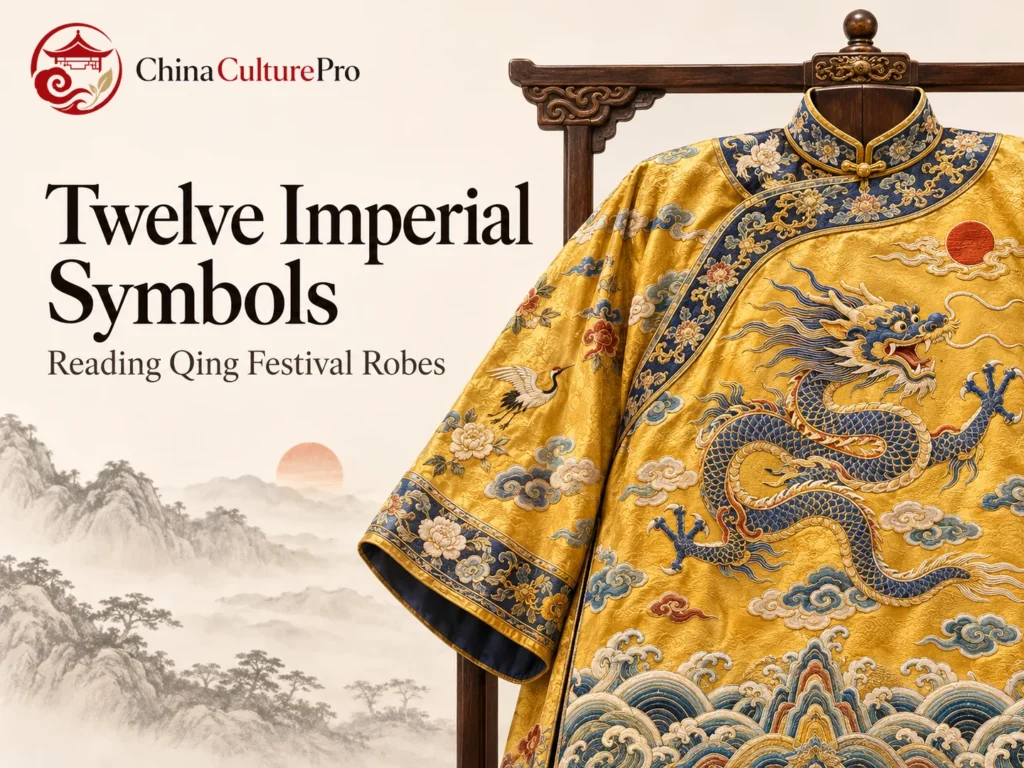

Quick Answer: What Are the Twelve Imperial Symbols?
The Twelve Imperial Symbols (十二章, shí’èr zhāng) are emblems associated with the Chinese emperor’s ceremonial dress. They include celestial signs, natural forms, ritual objects and marks of judgment. A Qing festival robe can carry the full set as small designs among larger dragons and clouds.[1][2]
- Celestial signs. Look for the sun, moon and stars.[1][3]
- Animals and objects. The dragon, colorful bird and ritual vessels can appear as separate emblems.[1][2][3]
- Other motifs. Plants, grain, fire and geometric marks complete the set.[1][2]
The emblems are easiest to see when the robe can be viewed from more than one side.[2][4]
A dragon robe can draw the eye first to its large dragons, bright ground and waves. On a Qianlong festival robe, the smaller emblems have their own locations and meanings. You may need to look at the shoulders and turn to the back to find the whole set.[2][4]
The Twelve Symbols and Their Traditional Meanings
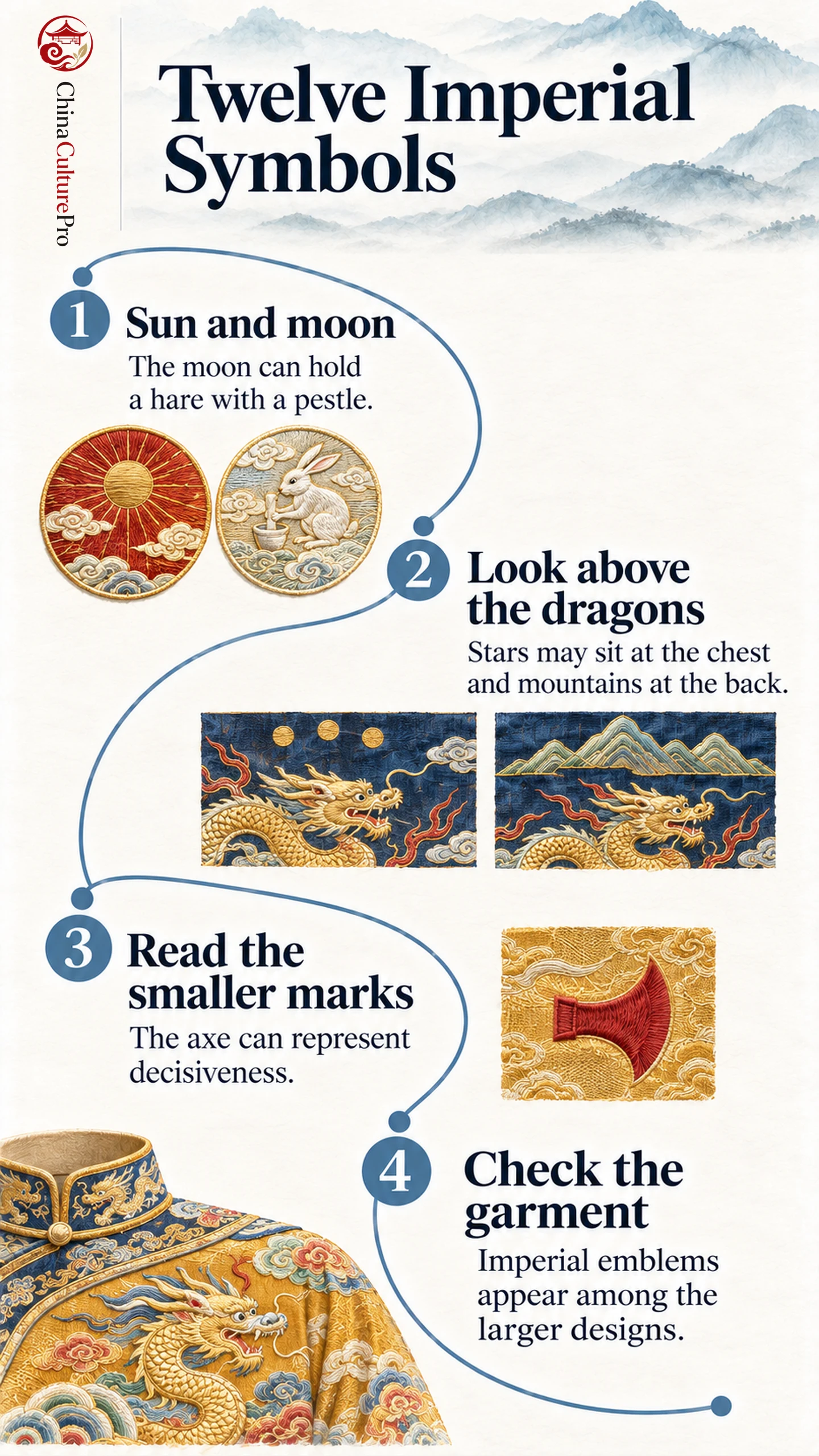
The emblems are listed in the Book of Documents. Their interpretations vary in detail across sources. The axe (黼, fǔ) and fu emblem (黻, fú) are among the smallest marks. The table lists their traditional associations alongside those of the other ten emblems.[1][2][3]
| シンボル | 確認したい特徴 | 伝統的な連想 |
|---|---|---|
| Sun | A disc that can contain a three-legged bird | Light and illumination |
| Moon | A disc that can contain the moon hare | Light and illumination |
| 星曜 | A small group of stars, often three | Light and illumination |
| Mountains | A compact group of peaks | Stability or the power to bring rain |
| 龍 | A small dragon or a pair of dragons | Adaptability |
| Colorful bird | A pheasant-like bird with patterned plumage | Refinement and literary accomplishment |
| Ritual vessels | A pair of sacrificial vessels, sometimes with animal designs | Courage, wisdom or loyalty |
| Waterweed | A small branching aquatic plant | Flexibility or refinement |
| 火 | An upright cluster of flames | Rising energy or upright conduct |
| Grain | Grains of millet or rice, sometimes on a plate | Nourishment and abundance |
| Axe | A hatchet head | Decisiveness |
| Fu emblem | Two opposed geometric shapes | Discernment |
The ritual vessels can bear a tiger and a long-tailed monkey, read in one interpretation as courage and wisdom. Other Chinese images of wisdom use different clues, such as a written character or water in a classical passage.[1][3]
Where to Look on a Qing Festival Robe
On some Qing robes, the sun and moon sit on opposite shoulders. The stars can appear above the chest dragon and the mountains above the back dragon. A frontal display may leave part of the set out of view.[2][4]
The water-and-mountain hem border can also contain peaks. The small mountain emblem belongs to the twelve-symbol set. Its position and scale help distinguish it from the repeated landscape near the hem.[2][4]
How Imperial Symbols Differ From Rank Badges
The full set expresses imperial authority and qualities expected of a ruler. The Qianlong robe could be used on occasions such as festival banquets or military inspections. A separate official badge identifies civil or military grade through the figure in its square field. The pheasant on a Qing badge or the military rhinoceros badge has its own rules.[1][2][5]
FAQs About the Twelve Imperial Symbols
Is the fu emblem the same as the character for good fortune?
The robe emblem is 黻, a paired geometric form. The character 福 expresses good fortune. The two are both pronounced fú in Mandarin and have different shapes and uses.[1][3]
Does a robe with a dragon necessarily carry all twelve symbols?
Dragons appear on many kinds of Qing court dress. Identify the small motifs as a group and check the garment’s catalogue entry to confirm a full set.[2][4]
出典
[1] 故宮博物院。 Twelve Imperial Symbols
[2] The Metropolitan Museum of Art. Emperor’s Twelve-Symbol Festival Robe
[3] The Metropolitan Museum of Art. China: Through the Looking Glass, Manchu Robe gallery
[4] The Metropolitan Museum of Art. The Manchu Dragon: Costumes of the Ch’ing Dynasty
[5] Palace Museum. Study of Qing rank badges and four-dragon surcoats