
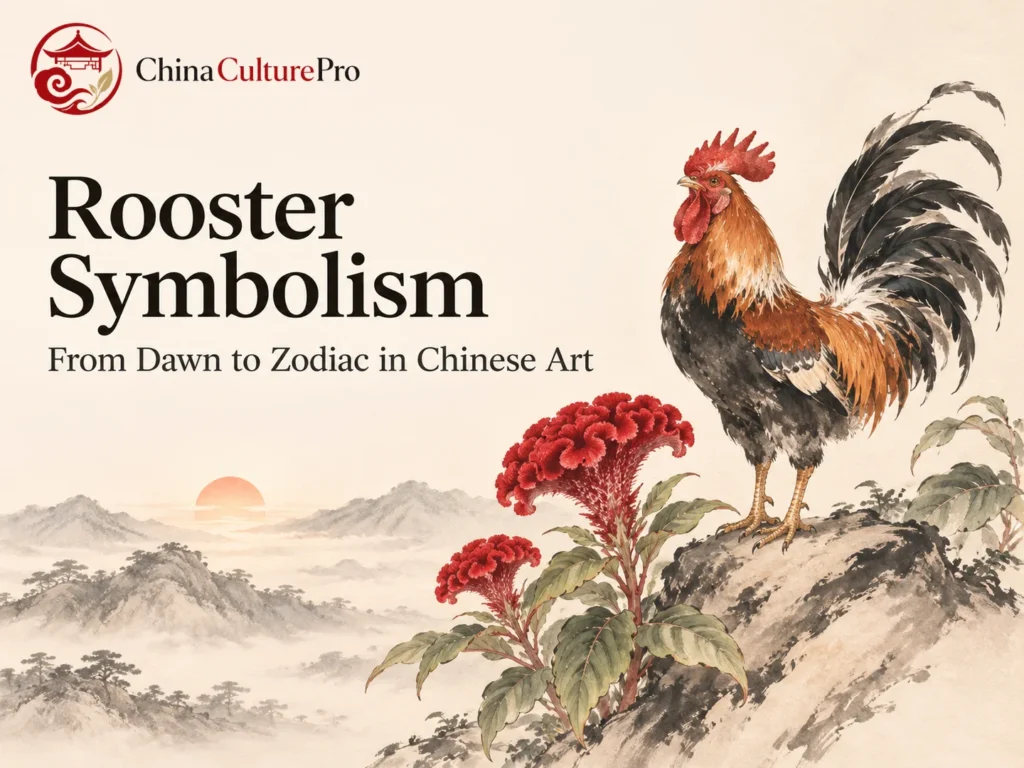

Quick Answer: What Does a Rooster Mean in Chinese Art?
A rooster (公雞, gōngjī) can evoke dawn, good fortune or a wish to rise in office. A rooster beside the cockscomb flower can carry a promotion pun, while the bird in a zodiac set represents the tenth sign.[1][2][3]
- Crowing bird. Its call marks the coming of morning.[3]
- Comb and flower. Their names can suggest advancement in office.[1][2]
- Zodiac figure. The rooster follows the Monkey and precedes the Dog.[3]
Look for the flower, inscription or other animals that accompany it.

In a hanging scroll, a rooster stands beside a red flower. In an incense burner, the hollow bird contains the incense. The familiar crest and curved tail identify both birds, but the flower and removable wings give the images different purposes.[1][4]
Why the Rooster’s Call Marks Dawn
One Chinese legend describes a heavenly rooster in a peach tree on Mount Taodu. The bird calls when the sun first reaches the tree, waking the world. That story gives a cosmic scale to a sound familiar from daily life. The bird can evoke daybreak and the diligence associated with rising early.[3]
A rooster can also appear in New Year prints. The bird’s name (雞, jī) is close in sound to auspiciousness (吉, jí), with different tones in modern Mandarin. Companion images narrow the intended wish. In some prints, a rooster beside a peony connects achievement with prosperity.[2][5]
How a Comb Becomes a Wish for Promotion
The word for a crown or comb (冠, guān) can echo the word for an official (官, guān). Paired with the cockscomb flower, a rooster can recall the wish to rise in rank (官上加官, guān shàng jiā guān). The red crest of the bird and the red flower help the eye make the connection before the words do.[1][2]
Qi Baishi’s Rooster and Coxcomb, dated 1947, puts part of the phrase into the title inscription at the upper right. Those written words make the promotion reading much clearer. Compare the golden pheasant in court painting, whose accompanying poem calls attention to virtues.[1][6]
A Rooster Shaped by Its Use
A Qing cloisonné incense burner takes the shape of a standing rooster. The hollow body holds incense. Detachable wings serve as the lid, and small openings in the wings let smoke escape. The wings turn a recognizable feature of the bird into the working part of the vessel.[4]
FAQs About Rooster Symbolism in Chinese Art
Why is the flower called cockscomb?
Its crest-like bloom resembles the comb on a rooster’s head. In Chinese, the shared crown sound helps the two images form a wish for promotion.[1][2]
When does a rooster represent the zodiac?
Look for an object record or a group of calendrical animals. A Kangxi-period porcelain rooster is catalogued as a zodiac figure. A bird alone in a different setting could carry another meaning.[3][7]
出典
[1] The Metropolitan Museum of Art. Qi Baishi, Rooster and Coxcomb
[2] Palace Museum. The Rooster in Auspicious Art
[3] The Metropolitan Museum of Art. Celebrating the Year of the Rooster
[4] The Metropolitan Museum of Art. Incense Burner in the Shape of a Rooster
[5] Palace Museum. Research on rooster imagery and New Year prints
[6] Palace Museum. Golden Pheasant and Hibiscus
[7] The Metropolitan Museum of Art. Zodiac Figure: Rooster