


Quick Answer: What Represents Wisdom in Chinese Culture?
Zhi (智, zhì) is a Chinese character for wisdom or discernment. In the Analects, Confucius associates the wise with water. In Buddhist art, a raised feature on the Buddha’s head can signify wisdom within that religious tradition.[1][2][3][4]
- Writing: Choose the character when you want a reader to see the idea directly.[1][2]
- Water imagery: Read the comparison with the wise alongside what the passage says about movement.[3]
- A Buddha image: The raised feature is one clue to the figure and its religious meaning.[4]
The character, the literary comparison and the religious image come from different settings.
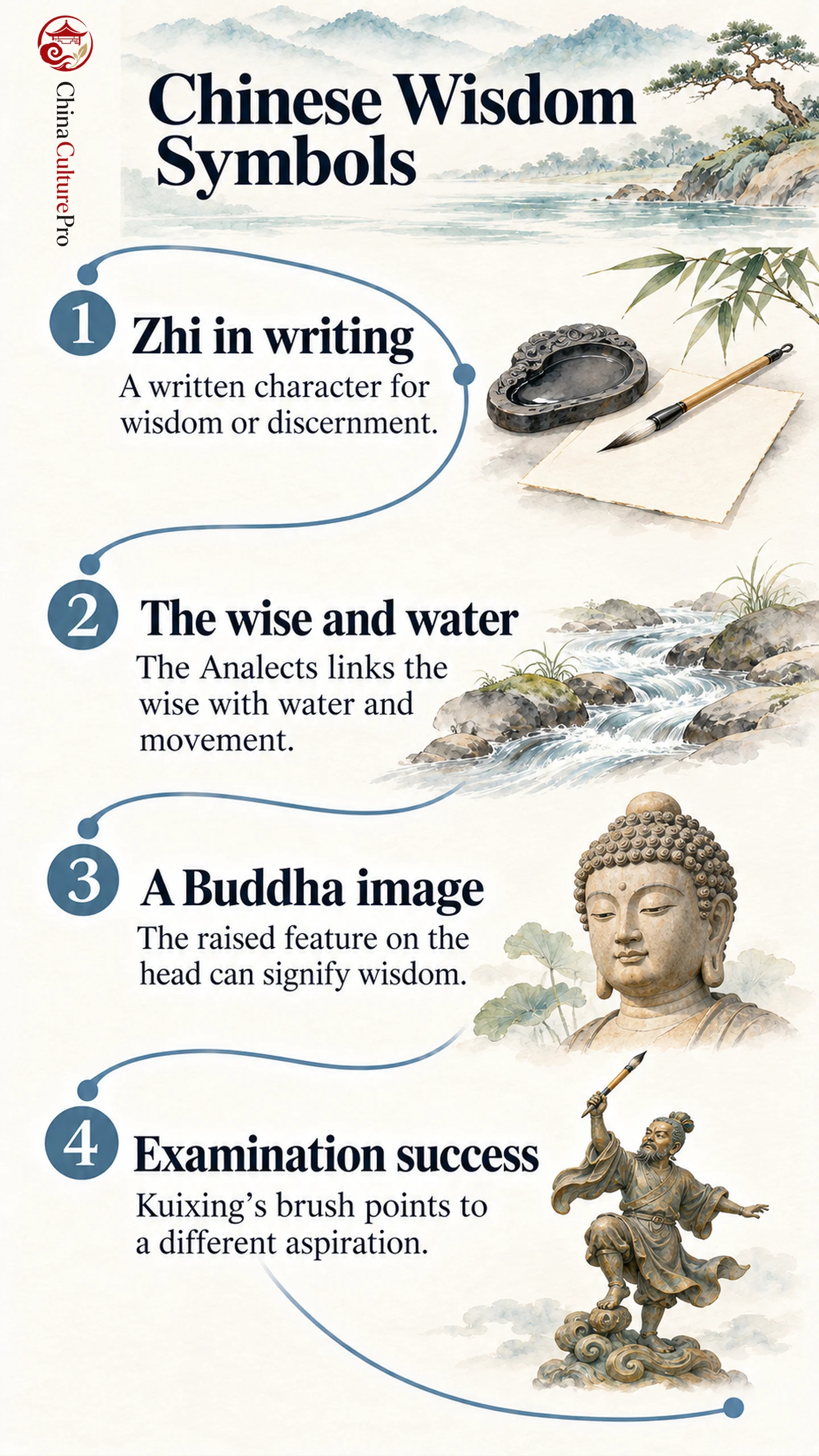
A word can name wisdom directly. A painted river or a detail on a sculpture needs context. The title, the passage or the figure depicted can supply that context.
Zhi in Writing and Confucian Thought
Zhihui (智慧, zhìhuì) is an ordinary Chinese word for wisdom. As a single written character, zhi can emphasize the quality of discernment. In early texts, 知 can sometimes be read zhì when it refers to being wise. In ordinary modern use, 知 is often read zhī and concerns knowing. The line about taking pleasure in water is an example of this older written usage.[1][2][3]
In discussions of wisdom in Confucianism, zhi can concern sound judgment under changing conditions. In the Analects, passages place it alongside humaneness and bravery. A reference to a Chinese symbol of courage therefore points to a separate virtue even when an inscription discusses the two together.[2]
Why the Analects Associates the Wise With Water
In the Yong Ye chapter of the Analects, the wise take pleasure in water and are described as active. The humane take pleasure in mountains and are described as still. The paired images let the reader consider two kinds of disposition. Movement is important to the comparison, alongside the names of water and mountains.[3]
In a painting with a running stream, the passage can provide a reading if an inscription or title calls it to mind. The stream itself can also provide a route for the eye through the composition. The classical comparison carries more weight when the artwork supplies a connection to it.
In the painting Confucius Giving a Lecture, the landscape setting has been read in relation to the same mountain-and-water comparison. Confucius sits higher than his students, and a scepter in his hand is a cue to teaching and debate. In this interpretation, the teacher and the landscape work together. The ruyi scepter has other associations when it appears alone or as a gift.[6]
The Sign of Wisdom on a Buddha Image
A Ming painting of Shakyamuni, Laozi and Confucius places the Buddha in a red robe. A raised feature on his head, often called an ushnisha, helps identify him. It is interpreted as a sign of wisdom in Buddhist iconography. In this painting, the figure’s robe, the head feature and the presence of the two other teachers all help the viewer place him.[4]
The painting brings three teachings into one setting. Confucius approaches the Buddha, while Laozi holds a roll associated with the Daodejing. Each figure has identifying details. The raised feature is the clue specific to the Buddha within that larger scene.[4]
Why Kuixing Suggests Examination Success
Kuixing (魁星, Kuíxīng) is associated with success in the civil service examinations. A sixteenth- or seventeenth-century Ming figure once held a raised writing brush, now missing. An ingot survives in the other hand. The ingot points to the benefits of a successful examination and appointment, while the pose identifies the deity’s action.[5]
A cylindrical porcelain vase dated around 1650 depicts the deity with a brush and a fish turning into a dragon. The carp’s transformation belongs to the story of leaping the Dragon Gate and parallels a candidate’s change in status after passing the examinations. On this vessel the brush and the transforming fish support the same reading.[7]
An image of an examination deity fits an aspiration about study or advancement. A character for wisdom can refer to discernment more broadly. The comparison of Wenchang and Kuixing explains how to distinguish two figures associated with learning.[1][2][5]
FAQs About Chinese Wisdom Symbols
What Chinese characters can I use for wisdom?
Use 智慧 for the common word zhihui. The single character 智 can express wisdom or discernment when one character suits the design.[1][2]
Is water always a wisdom symbol in Chinese art?
Water is part of a comparison about the wise in the Analects. In a painting, the inscription, title or other imagery can help establish whether that comparison applies.[3]
出典
[1] Ministry of Education, Taiwan. Concised Mandarin Chinese Dictionary: Zhihui
[2] Philosophy East & West. Wisdom and the Characters Zhi and Zhi
[3] Chinese Text Project. The Analects: Yong Ye
[4] Smithsonian Institution, National Museum of Asian Art. Shakyamuni, Lao Tzu, and Confucius
[5] The Metropolitan Museum of Art. Polestar Deity Kui Xing
[6] Confucius Research Institute. A Confucian Perspective on Confucius Giving a Lecture
[7] The Metropolitan Museum of Art. Vase with the Pole Star Deity, Kui Xing