


Quick Answer: What Does Tu Culture Include?
Tu culture belongs to the Tu(土族,Tǔzú), often called Monguor in English, with communities concentrated in Qinghai and neighboring Gansu. [1]
- Language: Mongolic speech has developed through contact with neighboring languages.
- Textiles: Colorful garments and raised embroidery involve different forms of making.
- Celebrations: Circle dancing and village harvest festivals have distinct local settings.
- Everyday life: Food, courtyard homes and religious observances connect households with community occasions.
The category contains regional differences; one costume or festival cannot represent everyone.
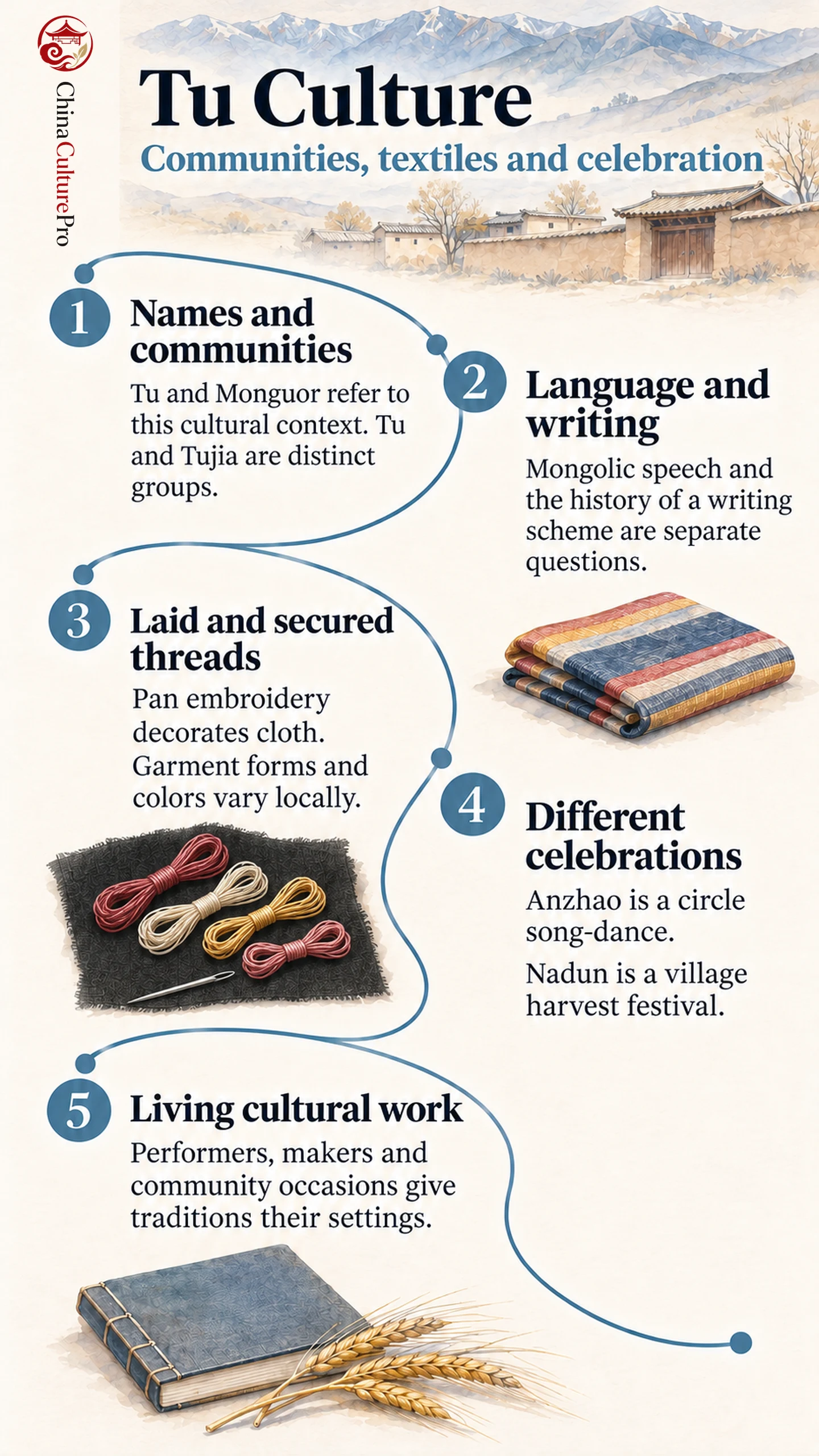
Bright sleeve panels and dense silk embroidery are familiar images of Tu culture. To understand them, look beyond color: how are the threads secured, who wears the garment, and for what occasion? The same attention to setting helps distinguish a circle dance from a village harvest celebration.
Tu and Monguor: Communities in Qinghai and Gansu
Huzhu, Minhe and Datong in Qinghai, and Tianzhu in Gansu, are important Tu settlement areas, within varied mountain and valley environments. [1]
Within China’s ethnic classification, Tu is distinct from Tujia and from Mongolian communities in China. Local self-designations vary. [1]
Language, Contact and the 1979 Writing Scheme
The Tu language(土族语,Tǔzúyǔ)belongs to the Mongolic grouping. Regional varieties differ, with Chinese and Tibetan influencing vocabulary and communication. [1]
A Latin-based Tu writing scheme was devised in 1979. Its creation and actual use should be distinguished. In a 2020 study, Du Min and Liu Zhigang examined the scheme’s trial history and reported that trial use had ceased after 2001, with limited establishment in everyday written life. Older introductions describing it simply as “currently being tried” should not be read as present-day evidence. [2]
This history also separates language from literacy. A community can sustain spoken traditions while using Chinese or Tibetan writing for other purposes. A proposed orthography, a published teaching text and widespread daily use are different stages, not interchangeable measures of a language’s cultural value. [2]
Pan Embroidery and Colorful Dress
In pan embroidery(盘绣,pánxiù), one thread is laid along the surface while a second secures it with stitches. The two threads work together to create dense, raised decoration. The Huzhu heritage record describes silk on a dark cotton ground, worked in the hands without a stretching frame. This is embroidery applied to fabric, rather than weaving the fabric itself. [3]
Designs include flowers, clouds, geometric forms and auspicious motifs. A motif’s meaning is best learned from the maker, object and occasion in which it is used. The craft entered the national intangible heritage list in 2006. Its skills have passed through family relationships as well as wider teaching. [3]
Dress is a separate subject from a stitch technique. The Huzhu clothing tradition received its own national listing in 2008 and includes several named historical garment forms. [4]
Contrasting bands of colored cloth on women’s sleeves have inspired the familiar rainbow comparison. Yet garment cuts, headwear and decoration differ with locality, period and occasion. The comparison is useful for recognizing a visual feature, not for claiming that every Tu person wears an identical seven-color outfit. [4][7]
Anzhao and Nadun: Different Community Settings
Anzhao(安昭,ānzhāo)is a circle song-dance especially associated with Huzhu. In the form described by its national heritage record, one or two accomplished singers lead, others answer, and participants sing while moving without instrumental accompaniment. Weddings and festive gatherings provide settings for the dance. It was nationally listed in 2011. [5]
Nadun(纳顿,nàdùn)belongs particularly to Minhe’s Sanchuan area. The harvest festival involves village organization, ceremonial gatherings and performances that include masked dance. Its national listing dates to 2006. [6]
| 伝統 | Main context |
|---|---|
| Anzhao | Participatory circle singing and dancing at weddings and other celebrations. |
| Nadun | A harvest-season village festival with organized ceremonial and performance activities. |
The Nadun heritage account describes celebrations rotating through communities from the seventh lunar month’s twelfth day to the ninth month’s fifteenth day. Its reported 63-day span describes a regional sequence. One village does not necessarily celebrate continuously for that whole period. The record also acknowledges a lack of direct written evidence establishing the festival’s earliest origin. [6]
Buddhist Traditions, Homes and Food
Tibetan Buddhist traditions influence important parts of Tu religious life, alongside local beliefs and community observances. Temple activities, household religious spaces and village festivals should be understood in their particular settings rather than combined into one compulsory personal practice. [7]
Traditional courtyard houses use earthen walls and timber structures, with rooms arranged around an enclosed yard. Agricultural work, storage, cooking and family life help explain this domestic layout. Historical house descriptions do not establish the design of every modern home. [7]
Barley, wheat and potatoes feature in accounts of everyday food, alongside milk tea, vegetables and meat. Festive fried foods and meals for guests add other occasions to Chinese food culture. A household menu varies with season, resources and preference. [7]
Contemporary Culture Beyond a Festival Costume
An August 2025 Huzhu county report describes a contemporary event bringing several traditions together: regional opera, shadow puppetry, Hua’er(花儿,huā’ér)singing, a narrative-poetry performance competition and opportunities to learn about embroidery production. The program brought distinct performance forms and textile skills into a shared contemporary setting. [8]
Such programs can introduce audiences to performing arts and makers, but their combined format should not be mistaken for an unchanged village ritual. A staged selection, a community celebration and a workshop each give participants different roles.
For a reader, the useful questions remain concrete: where was a garment made, which dance was performed, and who explained its use? Answers locate inherited skills in the lives of particular communities while leaving room for new work.
FAQs About Tu Culture
Are Tu and Tujia the Same People?
No. They are separate ethnic categories with different regional histories. Similar English names do not establish a shared language or identical customs. [1]
Is Tu Simply Another Name for Mongolian?
No. Tu is a distinct category. Mongolic describes a language relationship, while Monguor is a name used in English writing about Tu communities. [1]
Does Nadun Last for Months in Every Village?
No. The long festival season describes celebrations moving among communities. A regional sequence and one village’s own observance have different durations. [6]
Is Pan Embroidery a Kind of Weaving?
No. It decorates an existing textile ground by laying and securing threads. Weaving makes cloth by interlacing its structural threads. [3]
出典
[1] National Ethnic Affairs Commission. Tu overview
[2] DuMin andLiuZhigang. Creation and useofMonguorcharacters
[3] China Intangible Cultural Heritage Network. Tu pan embroidery
[4] 中国無形文化遺産ネットワーク. Tu clothing
[5] China Intangible Cultural Heritage Network. Anzhao
[6] China Intangible Cultural Heritage Network. Tu Nadun Festival
[7] National Ethnic Affairs Commission. Tu customs
[8] Huzhu county government. 2025AnzhaoNadunactivities