

Quick Answer: What Does Maonan Culture Include?
Maonan(毛南族,Máonánzú)culture includes regional languages, ritual arts, bamboo weaving, food traditions and community gatherings.
- Communities: Important centers lie in Huanjiang, Guangxi, and parts of southern Guizhou. [1]
- Language: Maonan speech and character-based records preserve different kinds of cultural knowledge. [1][2]
- Ritual and festival: A seasonal celebration and a broader tradition of fulfilling vows have distinct roles. [4][5]
- Craft and performance: Patterned bamboo hats and a Guizhou drum dance represent different regional practices. [6][7]
No one festival, surname or costume represents every Maonan person. Place and context matter when describing a particular tradition.
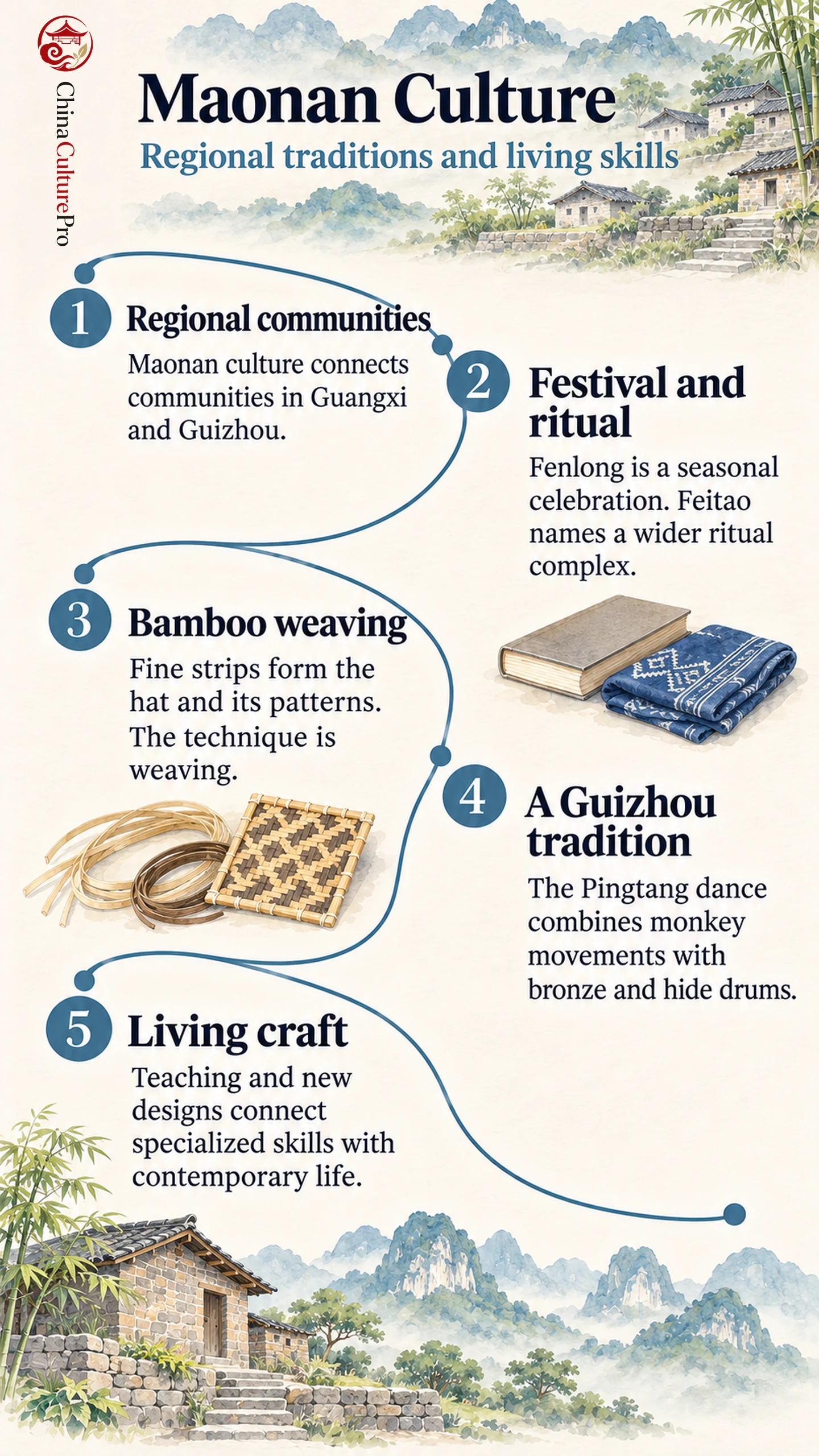
A patterned hat may look embroidered until its fine bamboo strips become visible. A festival performance may likewise resemble a complete ritual while presenting only one part. Maonan culture becomes clearer when material techniques, community events and religious practices are examined separately.
Maonan Communities in Guangxi and Guizhou
Huanjiang in northwestern Guangxi is a major Maonan cultural center, particularly its Shangnan, Zhongnan and Xianan areas. Communities also live in river valleys around Pingtang and Dushan in Guizhou. Mountain basins, karst hills and small cultivable spaces provide different settings for settlement. [1]
The Maonan are one of China’s officially recognized ethnic groups. This identity connects people across provincial boundaries without requiring identical speech or customs. Local contact with Zhuang communities and other neighbors is part of that history. [1]
Guizhou therefore belongs within the account from the beginning. It is more than a footnote to the better-known Huanjiang festival and craft traditions.
Language and Character-Based Records
Maonan belongs within the Tai-Kadai language family, also called Kra-Dai. It has its own sound system and grammar; it is not simply Chinese spoken in a mountain village. Linguistic documentation also distinguishes Maonan speech in Guangxi from Yanghuang speech associated with communities in Guizhou. [2][3]
Multilingualism developed through contact with Zhuang, Chinese and other neighboring languages. Historical tusuzi(土俗字,tǔsúzì)records adapted Chinese-character forms, sounds and meanings to represent local speech. Songs, stories and religious texts could be recorded this way. [1]
A community can thus have oral traditions and written records without one universally used modern orthography. Describing the absence of a standard script as the absence of literature would miss those different ways of preserving knowledge.
Fenlong Festival and Feitao Rituals
Fenlong Festival(分龙节,Fēnlóngjié)is associated with hopes for rain, productive fields and community well-being. Its traditional timing is described around the first dragon day after the summer solstice. “Dragon day” refers to the cyclical calendar, so it cannot be replaced by one permanent Gregorian date. [4]
Feitao(肥套,féitào)has a different scope. It is a collective name for vow-fulfillment and related ritual activities that bring oral stories, song, music, drama, dance and mask carving together. These practices connect with Nuo(傩,nuó)ritual traditions. The Huanjiang Feitao tradition entered the national heritage list in 2006. [5]
A festival can provide a setting for presenting ritual arts, but it is not another name for the complete ritual system. Likewise, seeing masks in a parade does not reveal the purpose of every ceremony. Requests for blessings express participants’ religious hopes and community concerns.
Flower Bamboo Hats: Materials, Pattern and Use
The flower bamboo hat(花竹帽,huāzhúmào)is woven from fine bamboo strips. Its patterns emerge from interlaced bamboo strips. The craft is particularly associated with the Maonan areas of southwestern Huanjiang. [6]
Makers split and refine bamboo into extremely thin strips, combine contrasting dark and yellow material, and form a patterned structure joining flatter and conical elements. Finishing contributes to the hat’s durability. This description identifies the technique without becoming instructions for reproducing a specific design. [6]
Historically, the hats served as rainwear and also acquired roles in dress, courtship gifts and dowries. The craft received national recognition in 2011 as an extension within the bamboo-weaving category. That recognition concerns a particular technique, not every bamboo hat sold under a regional name. [6]
Guizhou Monkey Drum Dance
Monkey Drum Dance(打猴鼓舞,dǎhóugǔwǔ)is associated with Maonan communities in Pingtang, Guizhou. Performers imitate monkey movements through crouching, springing and other gestures, while bronze and hide drums guide changes in rhythm. Presentations can involve one dancer, a pair or a larger group. [7]
Its 2008 national listing identifies a regional performance tradition. It should not be treated as the standard dance of every Maonan gathering or as evidence of a literal shared animal ancestry. Such distinctions help locate the dance within both Guizhou culture and the diversity of Chinese performing arts. [7]
Food, Houses and Everyday Materials
Agriculture and livestock keeping shaped household life. Rice and maize feature alongside other grains and tubers, while sour preparations are prominent in food traditions. Preserved vegetables belong to a wider repertoire that also includes meat-based foods; sourness alone does not identify a dish’s ingredients. [8]
Traditional raised houses used timber and stone, with living spaces above areas for storage or animals. Stone also appeared in steps, foundations and household objects. Later masonry and concrete homes changed these settings. A historical house type explains material choices without defining every present home. [8]
Clothing changed too, with everyday garments and festival dress serving different purposes. Food, buildings and clothing together show how available materials and social occasions shape practical choices. [8]
Craft Teaching and Contemporary Change
In July 2025, Hechi University students visited craft practitioner Tan Sujuan in Huanjiang. She explained hat-making techniques and cultural meanings during a direct exchange with the group. This documents one setting in which specialized knowledge is discussed with new learners. [9]
At the June 28, 2026 Fenlong celebration, Tan described developing small bamboo handbags and lamps using elements of the hat tradition. The event also included a parade and presentations of ritual arts. New products and public performances show different ways a craft enters contemporary life; they do not make every modern object a traditional ritual item. [10]
FAQs About Maonan Culture
Are Maonan and Miao the Same People?
No. They are distinct ethnic categories. Similar English spellings should not merge their different languages, histories and regional traditions. [1]
Is a Flower Bamboo Hat Embroidered?
No. Its patterns are created by weaving bamboo strips. Embroidery instead adds stitches to a supporting material. [6]
Are Fenlong Festival and Feitao the Same Thing?
No. One is a seasonal festival; the other names a broader complex of ritual activities and arts that may be presented during celebrations. [4][5]
Does Maonan Culture Exist Only in Guangxi?
No. Communities in Guizhou also have significant traditions, including the Pingtang drum dance. [7]
出典
[1] National Ethnic Affairs Commission. Maonan overview
[2] Tian Qiao Lu. A Grammar of Maonan
[3] Minzu University language center. Maonan language documentation
[4] China News Service. Huanjiang Fenlong Festival2024
[5] China ICH Network. Maonan Feitao
[6] China ICH Network. Maonan flower bamboo hat weaving
[7] China ICH Network. Maonan Monkey Drum Dance
[8] National Ethnic Affairs Commission. Maonan customs
[9] Hechi University. Visit to Tan Sujuan
[10] China News Service. Huanjiang Fenlong Festival2026