

Quick Answer: What Does Sibe Culture Include?
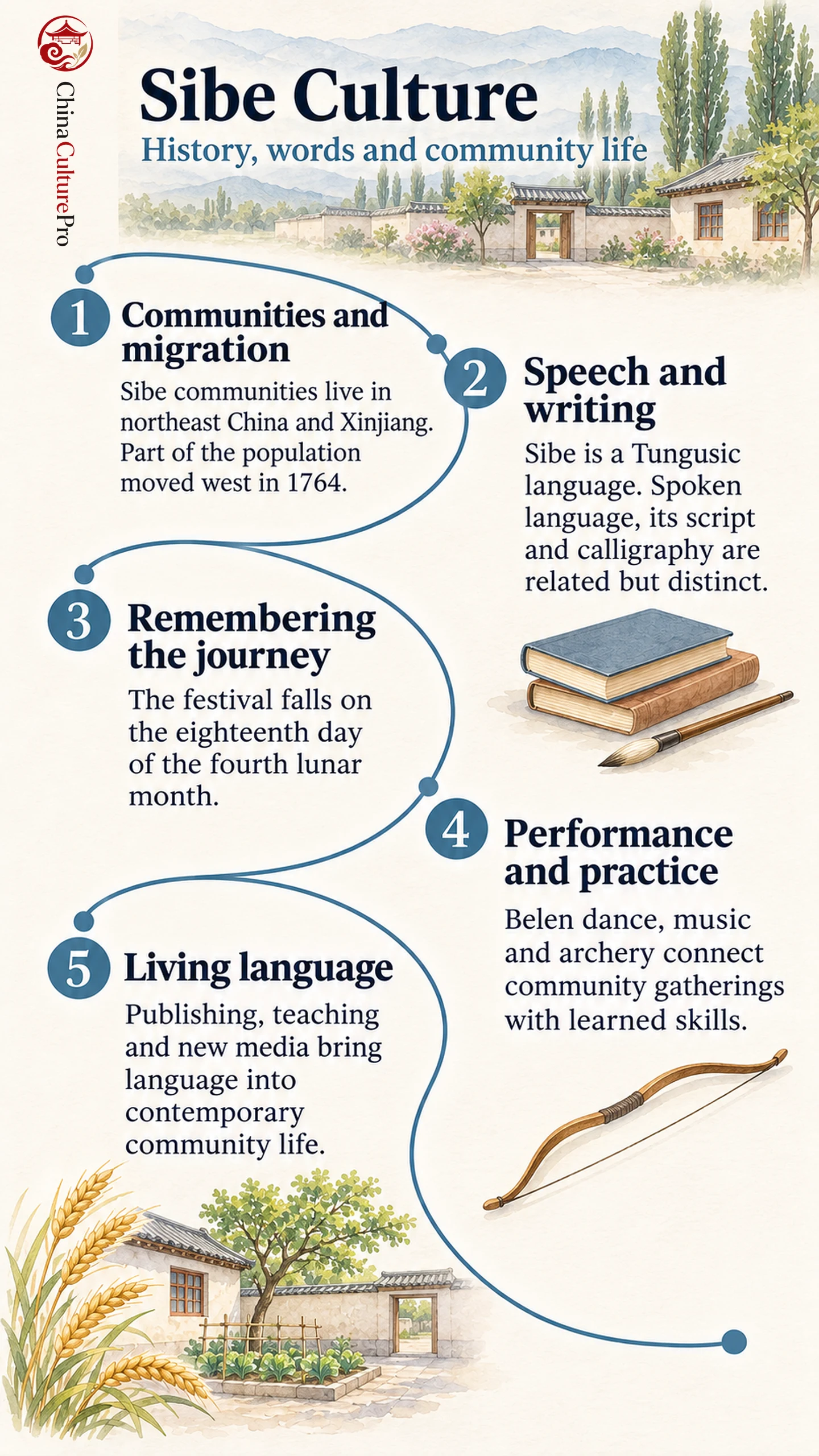
Sibe culture belongs to the Sibe(锡伯族,Xībózú), also written Xibe, with communities in northeastern China and Xinjiang. Migration memory, language, writing, performance and ordinary household life connect these geographically separated communities. [1]
- History: The 1764 westward movement involved soldiers and their families.
- Language: Sibe is a Tungusic language with multilingual speakers.
- Writing: A distinct modern script tradition developed from Manchu writing.
- Cultural life: Festivals, dance, archery and publishing give knowledge different settings.
Neither a common historical connection nor a language relationship makes every person’s experience identical. [1][3]
A commemorative gathering and a newly printed newspaper belong to the same broad cultural story. One remembers a journey across China; the other uses inherited writing for present-day communication. Together they show why Sibe culture includes both historical memory and continuing creative work.
Sibe Communities and the 1764 Westward Migration
Important Sibe communities live in Liaoning and other northeastern areas, alongside settlements in Xinjiang’s Ili region. Qapqal(察布查尔,Chábùchá’ěr)is a particularly important center in Xinjiang. The official ethnic category therefore spans widely separated places. [1]
In 1764, the Qing court dispatched a group of Sibe soldiers and accompanying family members from Shengjing, today’s Shenyang, toward Ili for permanent frontier service and farming. The event helps explain the later distribution of communities. It did not move the entire Sibe population out of the northeast. [10]
This connection with northeastern Chinese culture remains part of the story even when a description concentrates on Xinjiang. Descendants can share a remembered migration while developing different local languages, livelihoods and family histories.
Sibe Language, Script and Calligraphy
The Sibe language(锡伯语,Xībóyǔ)belongs to the Tungusic grouping and is closely related to Manchu. Linguistic descriptions also show contact with Chinese, Uyghur and Kazakh. Borrowed vocabulary records longstanding interaction among neighboring language communities. [3]
Sibe is related to Manchu culture, but language history and modern ethnic identification are different questions. A speaker’s language repertoire also depends on family, locality, education and use. Documentation includes speech from Yichegashan near Horgos and Kalahabake in Tacheng. [4]
The Sibe script(锡伯文,Xībówén)developed from Manchu writing, with a reform in 1947 adjusting it for Sibe. Knowing an alphabet, speaking a language and using it regularly in writing are separate skills. [1][4]
Calligraphy adds an artistic purpose to written communication. The national heritage project for Manchu and Sibe calligraphy was listed in 2014. Its practitioners developed different ways of shaping lines and arranging written forms, drawing on related script traditions. This is one strand of Chinese calligraphy, with its own linguistic and regional context. [5]
The Westward Migration Festival
The Westward Migration Festival(西迁节,xīqiānjié)commemorates the ancestral departure and is associated with the eighteenth day of the fourth lunar month. The lunar date is not a permanent Gregorian April 18. The Qapqal festival tradition entered China’s national intangible heritage list in 2006. [2]
Activities can include shared outdoor meals, songs, dancing and archery. Migration songs carry remembered events in performed form, bringing historical narrative into a gathering of relatives and neighbors. Their continuing composition and transmission also make them cultural works, rather than transcripts of every stage of the journey. [2]
A family remembrance, an organized public celebration and a staged commemorative program may emphasize different aspects of this history. Identifying the setting helps explain who participates and what the occasion means.
Belen Dance, Music and Archery
Belen(贝伦,bèilún), also rendered Beilun, names a range of Sibe folk dances. The Qapqal heritage record emphasizes improvisation and social participation, with several forms and differing movements. It received national recognition in 2008. [6]
Dongbur(冬布尔,dōngbù’ěr), a plucked-string instrument, accompanies the dance tradition described in that record. A repertoire can contain inherited forms and arrangements shaped by musicians. Its name does not prescribe one fixed performance for every gathering. [6]
Research on Sibe music also places borrowing, adaptation and ritual settings within its history. Rachel Harris’s fieldwork-based study challenges the image of an isolated community preserving everything unchanged. Social dancing and ceremonial music can coexist without sharing one purpose. [9]
Archery supplies another setting for learned practice, including festival demonstrations and competitions. Its historical connection with military life does not make it an inborn ability or a daily activity for every Sibe person. As with performing arts, knowledge depends on practice and transmission. [2]
Village Homes, Food and Everyday Life
Niru(牛录,niúlù)were historical organizational units with military and economic functions. In Qapqal, they also became associated with settlement patterns following the development of irrigation and farming. Their legacy helps explain village names and arrangements. [7]
Traditional homes include courtyards, adobe or timber structures and heated sleeping platforms. Domestic space accommodates storage, gardens, cooking and relationships between generations. These descriptions belong to particular periods and places; modern households can use other materials and layouts. [7]
Agriculture has included wheat, maize, barley and other crops, alongside vegetables and livestock. This places household meals within the wider variety of Chinese food culture. Ceremonial meals and ordinary working-day food have different menus and degrees of formality. [7]
Publishing and Teaching in Contemporary Communities
Qapqal News(察布查尔报,Chábùchá’ěr Bào)provides a concrete example of Sibe writing in public life. An October 2026 report traces its predecessor to 1946 and the current newspaper name to 1974. It also describes changes from earlier printing equipment to digital production, with activities explaining printing to learners. [8]
Publishing involves editors, translators, printers and readers. A language’s written life consequently depends on usable settings and continuing work, alongside the preservation of older books or attractive calligraphy.
Teaching performance offers another example. A linguistic text published by Norikazu Kogura in 2021 records a 2005 interview with Guo Mali, who discussed her work directing children’s dance and exchange among local performance traditions. Its value lies in the particular speaker and recording context; it is not evidence that every contemporary Sibe child has the same training. [3]
FAQs About Sibe Culture
Are Sibe and Xibe Different Peoples?
They are alternative English spellings for the same ethnic category. Other romanizations also occur, so the source’s location and spelling convention can help identification. [1]
Are Sibe and Manchu Exactly the Same?
No. Their language and writing histories are closely connected, while Sibe and Manchu are distinct modern ethnic categories. Shared features do not erase separate community experiences. [3][4]
Did All Sibe People Move to Xinjiang in 1764?
No. The movement involved a dispatched group of soldiers and family members. Other communities remained in the northeast, helping explain the later geographical distribution. [10]
Is the Westward Migration Festival on April 18?
It is associated with the fourth lunar month’s eighteenth day. Its Gregorian date changes, so “April 18” alone is an incomplete calendar description. [2]
出典
[1] National Ethnic Affairs Commission. Sibe overview
[2] China Intangible Cultural Heritage Network. Sibe Westward Migration Festival
[3] NorikazuKogura. Sibe Text:The Dancing oftheSibePeople
[4] Minzu University language monitoring center. Sibe language and writing protection
[5] China Intangible Cultural Heritage Network. Manchu and Sibe calligraphy
[6] China Intangible Cultural Heritage Network. Sibe Belen dance
[7] National Ethnic Affairs Commission. Sibe customs
[8] Ili News. Qapqal newspaper print and education work
[9] RachelHarris. Singing the Village:Music MemoryandRitualamongtheSibeofXinjiang
[10] National Ethnic Affairs Commission. Sibe history