


Quick Answer: What Does Blang Culture Include?
Blang culture belongs to the Blang(布朗族,Bùlǎngzú), also written Bulang, whose communities live across western and southwestern Yunnan. Tea cultivation is especially visible, alongside local languages, religious traditions, songs, textiles and farming. [1]
- Language: Regional speech varieties belong to the Austroasiatic family.
- Tea: Cultivating trees, making tea and consuming it are related but distinct activities.
- Belief: Buddhist observances and local ancestral traditions have different community settings.
- Arts: Accompanied singing, drum dances and weaving preserve learned skills.
The best-known tea villages offer important examples, without representing every Blang community.
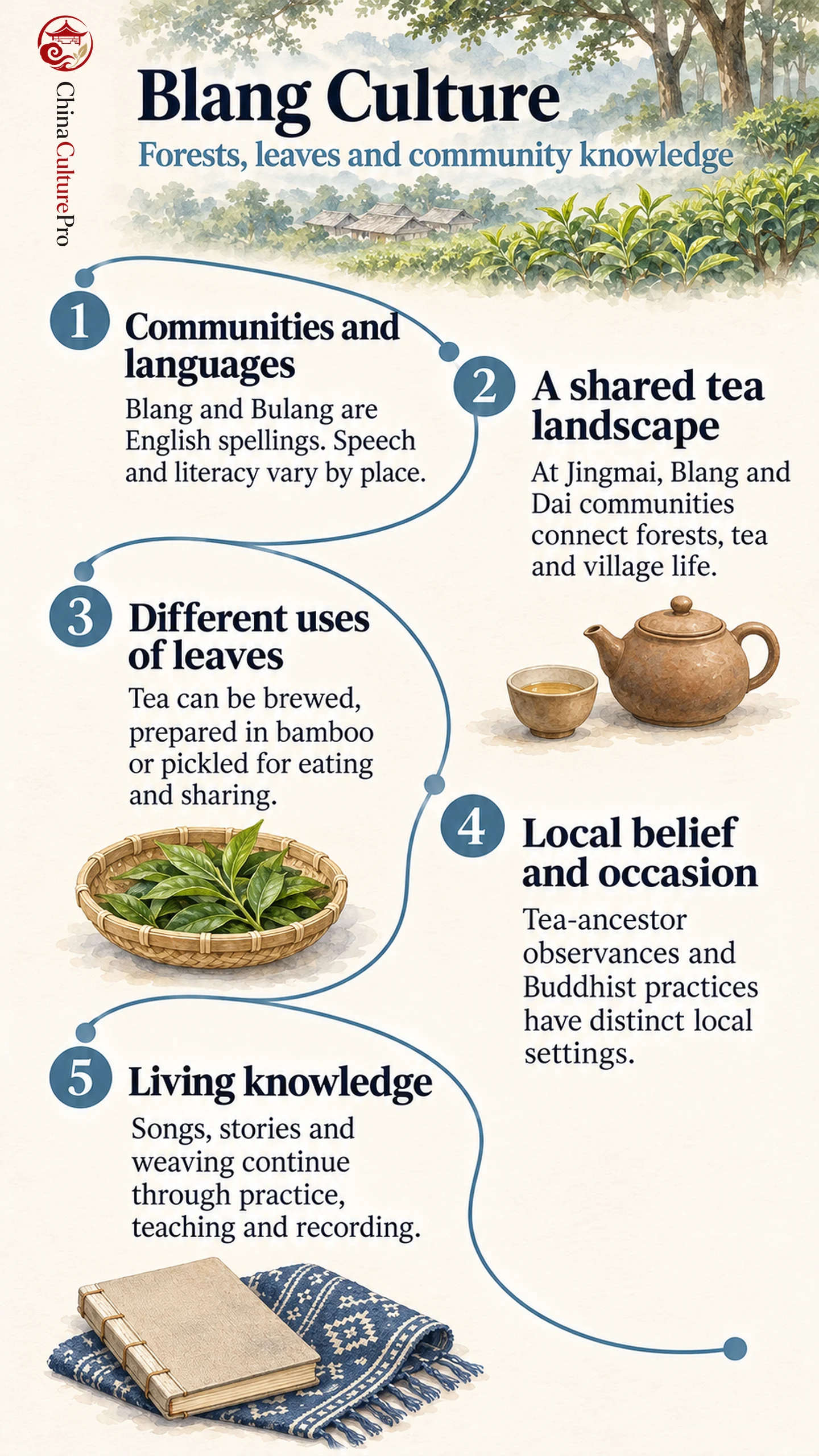
Tea leaves connect Blang households with forests, trade, hospitality and remembered ancestors. Yet tea is only one entrance into a wider cultural world. Listening to a local song or examining a woven cloth reveals other skills and relationships within the diversity of Yunnan culture.
Blang Communities, Languages and Writing
Blang settlements extend through Menghai in Xishuangbanna, parts of Lincang, Lancang and other areas of Pu’er, and places such as Shidian in Baoshan. Different local names and neighboring languages reflect this dispersed geography. The Blang are a distinct official ethnic group, not simply a name for everyone who grows tea in southwestern Yunnan. [1]
The Blang language(布朗语,Bùlǎngyǔ)belongs to the Austroasiatic family. Documentation includes varieties associated with Bulangshan in Menghai, Arwa speech in Lincang, and Lawa and Wu varieties elsewhere. A recording should therefore be identified by its locality as well as the wider language label. [1][2]
Language surveys describe no separate standardized ethnic writing system. That does not mean an absence of written communication: Chinese and, in some settings, Dai provide other means of literacy. Oral histories, songs and multilingual communication coexist with these written practices. [1][2]
Jingmai Tea Forests: A Shared Cultural Landscape
Jingmai Mountain(景迈山,Jǐngmài Shān)provides a specific example of Blang and Dai cultural connections. Its old tea forests, villages and surrounding woodland form a cultural landscape inscribed on the World Heritage List in 2023. [3]
Tea grows beneath a forest canopy, within a land-use system shaped by local knowledge, governance and spiritual relationships. The designation recognizes that shared landscape; it is not a certification that every Blang tea product comes from the property. [3]
The distinction helps when reading a tea label. A community name, a mountain name and a processing style describe different things. None alone supplies a complete history of the leaves or the people who produced them.
Tea to Drink, Eat and Share
Roasted tea(烤茶,kǎochá), bamboo-tube tea(竹筒茶,zhútǒngchá)and pickled tea(酸茶,suānchá)illustrate different ways of working with leaves. University accounts explicitly include both tea-drinking and tea-eating traditions. [4][10]
| Preparation | 特徴 |
|---|---|
| Roasted tea | Leaves are heated in a vessel before water is added, bringing toasted aromas into a drink. |
| Bamboo-tube tea | Bamboo forms part of preparation and handling, giving this tea a different material setting. |
| Pickled tea | Leaves become a sour preparation that may be chewed or eaten, rather than treated only as a brewed beverage. |
Anthropologist Zhen Ma’s fieldwork on Bulang Mountain records pickled leaves used as food, gifts, invitations and offerings. The research also describes changing preferences as households engaged with commercial tea markets. A taste valued in one generation or context need not remain equally popular in another. [5]
Pickled tea belongs within the broader study of food preservation, but this cultural description is not a home-fermentation guide. Its social uses matter as much as its sour flavor.
Festivals, Buddhism and Tea Ancestors
At Mangjing, the Shankang Festival(山康节,Shānkāngjié)connects community gatherings with reverence for tea ancestors. A documented celebration on April 17, 2024 included offerings, tea activities, music and dance around Yanleng Temple. Rice, tea and beeswax formed part of the ceremonial setting. These acts express gratitude and hopes for the community’s future. [6]
Theravada traditions are another important part of Buddhist life in China. They can interact with beliefs concerning ancestors, water, rice and local spirits. Their relationship with tea differs between places. [7]
In a 2011 account from a Menghai field site, researcher James Miller described Buddhist rainy-season observances and restrictions on cutting large trees, while noting that tea production there was not integrated into village religious life. This differs from the tea-ancestor emphasis recorded at Mangjing. The two examples illustrate local variation rather than one universal Blang religious system. [6][7]
Songs, Drum Dances and Woven Cloth
Blang accompanied singing(布朗族弹唱,Bùlǎngzú tánchàng)is associated particularly with Menghai communities. In a common performance form, a singer’s plucked-string accompaniment and another person’s answering lines create a musical exchange, often concerning courtship. The national heritage record describes a four-string instrument in this tradition and notes musical contact with Dai communities. The project was listed in 2008. [8]
The bee-barrel drum dance(蜂桶鼓舞,fēngtǒnggǔwǔ)has a different center in Shuangjiang. Its heritage record describes a cycle involving barrel-drum, elephant-foot-drum and handkerchief dance forms. Line formations and accompanying percussion belong to this distinct performance practice, also nationally listed in 2008. [9]
Woven cloth adds another material tradition. Cotton and other plant fibers have supplied clothing, bags and household textiles, with backstrap and horizontal looms recorded. Local materials, cuts and colors vary; dark clothing is one documented tendency, not a requirement for every contemporary person. These crafts and performing arts depend on learning, practice and opportunities to use them. [10]
Recording Knowledge in Contemporary Communities
In September 2024, Yunnan Provincial Library researchers visited Blang communities in Lancang and Simao. At Mangjing they recorded migration and hero stories; elsewhere they documented labor songs, lullabies, ritual recitation, weaving and dance. The range shows how oral heritage extends beyond a single famous festival. [11]
At Mangba in Simao, the team met Qian Shufen, who demonstrated woven cloth and clothing made for family and community use. Her example connects heritage with ongoing work. Recording an explanation preserves evidence, while making garments and teaching techniques carry skills into another person’s hands. [11]
FAQs About Blang Culture
Are Blang and Bulang Different Peoples?
In English writing about this ethnic group, Blang and Bulang are alternative spellings. Local self-designations also differ, so the place and language context remain useful. [1]
Is All Blang Tea Pickled Tea?
No. There are several drinking and eating preparations. Pickled leaves represent one tradition, and research documents changes in both production and taste over time. [4][5]
Does Jingmai Represent Every Blang Village?
No. Jingmai is a particular shared cultural landscape. Other Blang communities have their own environments, tea practices and relationships with neighboring groups. [1][3]
Does Blang Have No Written Communication?
No. The absence of a separate standardized ethnic script does not mean people cannot write. Chinese and Dai writing can support communication alongside spoken Blang traditions. [1][2]
出典
[1] National Ethnic Affairs Commission. Blang overview
[2] Minzu University language monitoring center. Blang language protection
[3] UNESCO World Heritage Centre. Jingmai tea forests
[4] Yunnan Agricultural University Tea College. Blang tea customs
[5] Zhen Ma. Making Senses:qualia of Puer
[6] Yunnan Culture and Tourism Department. Jingmai firstpostinscriptionShankang
[7] James Miller. Religion and ecology of Blang
[8] China Intangible Cultural Heritage Network. Blang accompanied singing
[9] China Intangible Cultural Heritage Network. Blang bee-barrel drum dance
[10] National Ethnic Affairs Commission. Blang customs
[11] Yunnan Provincial Library. Field documentation in Puer