


Quick Answer: What Was the Ancient Tea Horse Road?
The Ancient Tea Horse Road (茶马古道, Chámǎ Gǔdào) was a network of trade routes connecting parts of Sichuan and Yunnan with Tibetan regions. Tea and horses mattered to some of the exchanges that gave it its name. Other goods, routes and trading arrangements mattered at different times.[1][2][3][7]
- Official trade: Song authorities used Sichuan tea to procure cavalry horses. Later courts organized exchanges under different conditions.[1][2]
- Regional routes: Western Sichuan and Yunnan had different trading towns, paths and connections to the Tibetan highlands.[2][3][4]
- Transport: Porters and pack animals carried tea across difficult terrain, and markets helped distribute goods between stages.[2][4][5]
The name is a modern umbrella for routes with long and varied histories.[3][7]
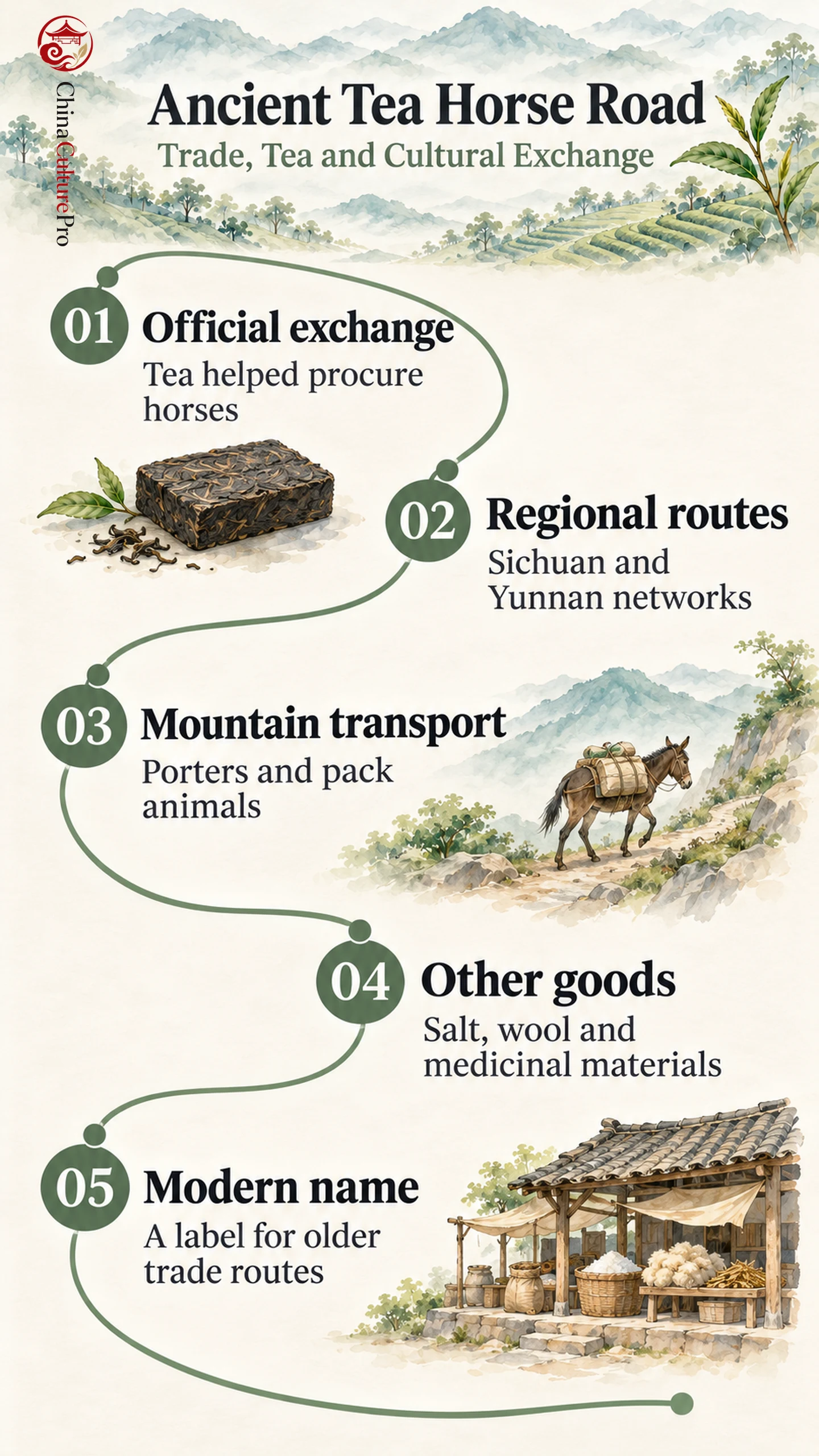
A parcel of tea leaving a Sichuan workshop might travel on a porter’s back before being loaded onto a pack animal. It could change hands in a mountain town, where traders arranged the next stage. Such journeys connect the history of tea with the history of work, transport and border trade in 中国 and neighboring regions.[2][3][5]
Why Tea and Horses Were Exchanged
During the Song dynasty, the government needed horses for military use. A program begun in Sichuan in the late eleventh century under Wang Anshi’s reforms used tea purchases and controlled trade to obtain horses from communities in the border regions. Paul J. Smith traces how the program initially acquired horses and made a profit. After the Song lost northern China to the Jurchen, changed markets and military conditions made the agency’s work harder. Smith argues that its later policies hurt Sichuan tea farmers and failed to meet horse quotas.[1]
Ming officials also used offices and regulated exchanges to manage frontier trade. The Oxford Research Encyclopedia describes a form of diplomatic exchange in which delegations presented horses and received tea as an imperial reward. These arrangements overlapped with practices associated with the Chinese tributary system. When demand for Tibetan horses changed under the 青(チン), tea continued to move in exchange for a wider range of goods.[2]
How the Sichuan and Yunnan Routes Differed
In western Sichuan, tea from the Ya’an (雅安, Yǎ’ān) area could reach Kangding (康定, Kāngdìng), historically known as Dartsedo. Songpan (松潘, Sōngpān) was another important distribution point farther north. Patrick Booz distinguishes routes used by traders from routes designated for official travel. Exchange in the region followed different paths over time as the importance of markets, official policy and transport geography changed.[2][3]
Farther south, Yunnan market towns served caravan routes of their own. Shaxi (沙溪, Shāxī) offers a specific example. Its market area included guesthouses, a temple district and a theater stage, as well as spaces for exchange. It shows how a caravan stop could combine trade, shelter and social activity. The surviving market and guesthouses record a Yunnan branch of caravan exchange, with different stops and links from those in western Sichuan.[2][4]
How Tea Moved Through the Mountains
Pressing tea into dense bricks made it easier to pack in regular loads. On some Sichuan stretches, porters carried tea to a transfer point. Animals such as mules or yaks could then carry loads on other legs. Steep paths and seasonal weather limited how people and goods could travel. The loading point and the mountain market were as much a part of transport as the path itself. Each helped people move a shipment from one stage to the next.[3][5]
Accounts from former porters show how a journey could involve long distances on foot. They describe wooden pack frames and T-shaped supports that let them rest a load without taking it off. These recollections belong to the later history of the routes. They offer direct evidence of how twentieth-century carriers worked, while Song records tell us about a different period of organization.[1][5]
What Trade Carried Beyond Tea and Horses
The routes supported trade in salt, wool, hides, medicinal materials and other goods. The balance changed by region and period. In parts of the borderlands, compressed border tea (边茶, biānchá) served as a commodity and sometimes as a means of exchange. Merchants also relied on people who could connect parties with different languages, contacts or access to markets.[2]
By the mid-eighteenth century, local innkeepers at Dartsedo brokered transactions between visiting tea merchants and Tibetan wholesalers. The market therefore depended on intermediaries as well as on carriers. This is part of the wider history of merchant networks. Tea was also a drink with uses beyond trade. In Tibetan settings it could be served to guests or offered in religious life, and butter tea is one way of preparing it.[2][6]
Why the Name Is Broader Than the Original Trade
Modern scholars began using the Ancient Tea Horse Road label around 1990. Song Shilei describes the term as extending the study of tea and horse trade into routes, local cultures and material heritage. Like the name Silk Road, it gathers many historical journeys into a broad frame. A tea office, a porter’s recollection and a surviving guesthouse each record a particular part of that wider history.[3][7]
FAQs About the Ancient Tea Horse Road
Was the Tea Horse Road one road?
It was a network of routes. Western Sichuan and Yunnan had different towns and mountain passages, and the routes people used shifted over time.
Did every load of tea pay for horses?
Some official exchanges procured horses. Other transactions exchanged tea for goods such as wool, hides and medicinal materials, with the mix changing over time.
How was tea carried on the Tea Horse Road?
Compressed tea could be packed into loads. On some routes porters carried it on foot, and pack animals carried it on other legs.
出典
[1] Paul J. Smith. Taxing Heaven’s Storehouse
[2] Oxford Research Encyclopedia of Asian History. The Sino-Tibetan Borderlands
[3] Patrick Booz. Trade Routes and Official Routes in Easternmost Kham
[4] World Monuments Fund. Shaxi Market Area
[5] National Geographic. The Forgotten Road
[6] China Culture. Tibetan Tea Culture
[7] Song Shilei. From Tea-Horse Trade to the Ancient Tea Horse Trail