


Quick Answer: What Is Suzhou Embroidery?
Suzhou embroidery, or Su embroidery (苏绣, Sūxiù), is a needlework tradition associated with Suzhou in Jiangsu. It includes detailed silk pictures, decorative textiles and work intended to be seen from both sides.[1][2]
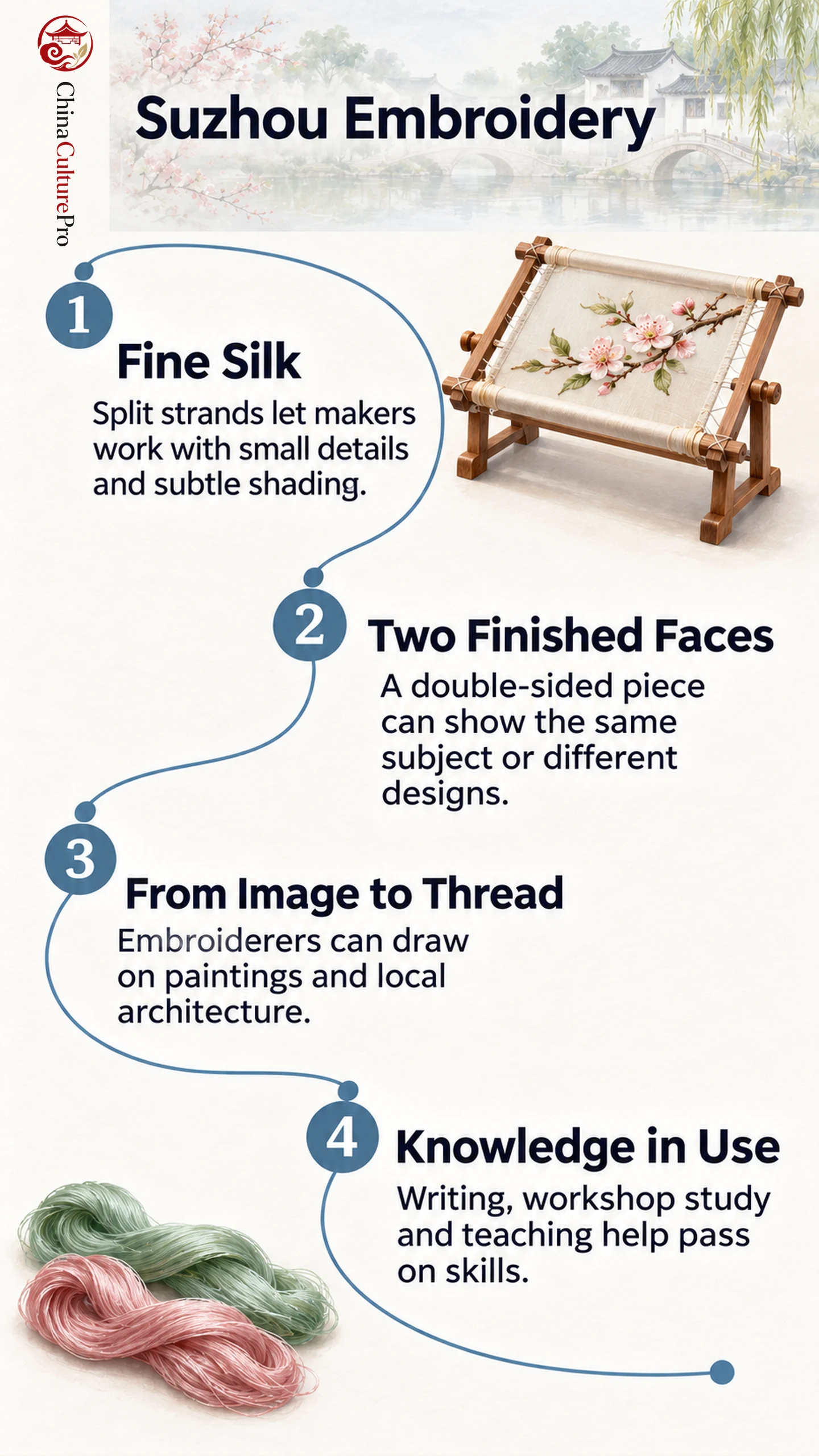
- Thread: Dividing silk can help a maker stitch fine outlines and subtle transitions.
- Surface: Stitch direction changes how light falls across a motif.
- Display: A double-sided piece is designed for both faces to be seen.
These are features of a broad repertoire. An individual piece may use only some of them.
On a silk flower, the narrow threads near a petal edge can be hard to see individually. The surface can look painted until the light shifts. That change helps explain what a needle can do with silk in Suzhou embroidery.
How Split Silk and Stitch Direction Create Shading
Makers use split silk (劈丝, pīsī) to work with strands finer than the original thread. Fine strands make it possible to place smaller stitches and bring adjacent colors closer together. A wider strand can cover more ground or give a stronger accent. The embroiderer can change strand thickness within a single image. A small color transition calls for a different treatment from a broad area of cloth.[1]
Notice whether the stitches follow the curve of a leaf or change direction at an edge. Silk reflects light differently across the surface as the angle changes. Direction and color work together. Try looking at the same petal from two angles. A light band that shifts as you move is a clue that thread direction and sheen help shape the image.[1]
In Chinese embroidery, the needle adds those details to a supporting cloth. In silk weaving, a pattern can instead form as threads interlace to make the cloth. Both can produce an intricate silk image.
Single-Sided and Double-Sided Su Embroidery
Double-sided embroidery (双面绣, shuāngmiànxiù) treats both faces as display surfaces. Turning the textile reveals another finished face. The maker has to consider where a thread starts, ends and travels because its path can show from either side.[1][5]
| Viewing format | What changes between faces |
|---|---|
| Single-sided display | One face is intended for viewing. The other may show the paths and ends of the threads. |
| Double-sided with one design | Both faces present a finished version of the same subject. |
| Double-sided with variations | The two faces may differ in color or design. |
When comparing two faces, check whether the difference is in the image, the colors or the angle at which the silk catches the light. A record or photograph of only one face cannot show how the reverse was finished.[1][5]
A robe provides a useful comparison with a two-sided display piece. The Smithsonian’s Suzhou embroidery teaching resource points to a Qing court robe worked on silk gauze. Its decoration is arranged for wear, where the visible surface wraps around the body. A freestanding screen has a different viewing problem because people can approach it from either side.[1][7]
From Painting Models to New Subjects
An embroidered landscape at the National Museum of China’s 2018 craft biennale credits Zhang Meifang (张美芳, Zhāng Měifāng) as the embroiderer and a painting by Wang Ximeng (王希孟, Wáng Xīmèng) as the model. The attribution separates the person who made the textile from the earlier artist. The finished textile measures 2.5 meters at its longest dimension. The scale gives the maker room to develop fine stitched details across a scene drawn from Chinese landscape painting into thread.[3]
A Suzhou exhibition in 2024 recorded another direction in Tang Xiaohong’s (汤晓红, Tāng Xiǎohóng) work. Her pieces drew on local rooflines, doors and brickwork. Some works also took their frame shapes from garden windows. The exhibition thus used Suzhou buildings for both the stitched subjects and the way the finished works were presented.[4]
How Suzhou Embroidery Is Recorded and Taught
The national entry documents Su embroidery across several periods. It records Ding Pei (丁佩, Dīng Pèi) writing on embroidery during the Daoguang reign and Shen Shou (沈寿, Shěn Shòu) developing lifelike effects in the late Qing and early Republican era. The writings complement surviving textiles. A stitched surface shows the effect a maker achieved, while a written account can describe the choices involved in achieving it.[2]
The inventory describes a Yuan-period fragment showing several stitch methods and Ming examples made from painting designs. These records help trace changes in technique and subject. They leave the starting date of the tradition open.[2]
The Suzhou local gazetteer traces the research institute to an embroidery group formed in 1954. Workshop research and training extended the practice alongside the study and reproduction of older pieces. Su embroidery entered China’s national intangible cultural heritage inventory in 2006.[2][6]
Teaching can take different forms. The local gazetteer describes an institute studying and reproducing earlier work, while the 2024 architecture exhibition paired finished pieces with opportunities for visitors to try the craft. A brief encounter with the materials and sustained workshop training serve different purposes.[4][6]
The name also appears among the four famous regional embroidery traditions. To identify an individual work, read the maker, date, textile and display details in its collection record.
FAQs About Suzhou Embroidery
Is Suzhou embroidery always double-sided?
Suzhou work can be made for one face or for viewing from both sides. The viewing format depends on the piece.
Why does Suzhou embroidery sometimes look painted?
Fine strands allow small changes in shade and stitch direction. From a distance these changes can blend into a continuous-looking image.
Do both faces have to show the same image?
Some pieces present the same subject on both faces. Other double-sided work can vary the colors or the design.
Can a landscape motif prove a piece was made in Suzhou?
Landscapes are among the documented subjects, but motif alone is insufficient. A maker’s name, workshop, date or other record helps support the attribution.
出典
[1] Smithsonian National Museum of Asian Art. Suzhou Embroidery
[2] China Intangible Cultural Heritage Digital Museum. Su Embroidery
[3] National Museum of China. 2018 Chinese Contemporary Arts and Crafts Biennale
[4] Suzhou Housing and Urban-Rural Development Bureau. Suzhou Embroidery and Architecture Exhibition
[5] Suzhou Municipal Government. Suzhou Crafts at the China National Arts and Crafts Museum
[6] Suzhou Local Gazetteer Office. Historic Suzhou Craft Workshops
[7] Smithsonian National Museum of Asian Art. Summer chaofu (formal court dress) for a top-rank prince