


Quick Answer: What Is Traditional Chinese Bookbinding?
Traditional Chinese bookbinding includes rolled and folded strips, pasted bindings and sewn books. In thread binding (线装, xiànzhuāng), stitches pass through holes near one edge of the stacked leaves. The folds of the individual leaves sit opposite the sewing.[1][2][3]
- Continuous strip: A scroll (卷轴装, juànzhóuzhuāng) rolls up. An accordion (经折装, jīngzhézhuāng) opens along repeated folds.
- Pasted spine: Butterfly (蝴蝶装, húdiézhuāng) and wrapped-back (包背装, bāobèizhuāng) books differ in where the folded edges sit.
- Exposed thread: Look for stitches near the spine of a side-sewn book.
The binding describes how the pages are held and opened. The text can be handwritten or printed.
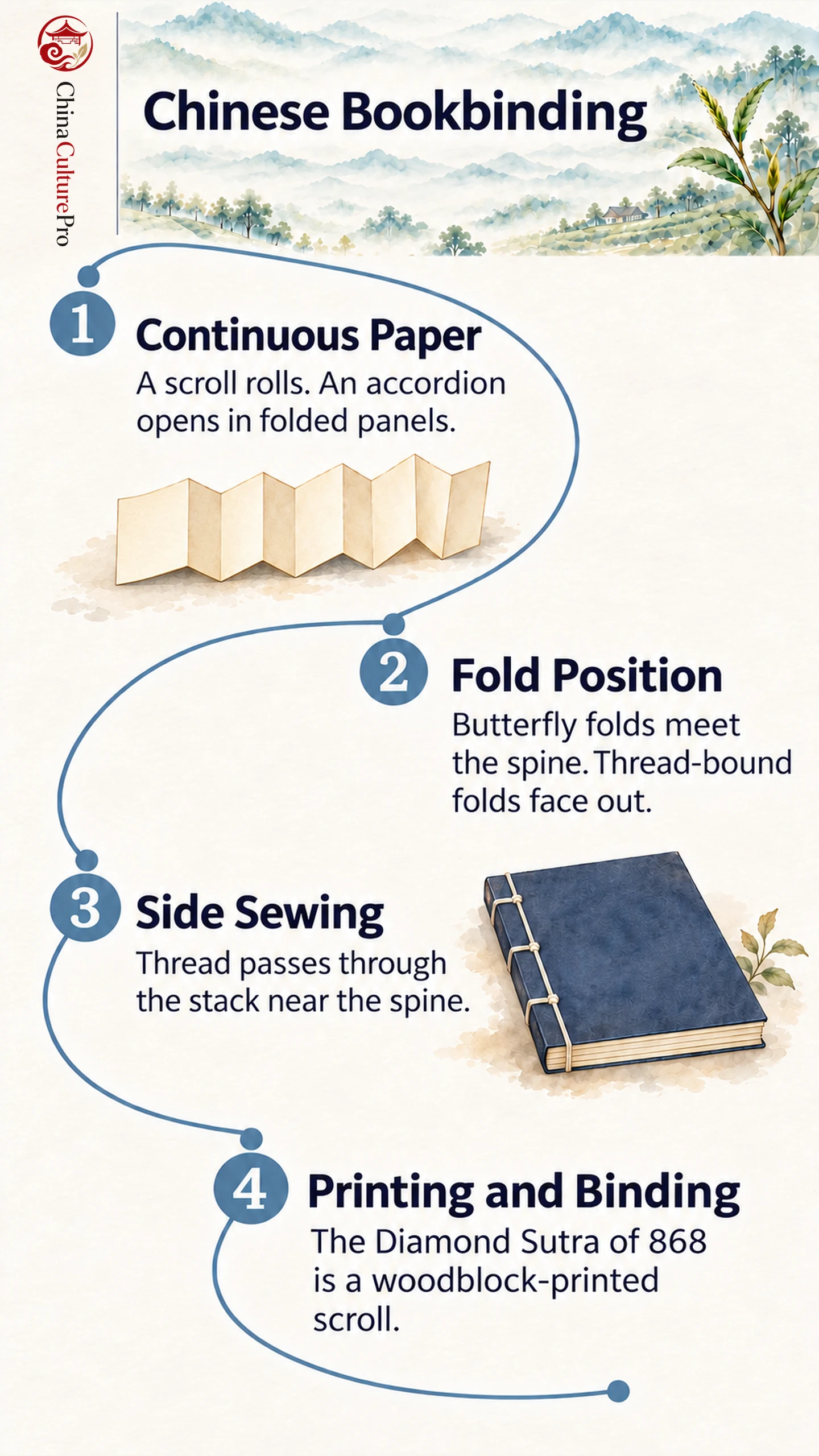
A photograph of an old Chinese book can make several bindings look alike. First follow the paper to see whether it opens as a continuous strip or in separate leaves. In a bound stack, check whether the folds meet at the spine or at the outer edge.
How to Tell the Main Formats Apart
| Format | Construction | 見分けるポイント |
|---|---|---|
| Scroll (卷轴装, juànzhóuzhuāng) | A strip joined from sheets can be wound onto a roller. | A long reading surface opens a section at a time. |
| Accordion (经折装, jīngzhézhuāng) | A continuous strip folds in alternating directions. | The folds form a stack of connected panels. |
| Butterfly (蝴蝶装, húdiézhuāng) | Individual sheets fold with the printed faces inward. Folded edges are pasted at the spine. | An open printed sheet spreads out from the center crease. |
| Wrapped-back (包背装, bāobèizhuāng) | Individual sheets fold with the printed faces outward. A cover wraps around the spine. | The folded edges face out and the continuous cover hides the spine. |
| Thread-bound | The sheets also fold with the printed faces outward. Thread secures the stack and separate covers. | Stitching appears near the spine on the front and back. |
The accordion and butterfly formats are easy to confuse in photographs of an open book. Follow the paper across successive openings. The accordion is one continuous folded strip. The butterfly book is a stack of separate folded sheets attached at their creases.[2][5]
Multiple structures survive in collections. The Dunhuang materials include some additional formats beyond these five. They are best read as evidence of ways people assembled and used texts, alongside the history of papermaking in China.[5]
Thread-Bound Books: Folded Leaves and Side Sewing
A sheet can carry two page faces printed on one side. Folding it with the text outward exposes both page faces and hides the blank side inside. The fold becomes part of the fore-edge (书口, shūkǒu), the edge where the reader opens the book. The two loose edges of each folded sheet sit at the spine, alongside those of the other leaves.[2][3]
The sewing holes go through the stack near that spine. The Bodleian conservation account shows how paper twists inserted through inner holes often hold the leaves together before separate covers are sewn on. Its conservators also found slim examples held together by the outside thread alone. The familiar exterior can conceal different internal constructions.[3]
A work could be divided among several separately sewn volumes, often called fascicles. One conserved Bodleian work has four fascicles associated with a single wrapper. In a catalogue, the wrapper, an individual volume and the full work are different units of description.[3]
What Binding Can Tell You About an Edition
The British Library’s Chinese Diamond Sutra dated 868 shows why print and binding need separate descriptions. Its text and frontispiece were made by woodblock printing on seven sheets joined into a scroll. The text has a dated colophon. The scroll is the format in which the printed sheets were assembled.[4]
For a sewn example, read the catalogue for dates and for notes about the cover, paper and sewing. A replacement cover can belong to a different stage of the object’s life from the leaves it protects. Some earlier structures survive only in particular collections or fragments. The broader history of Chinese printing helps put a method in context. To date an individual edition, look for evidence specific to that copy.[3][5]
The National Library of China also treats binding as a practical skill passed on in its workshops. In 2021, its traditional bookbinding techniques entered the national inventory of intangible cultural heritage in a listing that encompasses the use of traditional tools and materials across multiple formats.[1]
FAQs About Traditional Chinese Bookbinding
Is every traditional Chinese book thread-bound?
Thread sewing is one format among several. Scrolls roll up, accordion bindings fold continuously, and butterfly and wrapped-back examples attach the sheets differently.
Why are the pages folded at the outer edge?
With the printed sides facing out, a folded sheet puts two printed pages where the reader can see them and keeps its blank surface inside.
Is a woodblock-printed book always thread-bound?
Woodblock printing describes how the image or text reaches the paper. The 868 Diamond Sutra is a woodblock print in scroll format.
Can a cover date the printing?
A cover can help describe the surviving object. The dating of the text and the printing relies on other evidence as well, such as a dated colophon or a catalogue record.
出典
[1] China Ministry of Culture and Tourism, reporting from the National Library of China. Traditional Bookbinding Techniques Enter the National Heritage Inventory
[2] National Library of China. Rules for the Description of Ancient Books
[3] Bodleian Libraries. Conservation of Chinese Books
[4] British Library, International Dunhuang Programme. The Diamond Sutra
[5] Cheng Yu Tung East Asian Library, University of Toronto. The History of Chinese Bookbinding