

Quick Answer: What Is Chinese Stone Carving?
Stone carving (石雕, shídiāo) covers work on many kinds of stone, from small carved seals to figures and panels made for buildings. The stone itself, the depth of the cuts and the intended use all shape the work.[1][2][4][6]
- Material: Color, texture and the strength of the unworked piece influence the design.
- Shape: A design can project from a backing, stand on its own or have openings cut through it.
- Setting: A seal can be turned in the hand. A cliff figure is read from its site.
Start by asking what the stone was intended to do and where someone would see it.
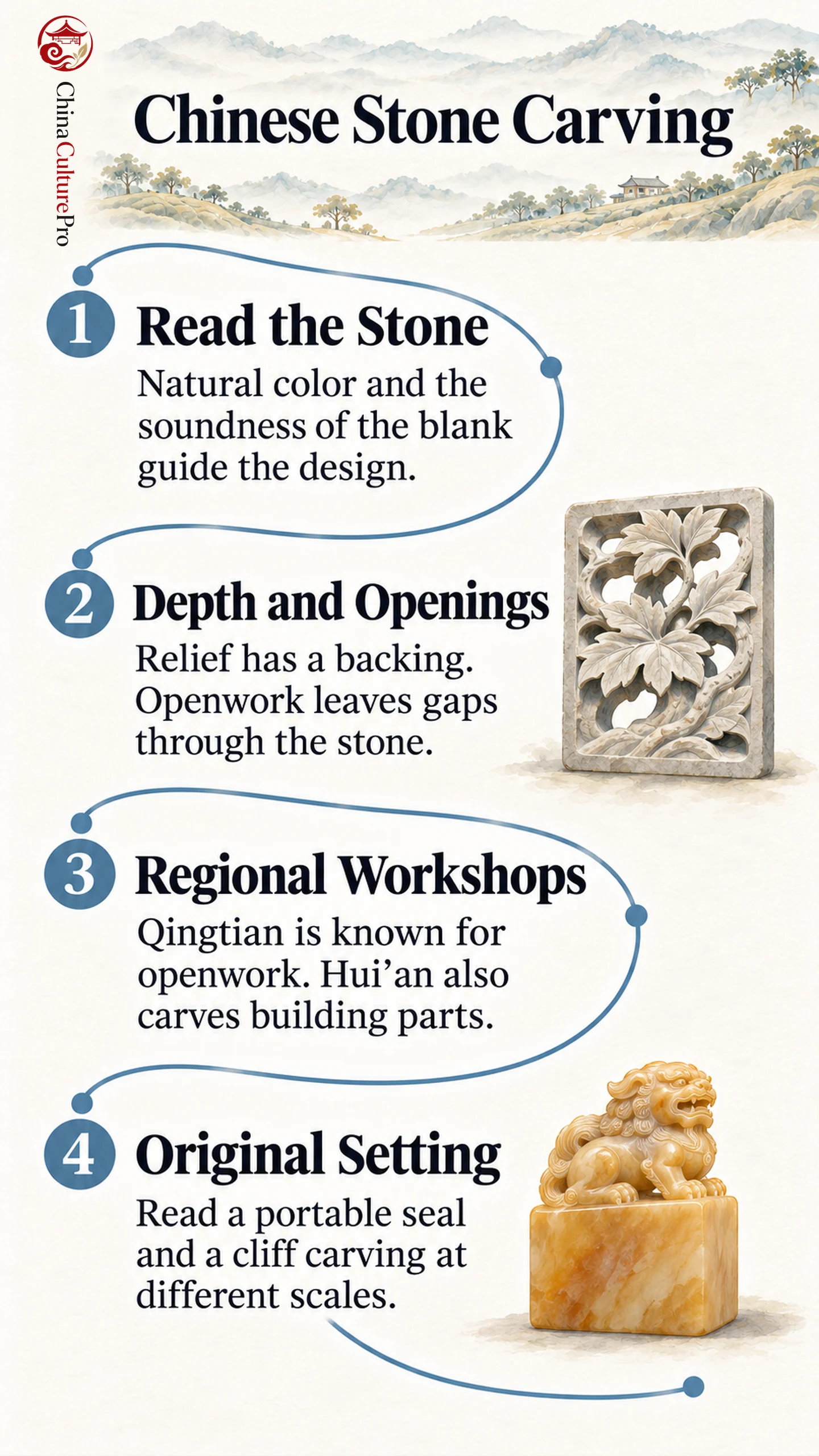
A small seal and a large temple carving reward the same first look. Check what the maker left standing, where the stone opens into a gap, and whether a patch of natural color has become part of the design.
How Stone Shapes a Workshop’s Choices
In Qingtian and Shoushan workshop records, examining the stone (相石, xiàngshí) comes before the final shape is established. A carver considers where there is enough sound material to hold a projection, and which part of a blank might suit a face, stem or cloud. A vein or change of color can determine where a motif sits.[1][2][3]
Roughing out removes the larger masses and establishes the silhouette. Finer cuts define edges and surface details. A workshop may then smooth or polish selected areas. The Qingtian record includes waxing among its processes. The Shoushan account describes successive roughing, refinement and finishing stages. The details of the finish depend on the material and the intended appearance.[1][3]
Stone names can refer to a local source, a category used in a workshop or a particular material. “Stone carving” is the umbrella. The techniques discussed in Chinese jade carving apply to their own materials, while carvers in other traditions work local stones with different properties.
Relief, Openwork and Carving in the Round
| Technique | What is shaped | Clue to look for |
|---|---|---|
| Carving in the round (圆雕, yuándiāo) | The figure has volume on several sides. | Look for modeled sides and back. |
| Relief (浮雕, fúdiāo) | A design projects from a background that stays attached. | A shadow can reveal how far it rises from the backing. |
| Openwork (镂雕, lòudiāo) | The maker removes stone through part of the piece. | Light passes through a gap in the carving. |
| Incised line | The design sinks into the stone surface. | A groove holds the line below the surrounding surface. |
One carving can combine several methods. A figure may have rounded modeling and cut-through spaces between branches. A slab can carry shallow relief alongside recessed letters. The Hui’an and Qingtian records both describe workshops using more than one method.[1][4]
Regional Workshops and Their Forms
Qingtian, in Zhejiang, is associated with a local carving stone rich in pyrophyllite. Its heritage entry describes using differences in natural color as part of a composition and identifies openwork as a strength. The same regional material can serve as a seal blank or as a larger sculptural subject.[1]
Shoushan stone carving in Fuzhou includes small works intended for close viewing. A Palace Museum example shows what a compact piece can contain. Three seals associated with the Qianlong emperor and the links that connect them were all carved from one piece of tianhuang stone. The seals can stamp an impression. The chain lets the three bodies move while keeping them linked. The guide to Chinese seal carving explains the role of the face that takes the impression.[2][5]
Hui’an, in Fujian, is known for hard local stone and architectural work. Its heritage entry also records garden sculpture, steles, small craft objects and vessels. When a carving is a building component, its position in temple architecture can matter as much as the figure or motif. A pattern seen low on a wall is encountered differently from one viewed above a doorway.[4]
Reading a Carving in Its Original Setting
At the Longmen Grottoes near Luoyang, Buddhist caves and niches were carved into limestone cliffs. Much of the work dates to the late Northern Wei through the Tang period. A figure seen within a cliff niche belongs to a specific spatial and religious arrangement. A close photograph can show its chisel work while leaving that larger arrangement out of frame.[6]
An inscription gives a different kind of evidence. A paper impression can make recessed characters easier to study, as the guide to Chinese stone rubbings explains. The impression and the carved surface are distinct objects. Look for records that describe the site or workshop separately. The guide to Chinese intangible cultural heritage describes how living craft skills are documented separately from monuments.
FAQs About Chinese Stone Carving
Is every Chinese stone carving made of jade?
Chinese carvers work with many materials. Examples include limestone cliffs at Longmen, Qingtian carving stone and the hard stone used in Hui’an workshops.
What is the difference between relief and openwork?
Relief keeps a background behind the design. Openwork removes stone all the way through selected areas. A single piece can use both.
Do stone carvers always polish the whole surface?
Workshops can vary the finish. A carver may smooth selected parts and leave others with a different texture to separate features.
Is a stone rubbing the same object as a carving?
A rubbing is an impression made from a carved surface. The carving is the physical source of the impression.
出典
[1] China Intangible Cultural Heritage Digital Museum. Qingtian Stone Carving
[2] China Intangible Cultural Heritage Digital Museum. Shoushan Stone Carving
[3] Fuzhou Municipal People’s Congress. Rules for Safeguarding Fuzhou Shoushan Stone Carving
[4] China Intangible Cultural Heritage Digital Museum. Hui’an Stone Carving
[5] The Palace Museum. The Qianlong Emperor’s Three Linked Tianhuang Seals
[6] UNESCO World Heritage Centre. Longmen Grottoes