


Quick Answer: What Keeps Living Heritage Alive?
Safeguarding intangible cultural heritage (非物质文化遗产, fēi wùzhì wénhuà yíchǎn) means supporting the people who practice it and the conditions that let them pass it on. Teaching, recording and continued use all serve different purposes.[1][6]
- Apprenticeships: Learners practice under people who can demonstrate and correct the work.
- Communities: Practitioners help decide what should continue and how.
- Records: Interviews and demonstrations can retain details for later use.
Ask who still uses the practice, who is learning it and what they need to keep going.
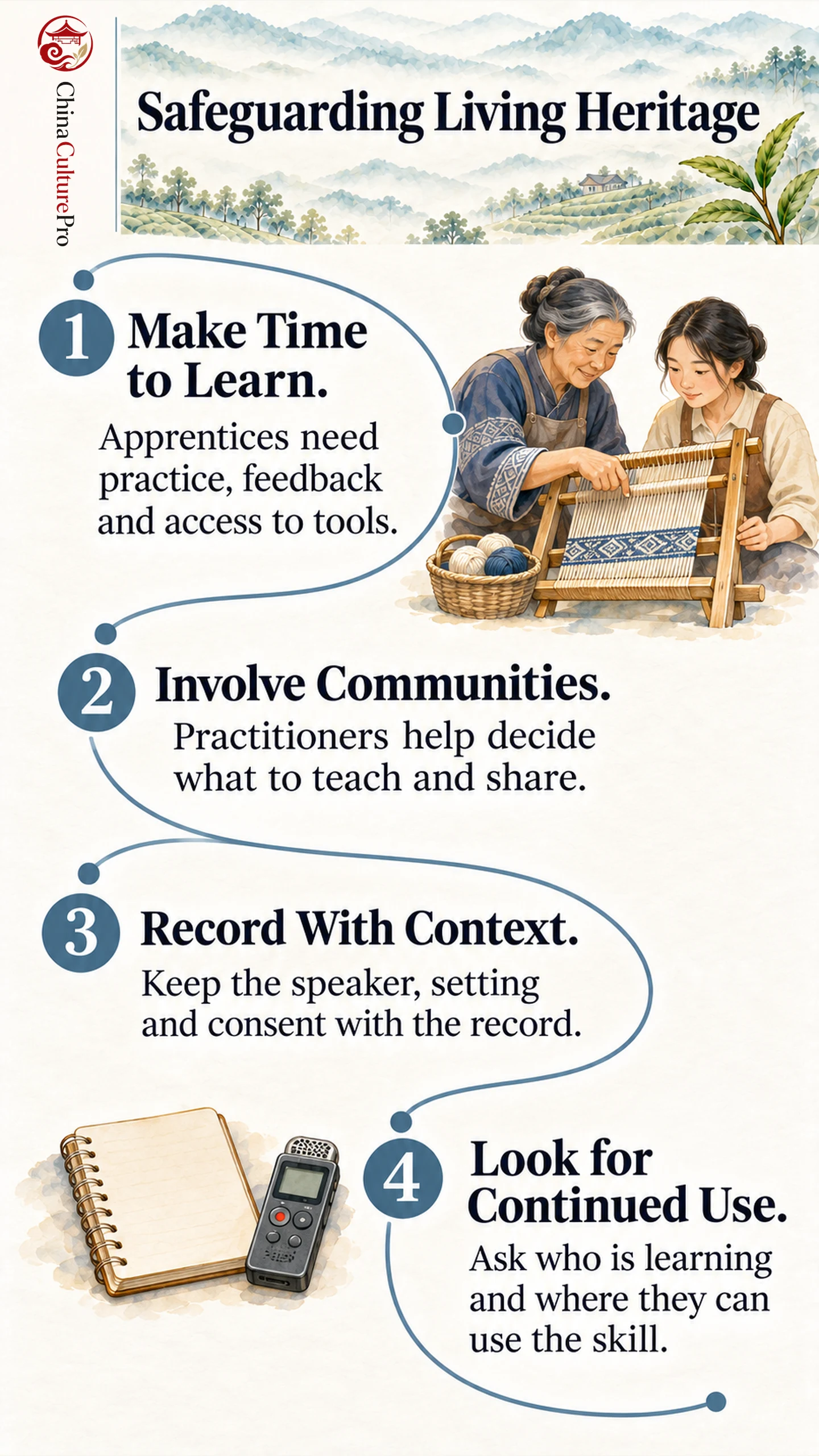
A loom in a museum and a video of a storyteller preserve different kinds of evidence. A person learning to weave or tell the story needs time, guidance and a setting in which the skill can be used again.
Apprenticeships and the Conditions for Practice
Some knowledge is hard to capture in words. A textile apprentice may learn to notice a change in tension. A storyteller may learn when to pause or shift cadence. A teacher can recognize the error and show what to adjust. That repeated exchange is part of the practice itself. Workshops also need access to tools, materials and places to work.[1][6]
In Hainan, the UNESCO review of Li textile techniques describes training in skills such as spinning, plant dyeing and weaving. It also notes that cooperatives and enterprises have helped sustain livelihoods. Learning the steps matters, and practitioners need ways to keep using them after a course ends.[2]
The review of wooden movable-type printing notes support for bearers to teach apprentices and for educational facilities. In printing, a learner needs practice across linked tasks. Carving a character and carrying a prepared text through to a bound book involve different skills.[4]
Communities, Schools and Shared Decisions
Article 15 of UNESCO’s 2003 Convention calls for broad participation and an active role for communities, groups and individuals who keep the heritage in use. That role can include deciding who should teach, which parts of a practice are appropriate to share and where learners can continue beyond an introductory session.[1][6]
The programme for Hezhen Yimakan storytelling has involved families, communities, schools and authorities. UNESCO describes school participation as a way to involve more young people and support the transmission of the Hezhen language. The programme also widened participation by women. Learning to tell the story also gives learners a setting in which to use the language.[3]
The balance of roles differs across practices. In the Regong arts learning can happen with family members, in apprenticeships and within monasteries. The setting shapes what a learner can see, practice and understand.
What Good Documentation Can Preserve
China’s programme for recording representative bearers combines oral histories, recordings of practice and teaching, and existing materials such as manuscripts, images and earlier recordings. A dated interview can preserve the practitioner’s account of how they learned. A close recording of a task can show how their hands move. A teaching session can capture how they correct a learner.[5]
Context makes recordings usable. An interview log can name the speaker and interviewer, place, date and topic. Related photographs and documents can help a later reader understand what is being described. UNESCO’s ethical principles also give the communities involved the primary role and call for informed consent and respect for customary access. Permission to record and permission to share should be discussed separately.[6][7]
How to Read a Safeguarding Outcome
A safeguarding outcome can be a new opportunity to use a skill, a stable group of learners or a programme that supports a language alongside a performance. The UNESCO decision on Li textiles transferred the element to the Representative List in 2024. The decision noted wider transmission and called for continued attention to the knowledge carried in textile motifs.[2]
In 2025 UNESCO selected the Yimakan safeguarding programme for the Register of Good Safeguarding Practices. The subject of that entry is a programme of work. The guide to Chinese intangible cultural heritage explains how the register and the lists have different purposes. To understand the outcome, read what the programme changed and who can take part now.[1][3]
FAQs About Protecting Chinese Living Heritage
Does a UNESCO listing safeguard a practice by itself?
A listing can draw attention to a practice and record commitments. Continued learning, resources and opportunities to use the skill sustain it.
Can a video replace an apprenticeship?
A recording can preserve detail and support teaching. Apprenticeships also provide practice and direct feedback in the situations where the skill is used.
Can a practice change and still be living heritage?
Yes. Communities can adapt a practice to different settings as they continue to recognize, use and transmit it.
Should all heritage recordings be public?
Access can vary. The people involved may allow recording for a limited purpose, or keep certain knowledge within customary settings.
出典
[1] UNESCO. Basic Texts of the 2003 Convention
[2] UNESCO Intergovernmental Committee. Decision 19.COM 7.c.1: Traditional Li Textile Techniques
[3] UNESCO. Safeguarding Programme for Hezhen Yimakan Storytelling
[4] UNESCO Intergovernmental Committee. Decision 18.COM 7.a.13: Wooden Movable-Type Printing of China
[5] China Intangible Cultural Heritage Digital Museum. Recording National-Level Representative Bearers
[6] UNESCO. Ethical Principles for Safeguarding Intangible Cultural Heritage
[7] Song Benrong, China Intangible Cultural Heritage Digital Museum. Oral History in the Recording of Representative Heritage Bearers