

Quick Answer: Who Was Sun Bin?
Sun Bin (孙膑, Sūn Bìn) was a fourth-century BCE military adviser associated with the state of Qi. The early biography connects him with campaigns against Wei. A distinct military text, Sun Bin Bingfa (孙膑兵法, Sūn Bìn Bīngfǎ), survives in excavated fragments.[1][2][3]
- Role: Early history places him alongside a Qi field commander.
- Manuscript: Western Han bamboo slips excavated at Yinqueshan (银雀山, Yínquèshān) preserve part of the text attributed to him.
- Name: Sun Wu (孙武, Sūn Wǔ) is associated with the more familiar Art of War.
Use the biography for the campaign tradition and the slips for the history of the military text.
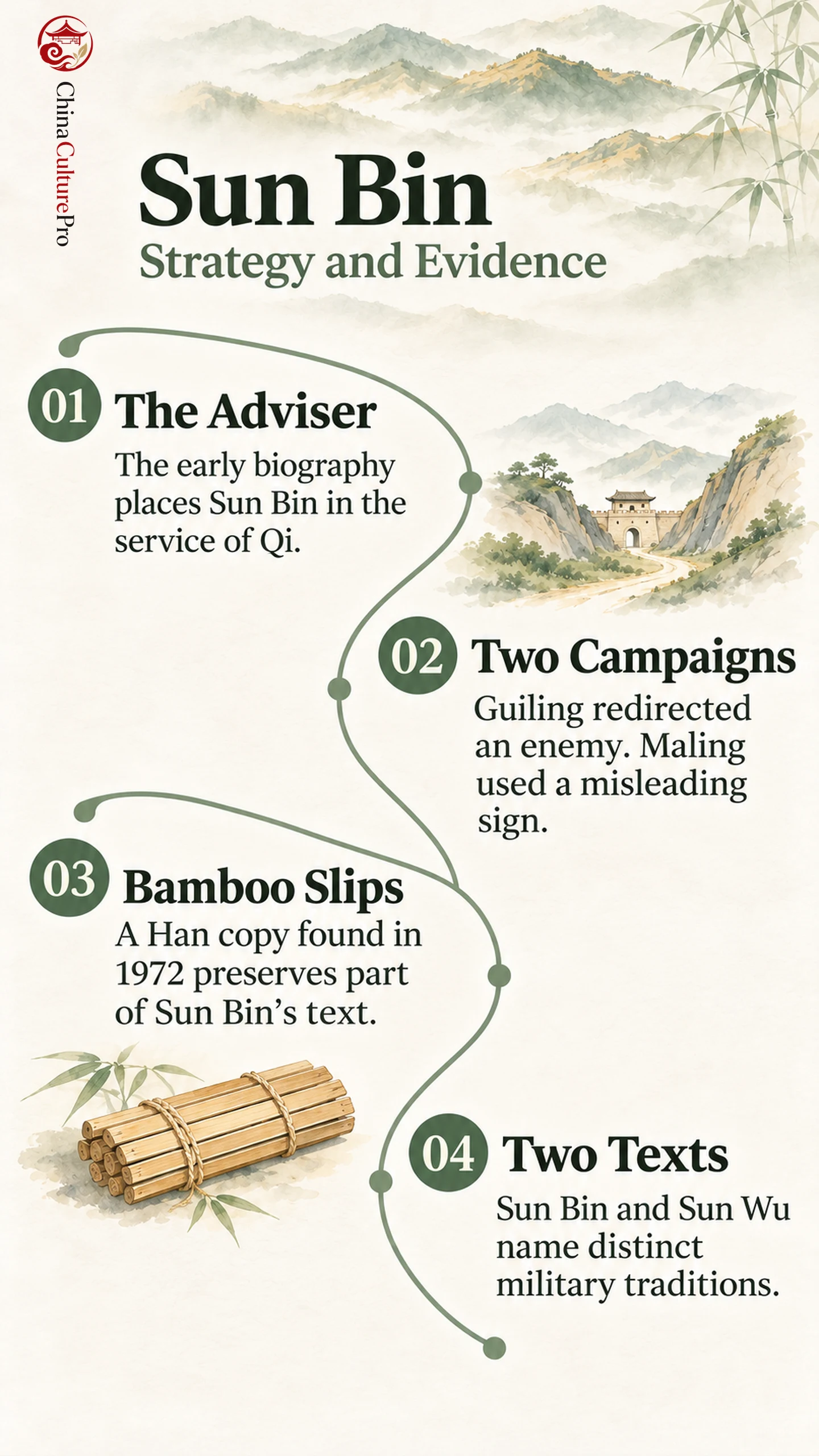
Sun Bin is remembered both as a strategist in a historical narrative and as the name attached to a military text on bamboo. Those two records answer different questions. The first describes how the adviser acted. The second lets readers compare what ancient manuscripts actually preserve.
What Sima Qian Records About His Life
The Records of the Grand Historian places Sun Bin in the later world of the Warring States period. Its story begins with his rivalry with Pang Juan (庞涓, Páng Juān), a commander in Wei. It attributes to Pang a scheme that led to Sun Bin’s punishment and disfigurement. The biography was compiled long after the events and describes what the punishment did in broad terms. Its wording cannot settle the precise anatomy of the injury.[1]
According to the account, Sun Bin reached Qi with the help of an envoy and came into the service of Tian Ji (田忌, Tián Jì). The biography illustrates his judgment with a horse-racing episode. Sun Bin changes which horses face each other so that accepting one loss can produce two wins. The result depends on which races Tian Ji chooses to contest with his strongest horses. The story introduces the kind of comparative reasoning the chapter later attributes to him in war.[1]
Guiling and Maling in the Campaign Tradition
In the Guiling (桂陵, Guìlíng) narrative, Wei attacks Zhao and Qi intervenes. Tian Ji commands the Qi force, with Sun Bin advising. Instead of heading straight into the fighting around Zhao, Sun Bin proposes threatening the Wei center and forcing the opposing army to return. The account describes a choice about where to apply pressure to change the enemy’s priorities.[1]
The later Maling (马陵, Mǎlíng) episode turns on the reading of signs. The biography says that Qi troops prepared fewer cooking hearths on successive days, leading Pang Juan to believe that Qi troops were deserting. A rapid pursuit then exposed his force to an ambush. Maling appears in several parts of the history, while the details of the fires and final confrontation belong to a particular narrative of the battle.[1][4]
The two stories make different choices intelligible. At Guiling, a threat to a different place draws the enemy away. At Maling, a misleading sign changes the pace of pursuit. Keeping those mechanisms separate helps readers recognize what each story is trying to explain without assuming the historian witnessed its details.[1]
The Bamboo Slips Found at Yinqueshan
In 1972, excavators found Western Han bamboo slips at Yinqueshan in Linyi, Shandong. The collection now held by the Shandong Museum includes writings identified with both Sun Wu’s and Sun Bin’s military traditions. The discovery provides a physical witness to separate works that readers might otherwise conflate because of their similar English titles.[2][3]
The date of a manuscript tells us when a particular copy existed. A copy can preserve material composed earlier, so the Western Han burial does not make Sun Bin a Han-era adviser. Nor does the archaeological find by itself tell us who wrote each passage or when its ideas first circulated. The excavation date is a third and much later point on that timeline.[2][4]
The slips are incomplete. Editors join fragments, propose their order and distinguish material that can be assigned to the text from material whose assignment is uncertain. When comparing translations, check how they mark gaps and possible attachments before treating their chapter counts as evidence of a complete ancient edition.[3]
How Sun Bin Differs From Sun Wu
Sima Qian’s chapter treats Sun Wu and Sun Bin as separate figures and places Sun Bin later. It also presents them as members of one line of descent. That is a genealogical claim in the biography. The separate texts found in the tomb support a distinction between works and their transmission, while the family relationship rests on different evidence.[1][2][4]
Use the name of the text to avoid ambiguity. The title The Art of War usually refers to the received classic associated with Sun Tzu, conventionally identified as Sun Wu. When a book refers to Sun Bin’s military methods or uses Art of War with his name attached, check the introduction for its account of the Yinqueshan slips and the edition it follows.[2][3][4]
FAQs About Sun Bin
Was Sun Bin the author of The Art of War?
The familiar classic is associated with Sun Wu. Sun Bin’s name is attached to a separate military work preserved in excavated fragments. English titles sometimes use “Art of War” for both.
Did Sun Bin lose his kneecaps?
The early biography describes a disabling punishment to his lower limbs and tattooing. Exact anatomical accounts go beyond what can be established securely from the transmitted episode.
What did the Yinqueshan excavation establish?
It recovered early manuscript witnesses to two distinct military works. Sun Bin’s text survives in incomplete form, with some fragments harder to assign than others.
出典
[1] Sima Qian, Records of the Grand Historian, chapter 65. Biographies of the Masters Sun and Wu Qi
[2] China Daily cultural portal, with Shandong Museum collection information. Bamboo slips chronicle China’s ancient military philosophy
[3] ChinaCulture.org. Sun Bin Art of War
[4] Victor H. Mair, Sino-Platonic Papers. Soldierly Methods: Vade Mecum for an Iconoclastic Translation of Sun Zi bingfa