

Quick Answer: Who Was Hai Rui?
Hai Rui (海瑞, Hǎi Ruì, 1514–1587) was a Ming dynasty (明, Míng) official known for opposing corruption and criticizing Emperor Jiajing (嘉靖, Jiājìng).[1]
- Challenge to the emperor: Hai submitted the Memorial on Governance (治安疏, Zhì’ān Shū) in 1566.[2][3]
- Local government: In Yingtian (应天, Yìngtiān), he organized river work and challenged large landholders.[5]
- Later reputation: A twentieth-century opera made him the central figure in a new controversy.[7][8]
The record of Hai’s career explains why he became a model of official integrity and why his methods drew opposition.
Hai grew up in Qiongshan (琼山, Qióngshān) on Hainan Island and passed the provincial stage of the imperial examinations in 1549.[1] He served as a county magistrate in Chun’an (淳安, Chún’ān) before taking a post in the Ministry of Revenue.[5]
Why Hai Rui Wrote to Emperor Jiajing
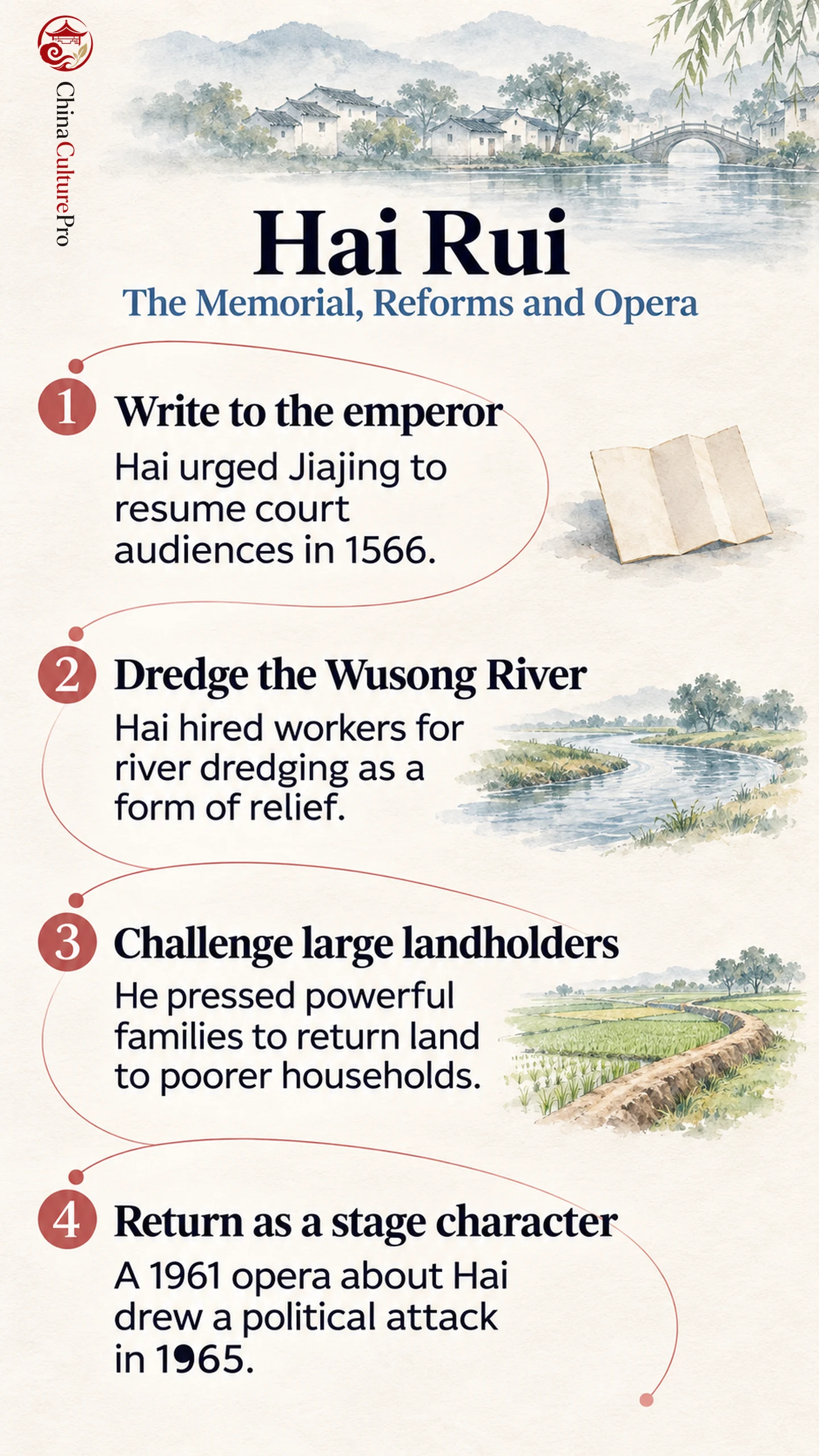
A memorial was a formal communication to the throne. Hai used his to argue that the emperor could only learn how people were faring if his officials were willing to speak frankly. In Hai’s view, those who flattered Jiajing shared responsibility for the problems the emperor failed to see. He urged Jiajing to return to regular court audiences and give up rites intended to prolong his life. He pointed out that Tao Zhongwen (陶仲文, Táo Zhòngwén), whose guidance the emperor had followed, was himself dead.[3]
The History of Ming records a palace eunuch telling Jiajing that Hai had bought a coffin in anticipation of his death.[4] Hai was imprisoned and was released after Emperor Longqing (隆庆, Lóngqìng) succeeded Jiajing.[9]
Land and River Work in Yingtian
In 1569 Hai became the regional governor of Yingtian, a jurisdiction covering prefectures in the lower Yangtze region. He hired workers to dredge the Wusong River (吴淞江, Wúsōng Jiāng), using paid labor as a form of relief. He pressed powerful families to return land acquired from poorer households. His scrutiny extended to Xu Jie (徐阶, Xú Jiē), a former grand secretary who had retired to the area.[5]
Hai’s aggressive methods prompted complaints. The History of Ming reports that some people made false accusations to take advantage of his campaign. After about six months as governor, he was transferred to grain administration.[4] He requested retirement and went home in 1570.[5]
From Ming Official to Stage Character
After years in retirement, Hai was recalled in 1585 under Emperor Wanli (万历, Wànlì).[5]
He died as censor-in-chief at Nanjing (南京, Nánjīng) in 1587.[6] Folk tales about his rulings carried his reputation for impartiality beyond the historical records.[1]
Historian Wu Han (吴晗, Wú Hán) wrote Hai Rui Dismissed from Office (海瑞罢官, Hǎi Ruì Bàguān), a Peking opera performed in 1961.[7] In November 1965, Yao Wenyuan (姚文元, Yáo Wényuán) attacked the play in a Shanghai newspaper. The dispute over the opera became one of the opening episodes of the Cultural Revolution.[8]
FAQs About Hai Rui
Was Hai Rui executed for criticizing the emperor?
Hai survived his imprisonment. The Ministry of Punishments proposed a death sentence, which the emperor left unresolved. The new emperor’s accession led to Hai’s release in early 1567.[4][9]
Did Hai Rui and Bao Zheng live in the same dynasty?
Hai served the Ming. Bao Zheng (包拯, Bāo Zhěng) served the Northern Song (北宋, Běi Sòng) in the eleventh century.[10]
Why do some English sources call him Hai Jui?
Hai Jui is an older romanization of the same name. Historian Ray Huang uses that spelling in his chapter about Hai’s career.[6]
出典
[1] Berkshire Encyclopedia of China. Hai Rui
[2] Ming court historians. Veritable Records of Emperor Shizong, volume 555, Jiajing 45, second month
[3] Hai Rui. Memorial on Governance
[4] Zhang Tingyu and others. History of Ming, volume 226, Hai Rui biography
[5] The Palace Museum. Hai Rui, Palace Figures
[6] Ray Huang. Hai Jui, the Eccentric Model Official, 1587, A Year of No Significance
[7] Lennet Daigle. Ethical Exemplarity and Historical Hermeneutics in the Early PRC, chapter III
[8] Jiaqi Yan and Gao Gao. Criticizing Hai Rui Dismissed from Office, Turbulent Decade
[9] Encyclopedia of World Biography. Hai Rui
[10] Berkshire Encyclopedia of China. Bao Zheng