


Quick Answer: Who Was Du Ruhui?
Du Ruhui (杜如晦, Dù Rúhuì, 585–630) was an early 唐 (唐, Táng) official and adviser to Li Shimin (李世民, Lǐ Shìmín), who became Emperor Taizong (太宗, Tàizōng). As chancellor, he helped supervise government with Fang Xuanling (房玄龄, Fáng Xuánlíng).[2][6]
- Military adviser: Du worked on campaign plans in Li Shimin’s staff.[1]
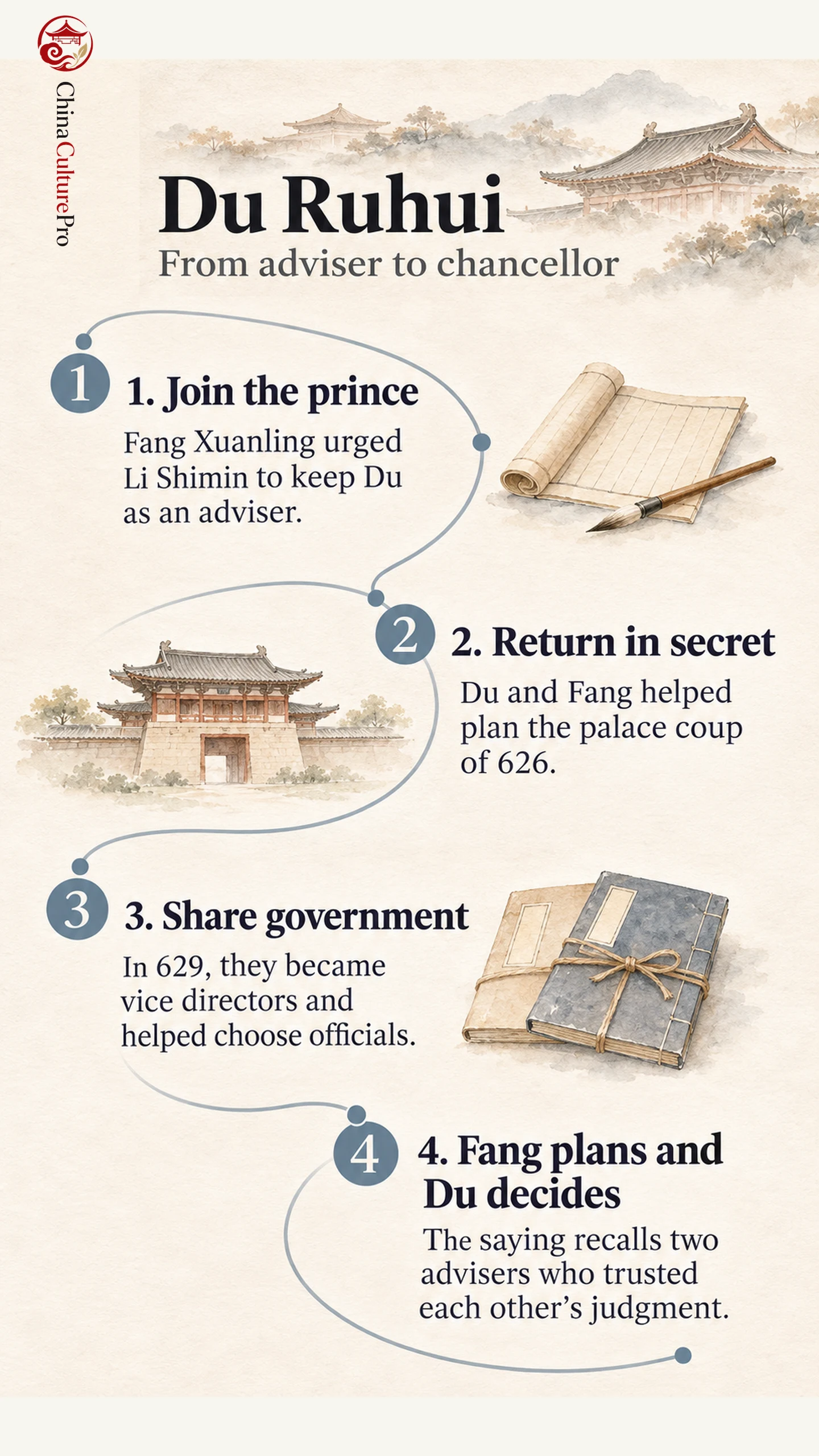
- Political ally: He and Fang returned in secret to help plan the palace coup.[1]
- Chancellor: Du helped manage appointments and the organization of the early Tang administration.[2]
His career shows how a prince’s advisers moved from planning campaigns to running the central government.
The relationship between Du and Fang began with a recommendation. It grew into a partnership that made recruitment as important a task as advising the emperor.
How Du Joined the Prince of Qin’s Staff
After a county post in the late Sui dynasty (隋, Suí), Du joined Li Shimin, the Prince of Qin (秦王, Qín Wáng). The Old Book of Tang (旧唐书, Jiù Tángshū) says Fang intervened when Du was reassigned, arguing that the prince would need Du if he aimed to extend his power.[1]
On campaign, Du took part in confidential deliberations. The New Book of Tang (新唐书, Xīn Tángshū) emphasizes his ability to reach decisions under pressure.[2]
Du Ruhui and the Xuanwu Gate Coup
Du and Fang had lost their posts before the Xuanwu Gate (玄武门, Xuánwǔ Mén) coup of 626. The Zizhi Tongjian (资治通鉴, Zīzhì Tōngjiàn) describes them returning disguised as Daoist priests to join the planning. Li Shimin’s brothers, Crown Prince Li Jiancheng (李建成, Lǐ Jiànchéng) and Li Yuanji (李元吉, Lǐ Yuánjí), died in the ambush. Li Shimin became crown prince before taking the throne.[3]
Governing with Fang Xuanling
In 629, Du became right vice director (尚书右仆射, Shàngshū Yòu Púyè) in the Department of State Affairs (尚书省, Shàngshū Shěng), with Fang as left vice director. Taizong told them to delegate routine business to subordinate officials. The chronicle explains that he wanted them to spend their time finding able candidates for office and bring him only major matters.[4]
Du had already served as minister of war and acting minister of personnel. He continued to oversee appointments after his promotion. The New Book of Tang credits the pair with promoting able candidates and removing people it judged unfit for their posts.[2]
What Fang Plans and Du Decides Means
The saying “Fang plans and Du decides” (房谋杜断, Fáng Móu Dù Duàn) describes complementary skills. The Old Book of Tang retells a story in which Taizong summons Du while discussing a proposal with Fang, then adopts Fang’s plan. The authors interpret the outcome as mutual trust in each other’s judgment.[1]
The saying captures how the two were remembered. In government they shared the work of finding people for office.[2]
FAQs About Du Ruhui
Did Du Ruhui serve through the whole Zhenguan reign?
Du resigned because of illness and died in 630, in the fourth year of Zhenguan (贞观, Zhēnguān).[4][6]
Was Du Ruhui in the Lingyan Pavilion portrait group?
Yes. In 643, Taizong commissioned portraits of 24 honored officials for the Lingyan Pavilion (凌烟阁, Língyān Gé). Du’s earlier portrait belonged to Li Shimin’s Literary Institute (文学馆, Wénxué Guǎn) group of 18.[5][1]
Where is Du Ruhui’s official biography?
It appears with Fang’s in chapter 66 of the Old Book of Tang. The New Book of Tang puts them together again in chapter 96.[1][2]
出典
[1] Liu Xu and others. Old Book of Tang, chapter 66, Fang Xuanling and Du Ruhui
[2] Ouyang Xiu, Song Qi and others. New Book of Tang, chapter 96, Fang Xuanling and Du Ruhui
[3] Sima Guang and others, with commentary by Hu Sansheng. Zizhi Tongjian, chapter 191
[4] Sima Guang and others. Zizhi Tongjian, chapter 193
[5] Sima Guang and others. Zizhi Tongjian, chapter 196
[6] Kelly Ngo. Ordering Tang China, chapter 3, A Cultural Symbol of the Worthy Official