


Quick Answer: What Are Chinese Measure Words?
Chinese measure words (量词, liàngcí) help form quantity expressions. In ordinary Mandarin counting phrases, a classifier or measure normally stands between a number and a noun.[1]
- Pattern: Number + classifier or measure + noun.
- Choice: Some words classify an object; others specify an amount or container.[4]
- Learning: Memorize useful noun–classifier pairs, not isolated English equivalents.
The examples here concern Mandarin, not an identical system across every Chinese language or dialect.
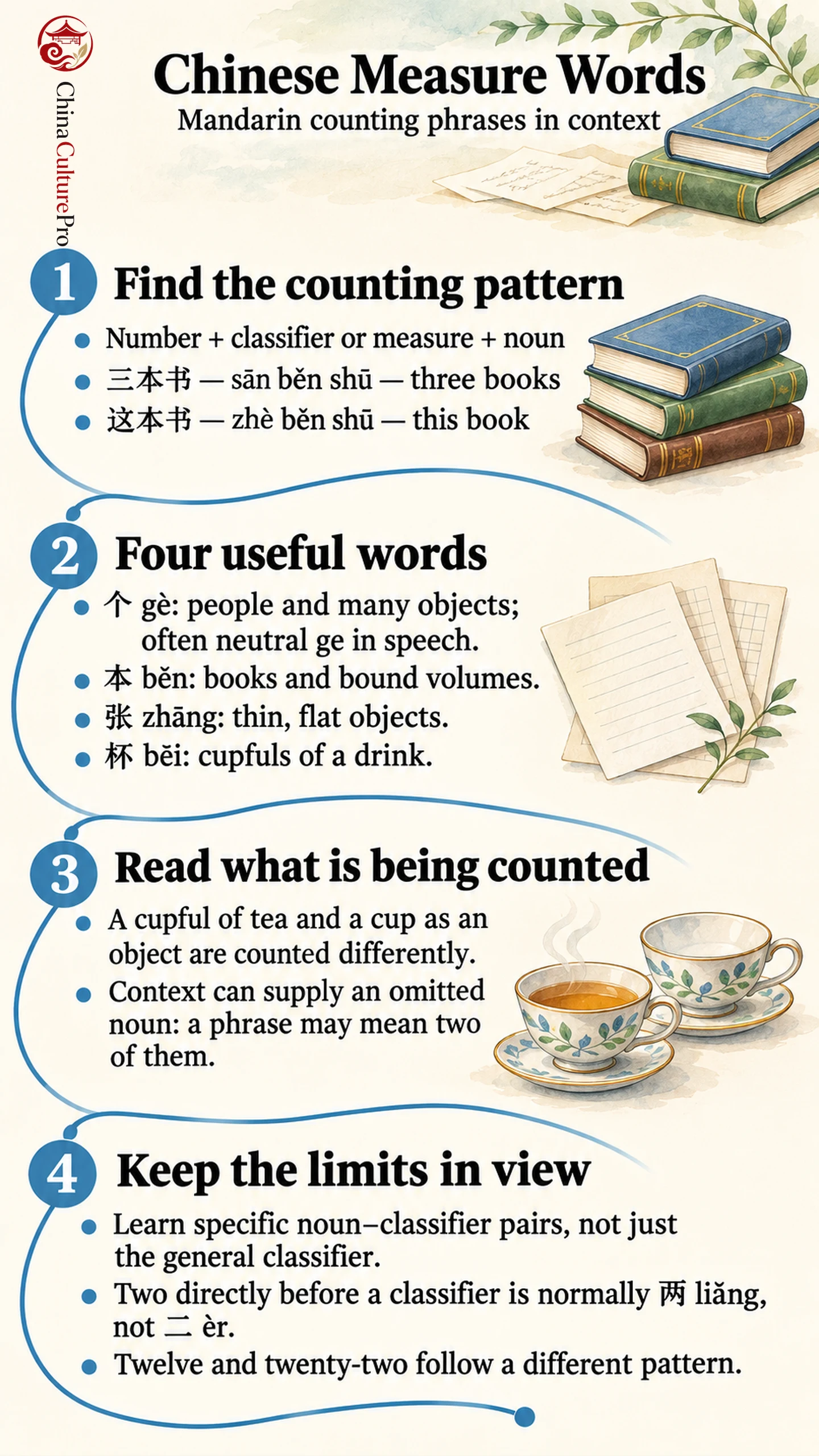
A reader who recognizes the number and noun may still miss what the phrase counts. The word between them helps organize the meaning: a bound volume, a sheet, or a cupful. Start with the phrase as a whole.
The Number–Classifier–Noun Pattern
三本书, sān běn shū, means “three books”: the number comes first, the book classifier next, and the noun last. Demonstratives also form classifier phrases: 这本书, zhè běn shū, means “this book”.[1][4]
These are noun phrases, not complete sentences. They can occupy a larger sentence without changing the internal counting pattern. The classifier helps specify how the noun is being counted.[1]
Four Useful Measure Words and Examples
These common uses provide a starting reference; they do not exhaust each word’s possible meanings.
| 語 | 定義 | Example and meaning |
|---|---|---|
| 个 (gè; often neutral ge in speech) | General classifier for people and many objects | 三个人, sān ge rén — three people.[2] |
| 本 (běn) | Classifier for books and bound volumes | 三本书, sān běn shū — three books.[4] |
| 张 (zhāng) | Classifier for thin, flat objects | 两张纸, liǎng zhāng zhǐ — two sheets of paper.[1] |
| 杯 (bēi) | Measure for cupfuls of a drink | 两杯茶, liǎng bēi chá — two cups of tea.[3] |
The pinyin gives Mandarin readings. Tone changes in connected speech are a separate question; see Chinese tones.
Reading the Phrase in Context
A cupful of tea and a cup as an object are counted differently. A drink can be measured with 杯; the vessel itself can be counted with 个. The classifier therefore helps distinguish an amount of liquid from an item of tableware.[3]
A familiar noun can also be omitted when context supplies it: a number-plus-classifier expression may mean “two of them” rather than naming the objects again.[2] Look back in the conversation or text before treating the phrase as incomplete.
Two Common Learning Traps
The general classifier covers many everyday nouns, particularly in colloquial use, but specific pairings remain important. Learn the appropriate word with each new noun; use a Chinese dictionary to check unfamiliar combinations.[5]
For “two” directly before a classifier, Mandarin normally uses 两 (liǎng) rather than 二 (èr). This shortcut does not extend to every number ending in two: twelve and twenty-two retain their ordinary final two.[2] Keep the whole number in view before applying the rule.
FAQs About Chinese Measure Words
Can I use the general classifier for every noun?
It is useful with many nouns, especially informally, but it does not replace learning more specific conventional pairings.[5]
Why does “two” change before a measure word?
Mandarin normally selects the counting form liǎng in that position. Numbers such as twelve and twenty-two follow a different pattern.[2]
Does every measure word name a physical unit?
No. A classifier may categorize a noun, while a measure specifies a quantity or container. Both can appear in quantity expressions.[4]
出典
[1] Kathleen Ahrens and Chu-Ren Huang. Classifiers, in A Reference Grammar of Chinese
[2] Julian K. Wheatley, MIT OpenCourseWare. Learning Chinese, Unit 2: nouns and measure words
[3] Julian K. Wheatley, MIT OpenCourseWare. Learning Chinese, Unit 3: measure phrases
[4] One-Soon Her, Ying-Chun Chen and Nai-Shing Yen. Mathematical values in the processing of Chinese numeral classifiers and measure words
[5] Pimsleur, Simon & Schuster. Mandarin Chinese 3: Classifiers or Measure Words