


Quick Answer: What Do Putonghua, Guoyu and Huayu Mean?
Putonghua(普通话,pǔtōnghuà), Guoyu(國語,guóyǔ)and Huayu(华语,huáyǔ)are names encountered in discussions of standard Mandarin Chinese. Their usual settings differ, and regional speech is not identical.[1][2][3]
- Putonghua: The usual name for the standard spoken language in mainland China.
- Guoyu: A familiar name for Mandarin in Taiwan, also found in institutional titles.
- Huayu: Common in Singapore and other Chinese-language communities, and also used in Taiwan language teaching.
These labels do not identify three unrelated languages. Nor does a name by itself specify a speaker’s accent, a character set or a pronunciation-teaching system.
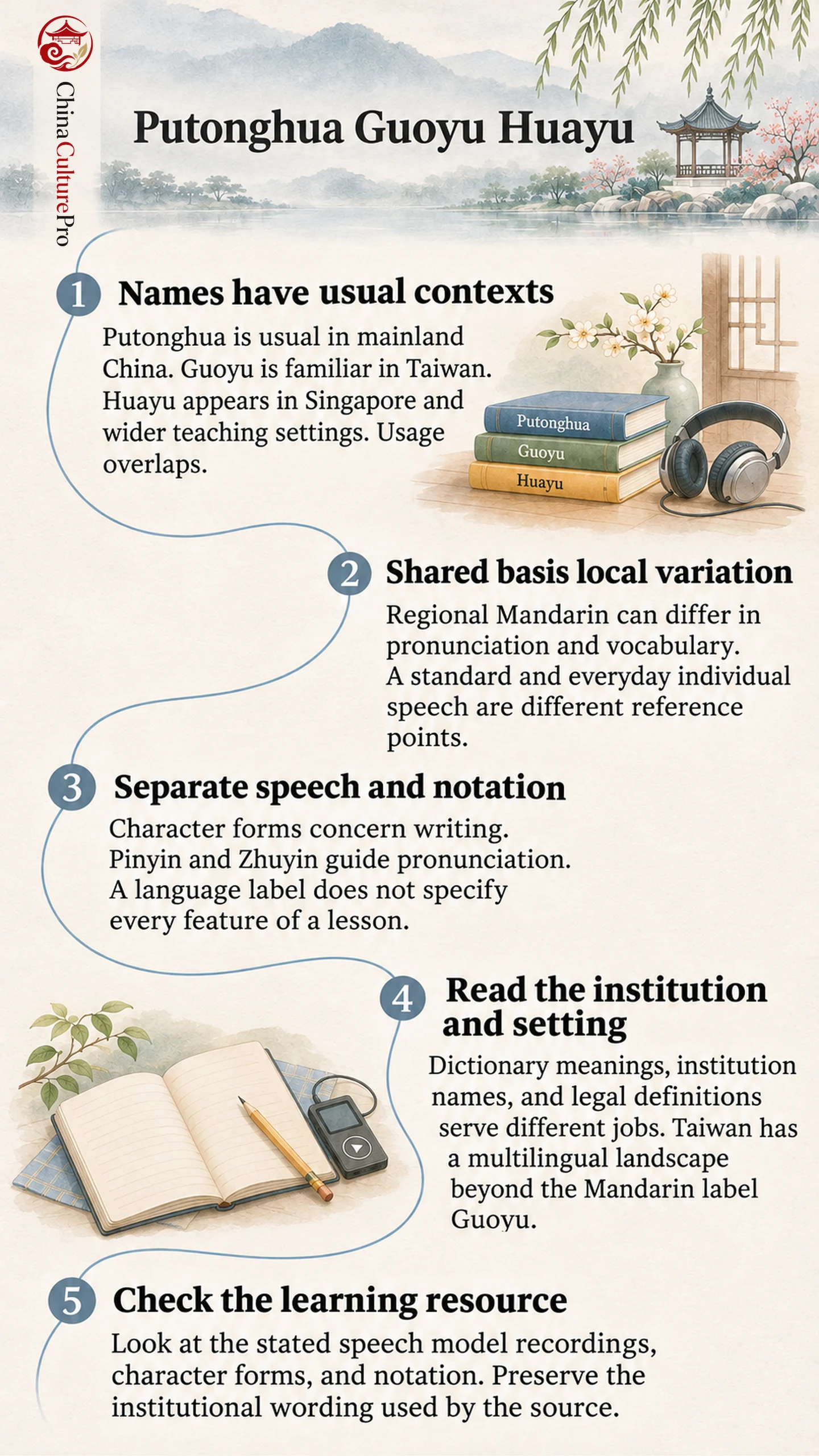
A course catalogue may say Guoyu, a conversation class may advertise Huayu, and a pronunciation reference may describe Putonghua. An English reader can encounter all three while learning Mandarin. The useful question is which standard, teaching context and audience the source has in mind, rather than which label must replace the others everywhere.
Three Names and Their Usual Contexts
The names emphasize different ideas: Putonghua is commonly glossed as “common speech” and Guoyu as “national language”; Huayu is another Chinese-language label whose precise reference depends on its setting. Those English glosses help explain the wording, but their literal meanings do not settle every present-day use.
| 料理名 | Usual context in this guide | What the label does not establish |
|---|---|---|
| Putonghua | Mainland China’s standard spoken Chinese | Every feature of an individual speaker’s local speech |
| Guoyu | Mandarin in Taiwan and names of educational institutions | An exhaustive list of Taiwan’s recognized languages |
| Huayu | Singapore and wider Chinese-language education and communities | One exclusive national accent or teaching method |
The usual contexts can overlap. Taiwan’s National Taiwan Normal University provides a concrete overlap: its institution is called the Guoyu Teaching Center in Chinese and the Mandarin Training Center in English, while its teaching information also uses Huayu.[4] Seeing the two Chinese labels on related educational material is therefore not evidence that the institution teaches two unrelated languages.
When reading an older source, check its date as well. The Taiwan dictionary records historical senses of Guoyu beyond the modern Mandarin meaning.[2] A present-day course label should not be projected automatically onto every historical document containing the same characters.
A Shared Standard with Regional Variation
The mainland Ministry of Education describes Putonghua through three bases: Beijing pronunciation, northern Chinese varieties and exemplary modern vernacular writing as the grammatical model.[1] That is a description of a standardized language, not an instruction to reproduce every local expression heard in Beijing. “Mandarin” can also appear in a broader discussion of related regional varieties; a guide to Chinese languages and dialects helps keep the standard and the larger language landscape separate.
Regional Mandarin can differ in pronunciation, everyday vocabulary and patterns of expression. The Singapore Chinese Cultural Centre’s authored account describes Singapore Mandarin as a regional form of standard Mandarin, shaped by other Chinese varieties as well as Malay and English. Its shared foundation coexists with local usage.[3]
A language name identifies a reference point; it cannot predict everything a particular person will say. For learning, compare the dictionary, recordings and usage notes attached to a resource. A regional word is best checked against the usage of the community being described.
Language, Characters and Pronunciation Guides
Keep spoken language, written characters and phonetic notation separate. A Mandarin lesson can combine Chinese characters with a pronunciation guide, but the guide is not a second spoken language. Likewise, the choice between simplified and traditional character forms concerns writing; see the comparison of the two character systems for that separate question.
拼音 is a romanization system: Latin letters represent Mandarin pronunciation. ISO’s Chinese romanization standard explicitly concerns modern Putonghua.[5] Reading a name written in Latin letters does not, on its own, tell you which regional accent a recording uses.
Zhuyin, or Bopomofo, uses a different set of phonetic symbols. Taiwan’s official manual describes its use for learning pronunciation, annotating characters and organizing dictionary information.[6] A learner can encounter different notation around a shared learning task. Check the symbols and their conventions directly rather than treating the course’s language name as a complete specification of its materials.
Names, Institutions and Multilingual Communities
Language labels carry institutional and historical context. A dictionary definition explains a word; an institution’s own name shows its chosen wording; a statute defines terms for a particular legal purpose. These are different kinds of evidence and should not be substituted for one another.
The literal translation “national language” can be especially misleading if read as a claim that Guoyu is Taiwan’s only recognized language. Taiwan’s Development of National Languages Act defines national languages to include the natural languages used by its established ethnic groups and Taiwan Sign Language, and provides for their equality.[7] The familiar Mandarin label does not replace that broader legal definition.
Singapore’s multilingual setting also matters when interpreting Huayu. Its Mandarin developed alongside other community languages and Chinese varieties.[3] Use the specific community or institution as context. A Chinese-language label does not establish that every family has the same home language or every speaker uses the same vocabulary.
Choosing a Term When Learning or Writing
For an English explanation, “standard Mandarin Chinese” is a useful starting description. Add the local label when discussing an institution, a named standard or a source that uses it. Preserve the wording of an institution’s official title rather than rewriting it to match a preferred regional term.
When choosing learning materials, inspect the stated pronunciation model, the recordings, the characters and the notation. Those details answer practical questions that a broad course title cannot. If an unfamiliar regional word occurs, check a local dictionary or ask the teacher how it is used in that setting.
In conversation, follow the speaker’s intended meaning and ask for clarification when necessary. Knowing these names helps connect related resources while preserving the wording appropriate to each source.
FAQs About Putonghua, Guoyu and Huayu
Are Putonghua and Guoyu different languages?
In this context, they name regional standards of Mandarin, with shared foundations and local differences. They are not labels for two unrelated languages.
Does Huayu mean only Singapore Mandarin?
No. It is also used in other Chinese-language communities and in Taiwan’s language-teaching institutions. Read the surrounding context.
Is Putonghua simply the Beijing dialect?
No. Beijing pronunciation is one basis of the standard; that does not make every local Beijing expression part of it.
Do the three names specify a writing system?
No. Check character forms and phonetic notation separately from the name used for the spoken language.
出典
[1] Ministry of Education, China. Overview of Languages and Writing Systems, October 2026
[2] Ministry of Education, Taiwan. Revised Mandarin Dictionary: Guoyu
[3] Luo Futeng, Singapore Chinese Cultural Centre. Mandarin in Singapore
[4] National Taiwan Normal University. Mandarin Training Center: Institutional Name and Teaching Information
[5] International Organization for Standardization. ISO 7098:2015: Romanization of Chinese
[6] Ministry of Education, Taiwan. The Manual of the Phonetic Symbols of Mandarin Chinese
[7] Ministry of Justice, Taiwan. Development of National Languages Act