


Quick Answer: What Is Sichuan Dialect?
Sichuanese(四川話,Sìchuānhuà)is a regional label most closely associated with Southwestern Mandarin(西南官話,Xīnán Guānhuà). It does not mean that everyone within Sichuan speaks one identical variety, or that local speech is identical to standard Mandarin, Putonghua(普通話,Pǔtōnghuà).[1]
- Regional scope: Locality matters; Chengdu is one important reference point.
- Sound: Familiar words can have different consonants and tone contours.
- Everyday use: Local expressions and grammatical forms need their own context.
Check which town, speaker and situation a recording represents. The province’s linguistic diversity is broader than a single popular accent.
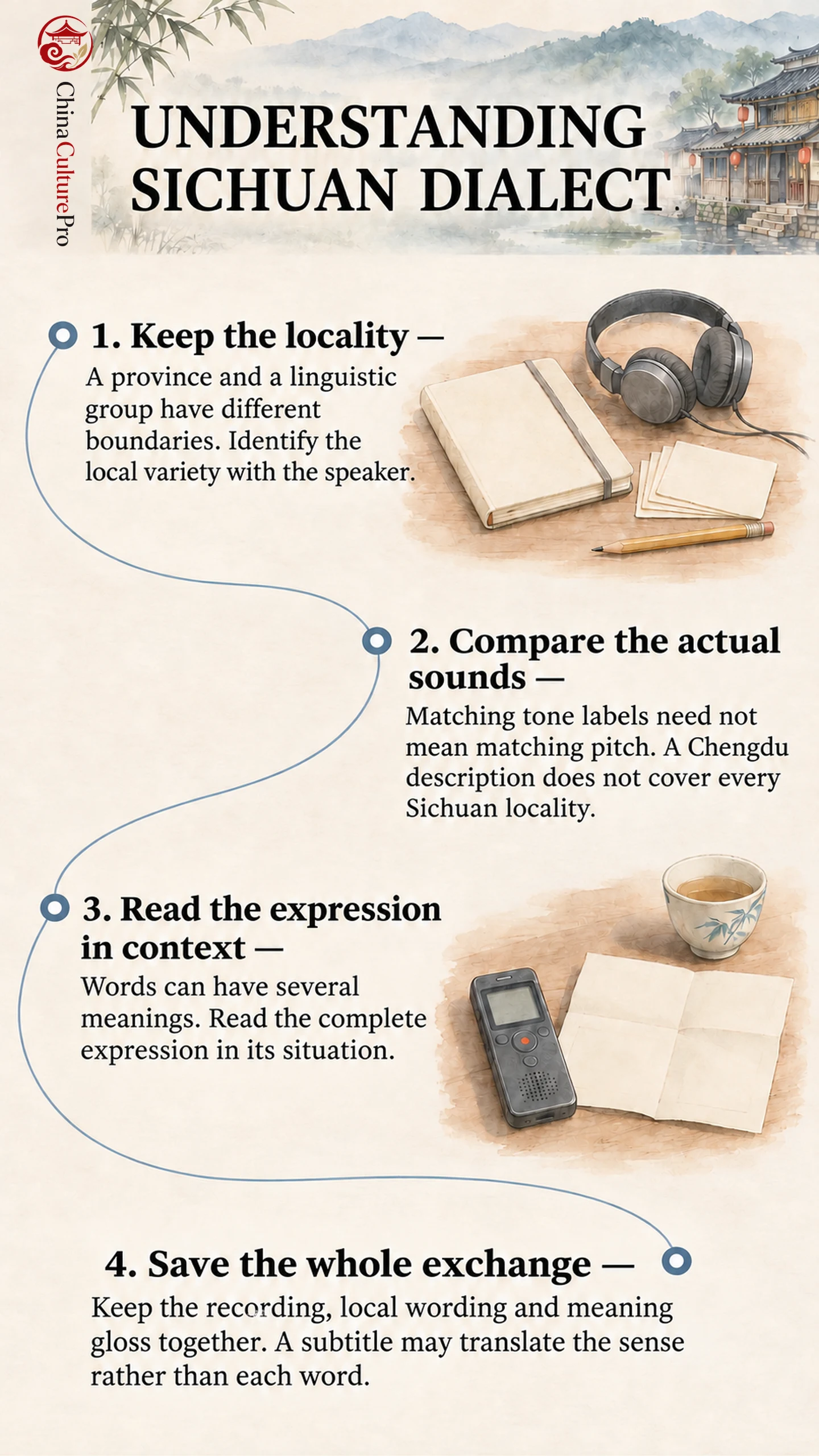
A familiar Chinese word can sound unexpectedly different in a Chengdu conversation. The difference may lie in its tone, a consonant or the local expression chosen instead. This guide explains those layers with specific evidence, while keeping the varied speech of Sichuan separate from a single set of imitation rules.
Southwestern Mandarin, Local Varieties and the Provincial Boundary
A province is an administrative area; a dialect group is a linguistic classification. In their account of Sichuan’s speech, Huang Shangjun and Li Guotai describe Southwestern Mandarin as dominant, alongside Hakka and Hunan-related varieties. Their broader regional discussion also connects language contact with migration into Sichuan.[1] Those communities should not be folded into one uniform pronunciation system simply because they share a province.
Southwestern Mandarin extends beyond Sichuan. Research on that group includes Sichuan and Chongqing, among other southwestern areas, and distinguishes the Chengdu–Chongqing subgroup as a particular research setting.[2] A local label can therefore cross today’s provincial boundary without making every locality identical.
Keep two questions apart: where a speaker comes from, and which variety the speaker is using now. Someone from Sichuan may speak standard Mandarin in one setting and a local variety in another. A place of birth alone is not a transcription of the recording.
The pinyin attached to Chinese names in this article gives Mandarin citation readings. It does not supply Sichuanese pronunciations. For the wider classification, see Chinese languages and dialects.
Why Familiar Sounds and Tones Differ
Historical tone categories vary within Sichuan. A 2026 study by Wang Qian and Zhou Jixu contrasts Chengdu with Chongzhou and Yibin. Its account distinguishes Chengdu’s merger of the historical entering tone(入聲,rùshēng)with the yangping tone(陽平,yángpíng)from an independent entering category in the latter varieties. The authors propose different historical layers; that is their interpretation of fieldwork, not a reason to declare one uniform origin for all Sichuan speech.[3]
Even two systems described as having four tones need not sound alike. Zeng and Shea’s 2024 Chengdu–Standard Mandarin comparison describes these contrasting pitch shapes:[4]
| Category in the study | Chengdu Mandarin | 標準中国語 |
|---|---|---|
| T1 | Rises in the upper range | Stays high |
| T2 | Falls in the lower range | Rises high |
| T3 | Falls from high | つけだれ |
| T4 | つけだれ | Falls from high |
The categories generally correspond across the varieties in that study, while their pitch realizations differ. The T2 label names a category in each system; its local pitch shape can differ.
Consonants also matter. Li and Hu’s phonetic description of Chengdu notes the absence of the retroflex sibilant series found in standard Mandarin.[5] This helps explain a recognizable difference, but is not permission to rewrite every Sichuan word by deleting an h from its Mandarin spelling. Copy a local example with its recording instead. The Chinese tones guide explains the basic tone vocabulary separately.
Everyday Words and a Chengdu Grammar Example
Bashi(巴適,bāshì)is a useful example of meaning that depends on context. A Sichuan Daily language-teaching report illustrates it with enjoyable food and an admired view, explaining a range around “comfortable” and “nice.”[6] “Delicious” can fit a food context, but cannot translate every occurrence.
Anyi(安逸,ānyì)also concerns ease and comfort: that is the ordinary Mandarin sense recorded in the Revised Mandarin Chinese Dictionary.[7] For regional usage, Jiang Shan discusses anyi and bashi as close in meaning but not completely interchangeable across contexts.[8] The pinyin labels here are Mandarin readings of the written forms. Learn the local sound from a speaker or an identified recording rather than reading those labels as Sichuanese.
Grammar can vary alongside vocabulary. Aini Li’s study of Chengdu compares the locative suffixes -头 and -面. For “in front,” its examples include 前头 and 前面. These are alternative ways of expressing location, not merely different tones on one word.[9]
The study drew on 40 native speakers, mainly from inner Chengdu, in interviews collected in 2017. The -面 form outnumbered -头 in the data, with social and stylistic variation. Therefore, hearing -面 does not by itself prove that someone is no longer speaking locally. The evidence documents changing usage in that community, not a fixed rule for every Sichuan town.[9]
Listening, Subtitles and Local Use
Local speech belongs to more than a vocabulary list. Huang and Li point to Sichuan opera as one setting in which dialect carries cultural expression.[1] Everyday conversation and a stage performance, however, have different purposes. Performance delivery serves its particular scene; choose conversational material for everyday exchanges.
For study, keep three things with a short recording: the speaker’s locality, the actual expression and its meaning in context. First establish what action or object is being discussed. Then compare the local wording with a Mandarin gloss and listen again to the original phrase.
A subtitle may translate the sense into standard written Chinese instead of preserving each local word. Do not assume that a matching subtitle gives you a character-by-character sound guide. Conversely, unusual written forms need not establish an entirely separate script; a transcript and a translation do different jobs.
Choose expressions suited to the exchange you need. A positive description of a meal, a locative phrase and a line from a comic performance should not all be copied with the same social purpose. Confirm the meaning before trying the expression elsewhere.
The Chinese characters guide explains why recognizing written forms and knowing their local readings are separate skills.
FAQs About Sichuan Dialect
Is Sichuanese the same as Standard Mandarin?
No. Much regional speech belongs to Southwestern Mandarin, but its local sounds and expressions differ from the national standard.
Does every Sichuan variety have four tones?
No. Some retain an independent historical entering category. Specify the locality before adopting a tone chart.
Does bashi always mean delicious?
No. It can express comfort or positive appreciation more broadly; the surrounding situation determines the useful English translation.
Can Mandarin pinyin show every local pronunciation?
No. Mandarin citation spellings are not a complete local transcription system. Use identified Sichuanese recordings and the notation explained by their source.
出典
[1] Huang Shangjun and Li Guotai. 海纳百川的四川话
[2] Phonetica. On the two rhotic schwas in Southwestern Mandarin: When homophony meets morphology in articulation
[3] Wang Qian and Zhou Jixu. 从成都、崇州和宜宾方言的音系特征看四川方言的两个历史层次
[4] Wenqi Zeng and Christine Shea. Phonetic and phonological factors in cross-dialectal tone perception
[5] Nan Li and Fang Hu. Vowels and Diphthongs in Chengdu Mandarin
[6] Sichuan Daily and Sichuan University’s Overseas Education College. 言子有李②:“好巴适”
[7] Ministry of Education, Taiwan. Revised Mandarin Chinese Dictionary: 安逸
[8] Jiang Shan. “巴适”和“安逸”在四川方言中的分布异同
[9] Aini Li. Regional dialect leveling in Mandarin Chinese: The case of locative variation in the Chengdu dialect