

Quick Answer: What Is the Teochew Language?
Teochew(潮州話,Cháozhōuhuà)belongs to Southern Min(閩南語,Mǐnnányǔ)within the Chinese language family. It is associated with eastern Guangdong and overseas communities, particularly in Southeast Asia.[1]
- Sounds: A commonly described system has eight tone categories, including short checked syllables.[2]
- Writing: Chinese characters and romanization provide different ways to represent words and sounds.
- Context: Local varieties, literary readings and overseas speech require attention to their own conventions.
A language label does not identify every speaker’s pronunciation. Read the location and transcription key before comparing two examples.
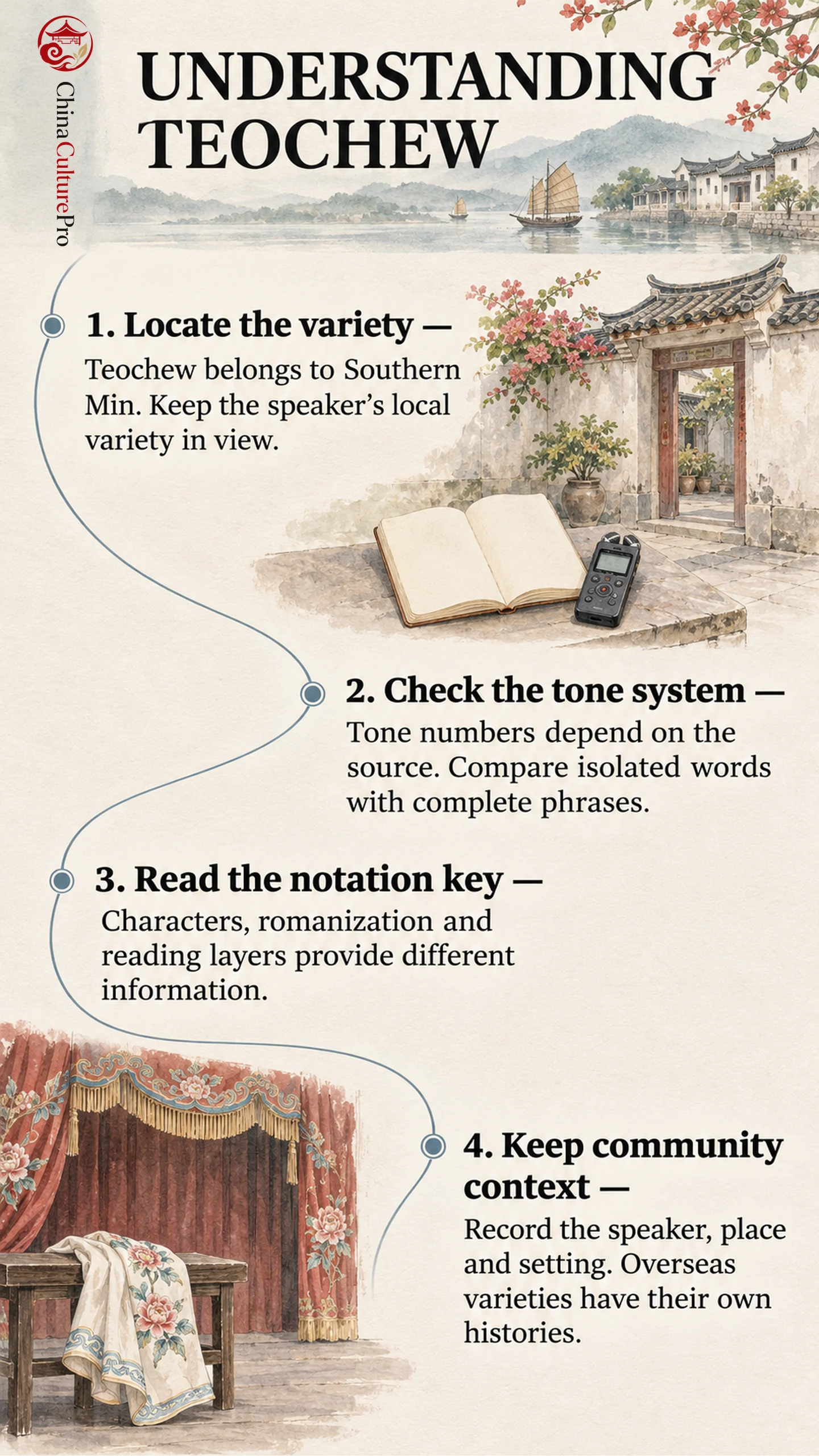
A subtitle can give the meaning of a Teochew sentence without showing how its words sound together. A dictionary adds another layer: its tone numbers may describe words in isolation. This guide separates language classification, spoken sound patterns and writing choices, then explains how community context helps make sense of differences.
Where Teochew Fits Among Chinese Languages
Teochew is associated with Chaoshan(潮汕,Cháoshàn)in eastern Guangdong. Its location in Guangdong does not make it Guangzhou Cantonese: Teochew belongs to Southern Min, whereas Cantonese belongs to Yue.[1][3]
The same classification connects Teochew with Hokkien, including varieties associated with southern Fujian and Taiwan. It does not make a Hokkien lesson interchangeable with a Teochew one. A family relationship between languages is different from the practical question of whether a listener understands an unfamiliar conversation.
Names also reflect the setting in which you encounter them. Teochew, Chaozhou and Chaoshan can appear in language resources, while a study may specify a narrower variety such as Jieyang. Preserve that narrower label when taking notes. Our Chinese languages and dialects guide explains why everyday “dialect” terminology can conceal substantial linguistic differences.
The tone-marked pinyin beside Chinese terms here gives their Mandarin readings. It identifies the written names; it is not a Teochew pronunciation guide.
Eight Tone Categories and Connected Speech
An eight-tone description includes six unchecked categories and two checked ones. Jiajia Cai’s 2024 paper gives the checked endings /-p, -k, -ʔ/, the last being a glottal stop.[2] Listen for both the ending and the tone.
Connected speech introduces tone sandhi: a syllable’s tone changes in context. Xiaocong Chen and Caicai Zhang’s 2021 experiments examined Teochew tonal variants before the end of a phrase, with their realization depending on the following tone.[4] A dictionary’s isolated reading can therefore be correct while differing from the form heard in a phrase.
Avoid treating one compact sandhi chart as a rule for every variety and construction. Suki Yiu’s study of Jieyang describes a six-tone inventory with bidirectional sandhi and examines its relationship with rhythm.[5] That differs in scope from an introductory chart of eight traditional categories. Preserve the study’s variety and counting method before concluding that two sources contradict each other.
Tone numbers label categories within a system. The high-level contour written 55 is numbered 5 in a traditional spelling scheme but T2 in Cai’s paper.[2][3] The two fives describe sustained high pitch on a five-point scale, not two successive fifth tones.
For learning, compare an isolated word with a short expression from the same speaker. Mark the phrase boundary and keep its original transcription. The Chinese tones guide supplies background vocabulary for this distinction.
Chinese Characters, Peng’im and Reading Layers
Peng’im(拼音,pīnyīn)is a name used for Teochew romanization. Guangdong’s scheme was published in 1960. Its Latin letters and tone numbers should be interpreted through its own key, even where the spelling resembles Mandarin pinyin.[3]
Different resources adapt their notation. The Chaoshan vernacular dictionary’s documentation, for example, uses final n to indicate vowel nasalization in its Peng’im-style spelling, and nd for a retained /n/ ending. Its other romanization can mark nasalization with a superscript n or nn.[6] Those are conventions of that resource. Adding an English-style n sound to every nasalized vowel would misread the notation.
Characters pose a separate question. Literary and colloquial readings(文白異讀,wénbái yìdú)allow the same written character to have different established pronunciations. One teaching guide gives 學, “learn,” as literary hag8, /hak⁵/, and colloquial oh8, /oʔ⁵/.[3] Recognizing 學 does not by itself tell you which form belongs in the expression you are studying.
Keep three things in your notes: the written form, its pronunciation in the complete expression, and the meaning. When sources disagree, first check whether they use different romanizations, local varieties or reading layers. Replacing one spelling with another before identifying the difference can remove information you need.
Teochew in Diaspora and Everyday Culture
Overseas Teochew develops within multilingual lives. Cher Leng Lee and Chiew Pheng Phua’s 2021 study investigated vocabulary through data from 41 Singapore Teochew speakers aged 12–86. Its setting includes the growing prominence of English and Mandarin and more restricted use of Teochew at home and in public.[7] The study compares vocabulary across ages in one research setting. It does not predict how every family’s language use will develop.
Cai’s preliminary comparison of ten Chaozhou and eight Singapore speakers, aged 46–56, found differences in pitch height and contour. Contact influence was a proposed explanation.[2] Treat a Singapore recording as evidence of that speaker’s speech, rather than correcting it solely against a mainland chart.
Luo Futeng’s account of Singapore Teochew supplies examples of language contact, including a word for jackfruit related to Malay nangka. He also records publications on opera rhymes and folk songs, alongside community language classes.[8] Such settings show why studying the language can involve more than memorizing isolated vocabulary. The wider Teochew culture guide connects language with regional and overseas traditions.
Choose a recording suited to your purpose: conversation for an everyday exchange, a recitation for a literary text, or a performance for its own setting. Save the speaker’s locality and the source’s notation alongside it. You can then compare versions without losing their context.
FAQs About Teochew
Is Teochew the same as Hokkien?
They are related within Southern Min. Their relationship does not make their pronunciation, vocabulary or learning materials interchangeable.
Does Teochew have eight tones everywhere?
Eight is a common traditional description. A source may count or analyze categories differently; check its variety and notation.
Can I use Mandarin pinyin to read Teochew?
Use a Teochew transcription system and its key. Similar-looking letters do not guarantee Mandarin sound values.
Why can one character have two Teochew readings?
Literary and colloquial readings preserve different established forms. The complete word or expression helps determine the appropriate reading.
出典
[1] Julian K. Wheatley, MIT. Learning Chinese: A Foundation Course in Mandarin, section 8.7
[2] Jiajia Cai. A Preliminary Study on Tonal Variations in Singapore Teochew
[3] Brandon Seah. Pronunciation and Orthography
[4] Xiaocong Chen and Caicai Zhang. Encoding of Contextual Tonal Alternations in Word Production in Teochew
[5] Suki Yiu. Iambic and Trochaic Rhythm in Jieyang (Southern Min)
[6] Chaoshan Vernacular Dictionary. Romanization Scheme Comparison
[7] Cher Leng Lee and Chiew Pheng Phua. Singapore Teochew as a Heritage Language
[8] Luo Futeng, Singapore Chinese Cultural Centre. The Teochew Dialect in Singapore