

Quick Answer: What Were Chinese Imperial Tombs?
Chinese imperial tombs were burial complexes for rulers and, in some cases, their families. A complex could include a central burial chamber, a mound or mountain, nearby pits and tombs, and spaces for ceremonies.
- Qin: The Terracotta Warriors came from pits associated with the First Emperor’s mausoleum.
- Han: Yangling’s excavated pits preserve pottery figures of people and animals.
- Tang: Qianling (乾陵, Qiánlíng) combines a mountain burial, a sculpted approach and nearby tombs with murals.
- Ming and Qing: Approaches lined with stone figures and carefully placed ritual buildings made the surrounding landscape part of the complex.
Each find has its own context. A figure from a pit and a crown recovered from a burial chamber tell different stories.

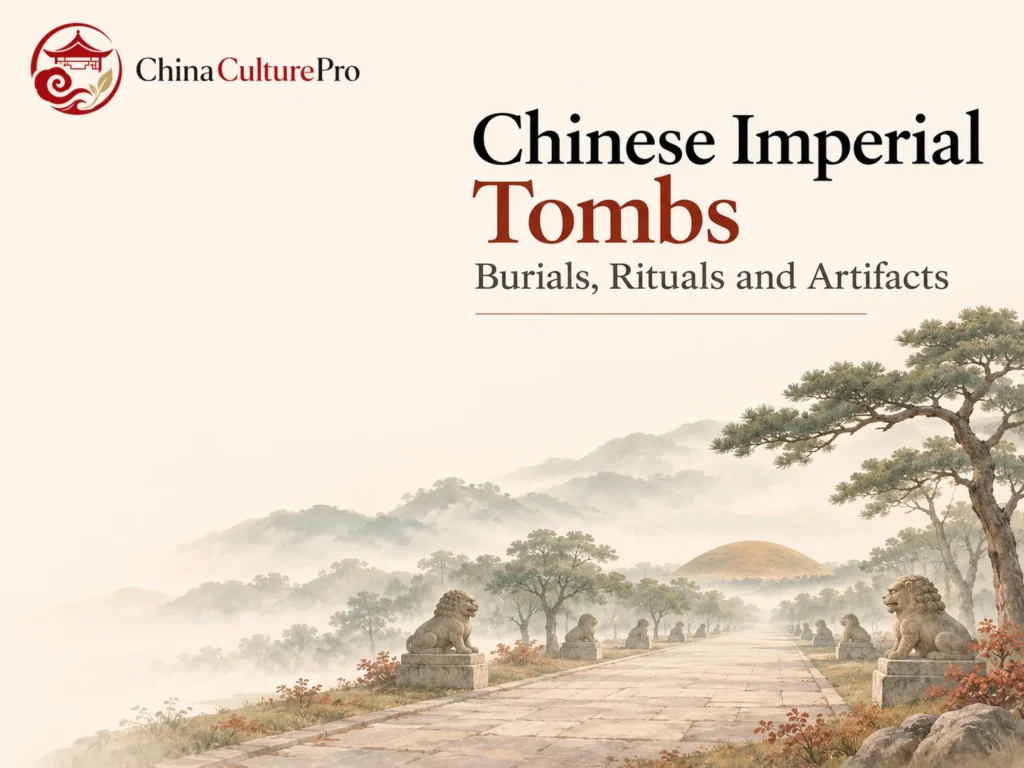
A mound, an avenue of stone figures and a group of small pottery animals can all belong to an imperial burial site. The mound covers a burial, the sculptures mark an approach and pottery may come from a nearby pit. In Chinese history, tombs preserve material evidence about court ceremony, craft and rank. Reading that evidence starts with locating a find within the larger complex. [1][4][7][8]
What Belongs to an Imperial Tomb Complex?
A mausoleum, or ling (陵, líng), could extend far beyond the chamber where a ruler was buried. Some sites have a central mound or mountain. Pits elsewhere in the grounds could hold objects or figures. Separate burials might hold other members of the royal family or people connected to the court. These elements varied from one site to another. [1][4][5][6][7]
A spirit way (神道, shéndào) is a ceremonial approach to the tomb. At some sites, stone people, animals and monuments mark the route. The paths and buildings above ground could be used for royal ceremonies after burial. In that sense a complex also had a place in the continuing work of the court and the lives of later Chinese emperors. [5][6][7]
Qin and Han: What the Burial Pits Preserve
The burial complex of Qin Shi Huang included extensive grounds around the central mound. UNESCO compares its arrangement with the Qin capital at Xianyang. The Terracotta Army was found in separate pits, where ranks of clay soldiers and horses give evidence about military formations, equipment and ceramic production. The central burial chamber remains unexcavated. The figures and their placement therefore document what was put in those pits. The contents of the chamber are a separate question. [1][2][3][9]
At Yangling, the mausoleum complex of the Western Han emperor Jing and Empress Wang, excavated pits yielded pottery people as well as animals such as pigs, cattle, horses and sheep. Some figures were designed to wear clothing, while others have garments modeled in clay. The groups of animals and people broaden the picture of what a court chose to provide in burial. They offer a material complement to written accounts of the Han dynasty. [4]
Tang Qianling: The Mountain, the Approach and the Murals
Qianling in Shaanxi is the joint mausoleum of Emperor Gaozong and Wu Zetian. The main burial occupies a mountain. On the ceremonial approach, stone horses, guards and monuments mark an ordered passage through the landscape. Their placement is part of what survives, even where buildings have disappeared. [5][6]
Archaeologists excavated nearby burials, including those of Princess Yongtai and Crown Prince Zhanghuai. One mural in the Shaanxi History Museum came from the east wall of the front chamber of Princess Yongtai’s tomb. It depicts a procession of court attendants, some holding fans or serving objects. The wall and chamber establish the original setting of the image. Its clothing and objects help readers study how a Tang tomb portrayed court service. [6][10]
Ming and Qing: Spirit Ways and Burial Landscapes
UNESCO describes the topography of Ming and Qing mausoleums as part of their design. Builders selected settings in accordance with feng shui (风水, fēngshuǐ), arranging buildings, monuments and sacred ways in relation to the terrain. A visitor approaching along a stone-lined route encounters the complex in a planned sequence. The placement of halls and sculptures helped make court hierarchy visible. [7]
Xiaoling, the tomb of the first 明 emperor, near Nanjing, influenced later designs. The Ming tombs near Beijing and the Eastern and Western 青(チン) tombs are part of a wider tradition with local variations. UNESCO also includes three Qing imperial tombs in Liaoning. Those sites incorporate features tied to the Qing rulers’ Manchu heritage. Comparing them with the mausoleums around the later imperial capitals brings those differences into view. [7]
What Archaeologists Can Learn From an Opened Tomb
Excavation at Ming Dingling began in 1956. The burial of the Wanli emperor and two empresses yielded crowns, textiles and other objects used by the court. The emperor’s crown was worked with fine gold threads. Silk clothing decorated with gold thread shows another way craft expressed rank in the burial. Dingling’s textiles offer a particular example for readers interested in Chinese silk history. [8]
Excavation also changes the environment around an object. In a study of how the Qin tomb has been portrayed, Hongmei Sun explains that concern about preserving the underground structure and its contents has weighed against opening it. An excavated pit, the layout of surviving surface structures and an unopened mound can all offer evidence. Claims about what is inside a sealed chamber require a different standard of proof. [2][3][9]
FAQs About Chinese Imperial Tombs
Were the Terracotta Warriors found inside Qin Shi Huang’s burial chamber?
They were found in separate pits within the larger mausoleum complex. The First Emperor’s central burial chamber has not been excavated.
Why do some imperial tombs have a spirit way?
The spirit way formed a ceremonial approach to the burial. Stone figures and monuments could mark the route, and the grounds continued to accommodate royal ceremonies.
What can archaeologists learn without opening the main chamber?
They can study surface layouts, sculpture, construction and associated pits or satellite tombs. That evidence can show how the complex was used and what was placed in excavated areas.
出典
[1] UNESCO World Heritage Centre. Mausoleum of the First Qin Emperor
[2] Emperor Qin Shihuang’s Mausoleum Site Museum and Smithsonian Institution. China’s Terracotta Army: Information and Teaching Resources
[3] Arthur Lubow and Sonja Anderson, Smithsonian Magazine. What You Need to Know About China’s Terra-Cotta Warriors and the First Qin Emperor
[4] Ministry of Culture and Tourism of China. Han Yangling Underground Site Museum and Burial Pits
[5] Ministry of Culture and Tourism of China. Qianling Mausoleum in Xianyang
[6] ChinaCulture.org. Qianling Museum
[7] UNESCO World Heritage Centre. Imperial Tombs of the Ming and Qing Dynasties
[8] ChinaCulture.org. Dingling Museum
[9] Hongmei Sun, Frontiers of Literary Studies in China. Becoming a Ruin: Breaking into the First Emperor’s Necropolis
[10] Shaanxi History Museum. Mural: Palace Maids