


Quick Answer: What Are Chinese Homographs?
Chinese homographs (同形异义词, tóngxíngyìyìcí) are different words sharing the same written form. Their meanings differ, and their pronunciations may differ too.[1]
- Writing: Identical characters do not guarantee one meaning.
- Sound: A tone or neutral-tone contrast can distinguish readings.[3][4][5]
- Context: Read the whole word and sentence before choosing a pronunciation.[7]
A character with several readings is a related problem, but character-level and word-level labels are not interchangeable.
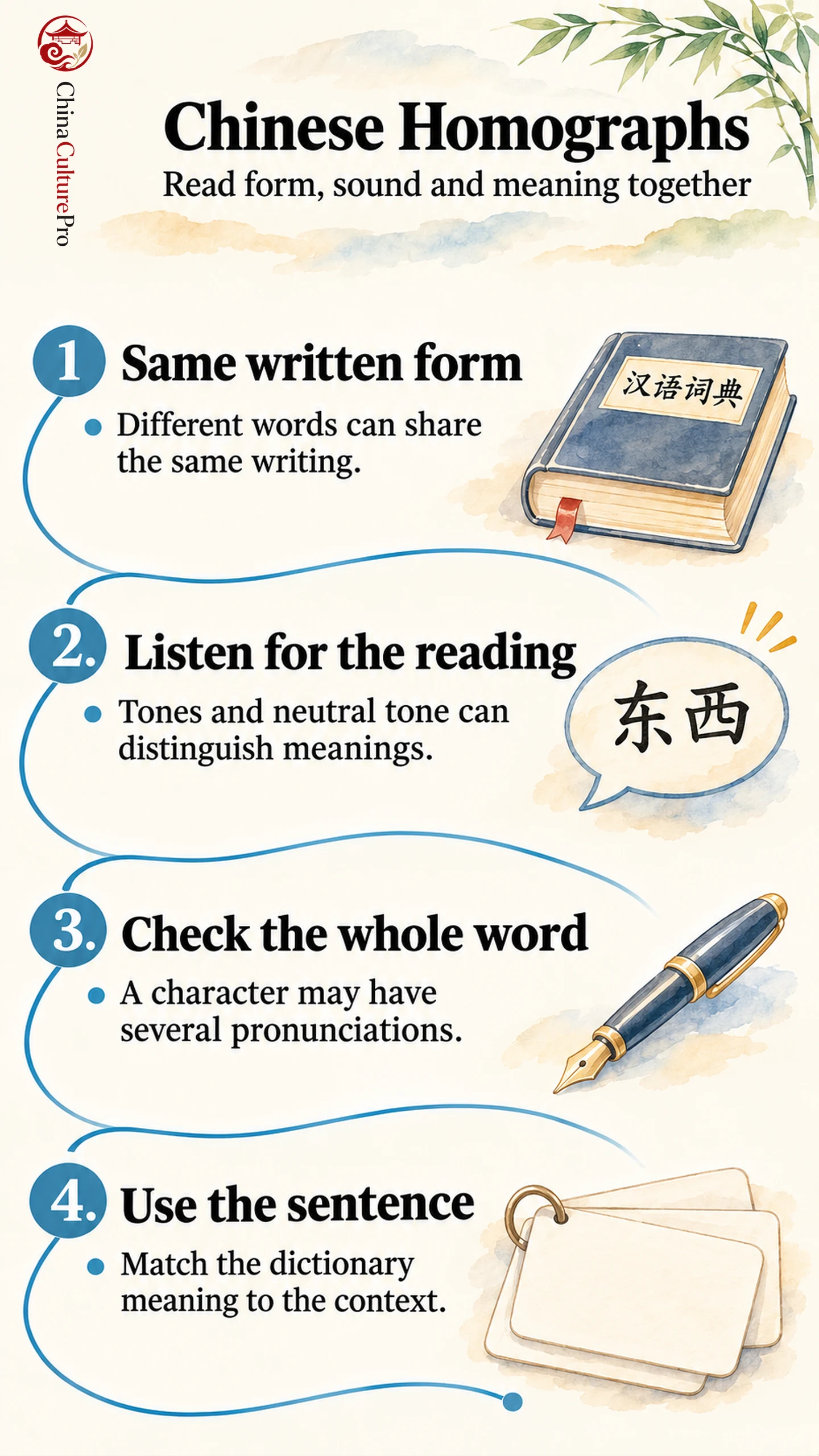
An identical written sequence can represent different words in different sentences. The useful habit is to keep the whole word, its pronunciation and one clear example together.
Three Related Terms
| 用語 | 定義 |
|---|---|
| Homographs | Different words that share the same written form.[1] |
| Homophones (同音词, tóngyīncí) | Different words that share the same pronunciation.[2] |
| Polyphonic characters (多音字, duōyīnzì) | Characters that have more than one pronunciation.[7] |
Our homophones guide focuses on shared sound. This article starts from shared writing and asks which reading fits.
Whole-Word Examples in Mandarin
| Written form | 読み方 | 意味 |
|---|---|---|
| 东西 / 東西 | dōngxi | Things or objects; xi has neutral tone.[3] |
| 东西 / 東西 | dōngxī | East and west, or an east–west direction.[4] |
| 好吃 | hǎochī | Tasty; good to eat.[5] |
| 好吃 | hàochī | Fond of eating.[5] |
Compare two constructed contexts: 买东西 (mǎi dōngxi), “buy things”, and 东西方向 (dōngxī fāngxiàng), “east–west direction”. The characters 东西 stay the same; the meaning and second syllable’s tone differ.[3][4]
For 好吃, distinguish a comment on food’s taste from a description of someone’s liking for eating. The tone on 好 is part of the lexical contrast, not an optional accent.[5]
A Character Can Also Have Several Readings
行 illustrates the character-level issue. In 银行 / 銀行 (yínháng), “bank”, it is read háng; in 步行 (bùxíng), “walk”, it is read xíng.[6]
These are different written words containing the same character. They demonstrate polyphony without making 银行 and 步行 a pair of whole-word homographs. Read Chinese characters as parts of words rather than assuming one fixed sound for every occurrence.
How to Choose the Reading in Context
- Identify the complete word and retain the surrounding sentence. Do not choose from an isolated character alone.
- Check the word’s dictionary entries, including tones and neutral-tone markings. Compare the meanings and example contexts with your passage.
- Select the reading that fits the sentence, then record the word, pinyin and meaning together. If the context remains insufficient, preserve the ambiguity rather than guessing.
Research on Chinese polyphones explicitly uses neighboring semantic context to resolve pronunciation.[7] A pinyin reference helps you keep the selected reading explicit.
FAQs About Chinese Homographs
Must homographs have different pronunciations?
No. Under the definition used here, they share writing and differ in meaning; pronunciation may also differ. Do not reduce the term to “same spelling, different sound” alone.[1]
Can a tone difference change the word’s meaning?
Yes. 好吃 contrasts hǎochī, “tasty”, with hàochī, “fond of eating”. 东西 also illustrates why a neutral-tone marking can matter.[3][4][5]
Will pinyin always remove the ambiguity?
No. It can distinguish different readings, but words can still share pronunciation. Keep meaning and sentence context alongside the pinyin instead of treating a sound transcription as a unique word identifier.[1][2]
出典
[1] Cambridge Dictionary. Homograph
[2] Cambridge Dictionary. Homophone
[3] Ministry of Education. Concised Mandarin Chinese Dictionary: 東西, things
[4] Ministry of Education. Concised Mandarin Chinese Dictionary: 東西, east and west
[5] Ministry of Education. Revised Mandarin Chinese Dictionary: 好吃
[6] Ministry of Education. Revised Mandarin Chinese Dictionary: 行
[7] Dongyang Dai and colleagues. Disambiguation of Chinese Polyphones in an End-to-End Framework with Semantic Features Extracted by Pre-trained BERT