
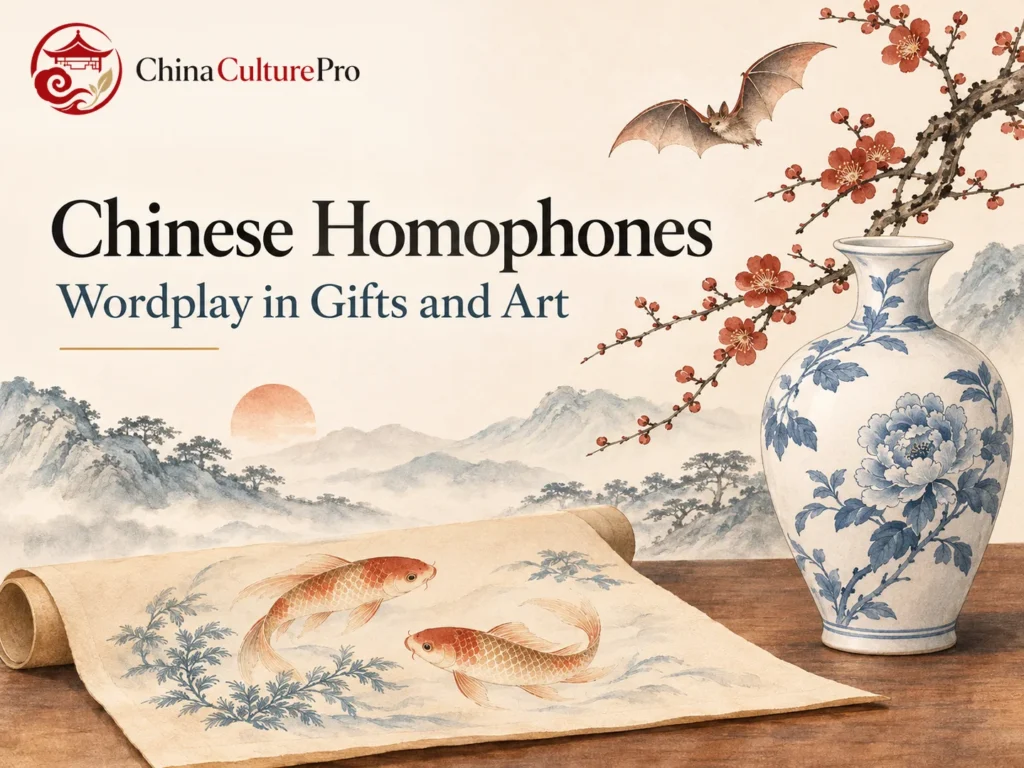

Quick Answer: What Are Chinese Homophones?
Chinese homophones (同音词, tóngyīncí) are different words with the same pronunciation within a particular language variety. Phonetic wordplay (谐音, xiéyīn) can use exact matches, similar sounds or a meaningful syllable in a longer name.
- Language: The written character and sentence context distinguish words that sound alike.
- Art: An animal, plant or object can stand for a wish through the sound of its name.
- Gifts: A sound association can make a present pleasing or awkward in a particular family or setting.
- Interpretation: Pronunciation, tone, the surrounding design and the occasion all matter.
A symbolic wish expresses an association people recognize. It does not establish that the object produces the hoped-for result.

A bat woven into silk can carry a wish for blessings, while a fish can suggest abundance. The connection becomes clearer when you hear the names. The same relationship between sound and meaning also appears in Chinese language use, from clarifying a surname to making a pun. [1][3][8]
Same Pronunciation, Different Words
In Mandarin, an exact sound match includes the tone. A difference in lexical tone can distinguish syllables, while several characters can also share the same syllable and tone. [9] For example, 张 and 章 are both read zhāng as surnames. A speaker may identify the intended character by describing its parts or citing a familiar name. [1]
That is one reason Chinese surnames cannot always be recovered from an unmarked romanized spelling alone. A written character supplies information that the sound may leave open. Context can do the same work in an ordinary sentence. [1]
Cultural sound associations also include looser resemblances. In Mandarin, 四 (sì, four) and 死 (sǐ, to die) have different tones. They are a familiar near-sound association, even though they are not exact Mandarin homophones. A cultural discussion that drops tone marks can hide this distinction. [1]
How a Sound Becomes a Picture
A rebus uses a pictured thing to evoke another word or expression. Chinese decorative art can combine such sound links with other kinds of symbolism. The Mandarin examples below show where the relevant sound occurs. [2][8]
| モチーフ | Sound link in Mandarin | Conventional wish |
|---|---|---|
| コウモリ | 蝠, fú, in 蝙蝠, biānfú, echoes 福, fú | 福や幸運 |
| 魚 | 鱼, yú, matches 余, yú | Surplus or abundance |
| Vase | 瓶, píng, matches 平, píng, in 平安, píng’ān | 平和 |
The bat example uses a syllable in the animal’s name. It does not require the whole word biānfú to sound identical to fú. This is a useful distinction when translating a museum explanation into a pronunciation lesson. A design can exploit part of a name and still form a recognizable pun. [2][3][8]
These associations are among the sound-based wishes encountered in New Year imagery and decorative objects. The exact combination determines whether a simple wish is expanded into a longer expression. [8]
Why Combinations Change an Art Motif’s Meaning
An eighteenth-century silk panel, probably once part of a chair cover, combines five bats, a musical stone and paired fish. The arrangement makes the motifs work together as an auspicious composition. Looking at one bat or one fish in isolation loses part of that design. [3]
A lacquer tray from the Qianlong period also places paired fish with a stone-chime form and other auspicious motifs. The fish participate in a wish for happiness and abundance, while paired fish also belong to a Buddhist symbolic set. The visual form therefore has more than one available reading. The surrounding emblems help establish which relationships the object presents. [4]
This is why a label such as “fish means wealth” is often too broad for a particular artwork. The name, number, arrangement and neighboring motifs can each contribute something different. A sound-based reading may coexist with a religious or conventional visual association. [4][8]
Wordplay in Gifts and Family Customs
The expression sòng zhōng (送钟, giving a clock) matches sòngzhōng (送终), an expression associated with attending the dying and funeral observances. A collected Chinese-American folklore account links this association to avoiding clock gifts. The record documents a tradition reported by a particular participant. [5]
Another family account describes avoiding the sharing of one pear between two people. The explanation turns on fēn lí (分梨, dividing a pear) and fēnlí (分离, separation). The informant describes how her family handles the practice. The practice is described through that family’s own experience. [6]
A historical object supplies a useful counterpoint. An eighteenth-century clock with a Qianlong reign inscription has five bats and a longevity character on its dial. A clock could carry auspicious decoration, even while a particular act of giving one could invite an unwelcome sound association. [7]
For a real visit or celebration, the recipient and occasion belong alongside the pun in any gift-giving decision. A brief check with the host can resolve uncertainty more accurately than a universal list of forbidden objects.
Reading the Sound Link in Its Own Context
Begin an interpretation with the actual word and intended phrase. Ask whether the link uses the whole word, one syllable or only a resemblance. Then look at the object and its setting. A decorative fish, a surname clarification and a household gift custom use language for different purposes. [1][2][6]
The examples here give Mandarin readings. A comparison with Cantonese pronunciation requires checking the actual local names rather than carrying the Mandarin spelling across unchanged. When explaining a pun in English, keep the Chinese characters and sound pair together so the reader can see which connection is being made.
That approach also preserves the difference between a recognized symbolic association and an actual outcome. A wish on a textile or a family explanation for avoiding a gift belongs to cultural interpretation. The object or account shows how a wish or concern was expressed. [3][6][8]
FAQs About Chinese Homophones
Do Chinese homophones have the same tone?
For an exact match within Mandarin, the tone is part of the pronunciation. Cultural wordplay also uses near sounds and partial-word matches, which should be identified separately.
Why do bats appear in auspicious Chinese art?
The syllable fú in the name for bat echoes fú, meaning blessings. Artists use that sound association in auspicious designs, often with other motifs.
Does every Chinese person follow homophone gift taboos?
Family and personal practices vary. A documented taboo explains an association that matters in some settings, while the actual recipient’s expectations determine its relevance to a gift.
出典
[1] New York State Asian Language Bilingual ESL Technical Assistance Center. Chinese Language and Culture: Having Fun With Chinese Homophones
[2] SFO Museum and Asian Art Museum of San Francisco. Hidden Meanings: Symbolism in Chinese Art, Object Gallery
[3] Metropolitan Museum of Art. Panel With Fish, Bats, and Clouds
[4] Metropolitan Museum of Art. Rectangular Tray With Fish Chime, Treasures, and Clouds
[5] University of Southern California, Digital Folklore Archives. Gift of Time Taboo
[6] University of Southern California, Digital Folklore Archives. Why You Can’t Split a Pear, Homophones Archive
[7] Science Museum Group. Zimingzhong With Bats
[8] SFO Museum and Asian Art Museum of San Francisco. Hidden Meanings: Symbolism in Chinese Art
[9] Massachusetts Institute of Technology. Hanyu Pinyin for Mandarin Speakers: Tones