
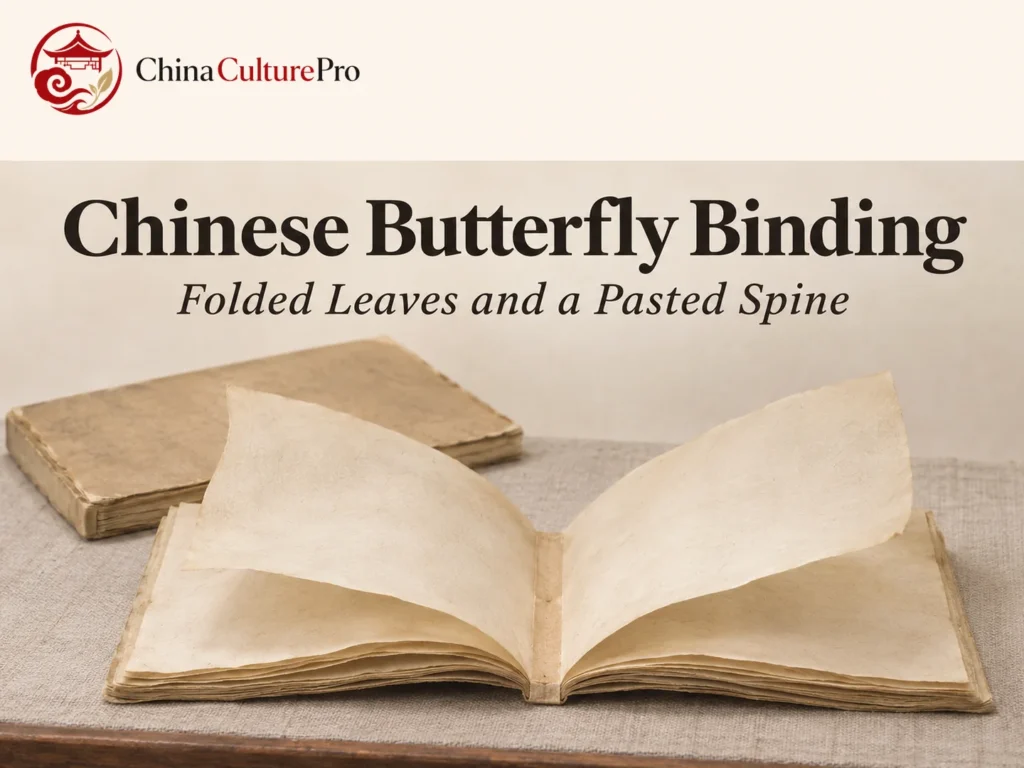

Quick Answer: What Is Chinese Butterfly Binding?
Chinese butterfly binding (蝴蝶装, húdiézhuāng) makes a booklet from sheets folded with their printed faces inward. The binder gathers the folded edges together and pastes them at the spine. Opening a printed spread parts the two halves of a single sheet, like the wings of a butterfly. [1][3]
- Sheet: Two pages usually share one printed face.
- Fold: The text faces inward, and the fold lies at the spine.
- Binding: Paste holds the folded edges and cover together. [1][3][4]
The location of that fold is one of the clearest ways to recognize the format. [1][3][4]

Start at the middle of a printed opening. In a butterfly-bound book, that line is the fold of the sheet. Follow the same sheet to either outside edge and you reach the two separate ends of the paper.
The Fold Makes the Spine
With Chinese woodblock printing, a single impression could carry a pair of pages. Between the paired pages is the printed centerfold (版心, bǎnxīn). It can identify a title or folio and gives the binder the line along which to fold the paper. The two halves face each other when the sheet is folded. [1][4][5]
The binder aligns the outer backs of the folds and attaches them to the cover with paste. The Palace Museum describes both soft and stiff cover forms. The defining feature is the binding at the folds, regardless of which type of cover encloses them. [1][3]
Why Blank Surfaces Appear Between Text Spreads
When a sheet has printing on only one side, its other side is blank. Folding the printed side inward leaves both blank backs facing outward. At the opening between adjacent folded sheets, those blank surfaces can face each other. A reader turning these sheets encounters the printed face of one sheet, then the blank backs of two neighboring sheets, then the printed face of the next. [1][3][4]
Those alternating openings follow from the sheet structure. Repairs, rebinding and differences in how a manuscript is written can change the pattern. A blank surface is therefore a useful clue in a surviving volume when read together with the fold and the pasted spine. [2][4][6]
How Butterfly Binding Compares With Other Formats
A concertina book is based on a long strip folded back and forth. Butterfly binding gathers individual folded sheets. In familiar wrapped-back and thread-bound books, the sheet is generally folded with the print outward, the folded edge at the fore-edge and the loose edges at the spine. A thread-bound volume often also shows the path of the sewing close to its spine. When the cover is closed, the easiest difference to check is where the folds sit. These relationships are central to identifying forms of traditional Chinese bookbinding. [2][3][4]
What Surviving Books and Repairs Can Show
A conservation report from the National Library of China’s network describes a Southern Song edition of Wenzhang Zhengzong from Southwest University. The report records its butterfly binding and identifies details of the printing, including engravers’ names in the centerfold. The engravers’ names are evidence from the impression. The folded and pasted edges are evidence from the structure of the surviving volume. [5]
The National Library’s account of a facsimile of the Song edition of Poetry of Chancellor Li describes a related opening arrangement with protective blank sheets between the printed leaves. That particular object illustrates how preservation and handling can affect what a reader sees when opening a book. The account ties the protective leaves to this book. It gives a reason to inspect each surviving volume for changes rather than assigning its binding from its title or its printing date alone. [2][6]
FAQs About Chinese Butterfly Binding
Are butterfly-bound books sewn through the spine?
In the standard form, paste secures the folded edges at the spine. Visible sewing can signal a different binding structure or later work on the book. [1][3][4]
Why is it called butterfly binding?
The name evokes the movement of the two folded halves opening out from the spine. Each opening on a printed sheet shows the two halves of that sheet. [1][3]
Can a Song edition have a later binding?
Yes. An edition can survive in a repaired or replaced binding. The date of printing and the date of the surviving structure require their own evidence. [2][5][6]
出典
[1] The Palace Museum. Butterfly Binding
[2] Cheng Yu Tung East Asian Library, University of Toronto. The History of Chinese Bookbinding
[3] Minah Song, Journal of the Institute of Conservation. The History and Characteristics of Traditional Korean Books and Bookbinding
[4] Liangyu Fu, University of Pittsburgh. Found in Translation
[5] National Library of China, Chinese Ancient Books Preservation Network. Conservation of Two Rare Books From Southwest University
[6] National Library of China, Chinese Ancient Books Preservation Network. Facsimile of the Song Edition of the Poetry of Chancellor Li