

Quick Answer: What Is Chinese Carved Lacquer Tihong?
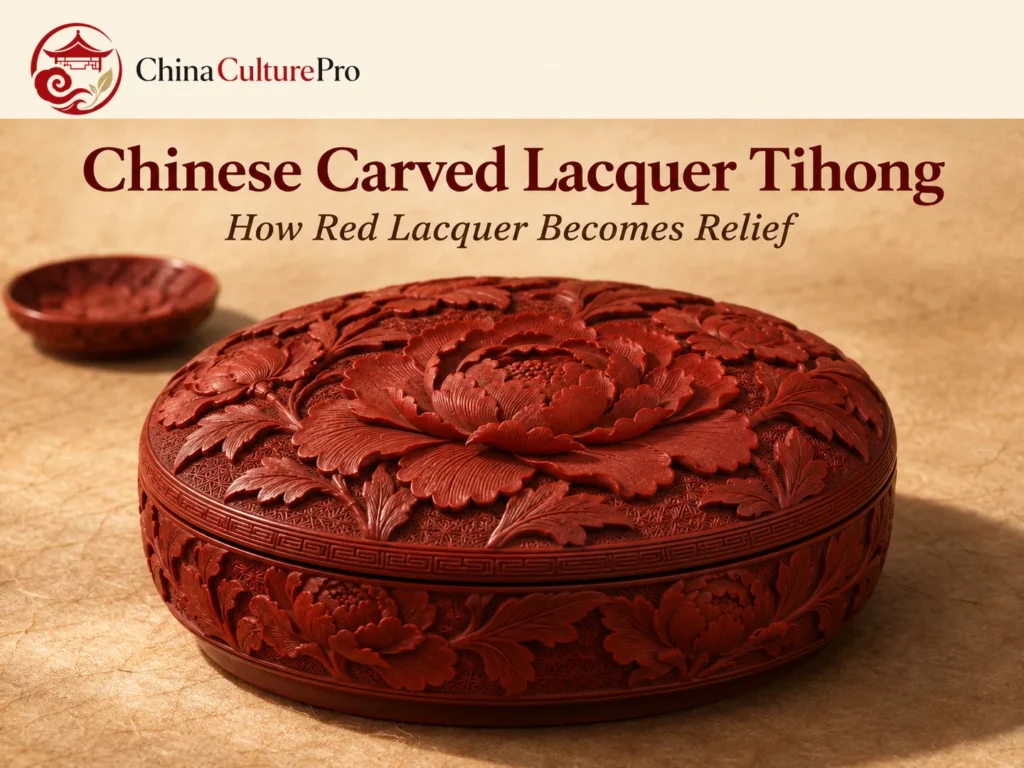
Chinese carved red lacquer (剔红, tīhóng) is made by building up coats of red lacquer over a formed body and carving the built-up surface. On a dish or box, flowers, birds and figures rise from the lowered lacquer around them. Museum catalogs may call this cinnabar lacquer, after the red mineral traditionally used as a pigment. [1][2][4]
- Body: A shaped core gives the object its form.
- Surface: Successive red coats build enough depth for relief.
- Decoration: The carver shapes the lacquer into raised motifs and recessed grounds. [1][2][4]
Look at where a leaf, cloud or figure slopes down into its background. The depth at that edge is evidence of the carved lacquer. [2][3][7]

A lidded box may look uniformly red at first. Move closer and its scarlet fields break into steps, ridges and incised lines. Changes in height tell you which details are in the foreground, and tiny repeating patterns can tell you whether the ground is water, sky or paving.
Why the Lacquer Has to Be Thick
A lacquered object can carry a thin finish over a body of wood or another material. In tihong the coating has a second job. It supplies the material into which the design is cut. The Smithsonian, for example, identifies a box dated 1403–1424 as carved red lacquer over a wooden core. Seen in profile, the wood gives the box its shape, while the red relief projects from the accumulated coating. [1][2][4]
The depth accumulates slowly, one coat at a time. The aim is a body of lacquer thick enough to carve without cutting through to the core. The Palace Museum describes many dozens of coats in its overview of historical tihong, with some accounts reaching a hundred or more. These figures describe the range of the craft. An individual catalog record may identify the materials and period without giving a layer count. Other types of Chinese lacquerware use lacquer as a painted surface or as a finish. [1][2][4]
How Carving Gives the Red Surface Depth
A cut around a petal defines its boundary. Lowering the surface beside it makes that petal stand out. Fine marks can then give the petal its veins or curl. Some designs add a patterned ground (锦纹地, jǐnwén dì) that helps the viewer read the scene across a surface of a single dominant color. [2][3][7]
On the Met’s Xuande-period garden box, repeated patterns set the sky, water and terrace apart. A scholar looks out across a lotus pond while an attendant prepares tea. The surrounding patterns organize the garden as distinct surfaces, even where they meet within a small portion of the lid. [3]
Three Museum Objects to Compare
A fourteenth-century Yuan dish at the Met depicts long-tailed birds and hollyhock. The date of this surviving piece provides a point of comparison for Ming court lacquer. It shows a scene carved on the broad, shallow interior of an open vessel. [1]
The Palace Museum catalogs a Xuande-period rectangular tihong box with lychees. Compare its outline with the round lid of the Met garden box. The Palace Museum’s catalog identifies lychees as the motif. The box measures about 14 centimeters along its longer side. Its size and shape give the fruit motif a different field from the wide, round garden lid. [2][3]
A Xuande-period dish in Beijing takes the shape of a lotus leaf with a turned edge. Its shallow relief carries scrolling lotus and auspicious emblems over a patterned background. The leaf shape belongs to the whole vessel. The smaller stems and emblems belong to the worked surface inside it. [7]
Where the Craft Continues
Beijing’s carved lacquer technique entered China’s national intangible cultural heritage list in 2006. The register traces both court production and later private workshops, including a Beijing shop established in 1904. The designation covers carved lacquer as a wider field, with red relief work among its forms. [2][5]
An exhibition of Beijing’s traditional handicrafts documented a contemporary carved red lacquer work by a team that included Guo Ming, Yin Xiuyun, Su Qiming and Song Xiuzhen. The exhibition placed this work alongside other Chinese traditional crafts. [5][6]
FAQs About Chinese Carved Lacquer Tihong
Is cinnabar lacquer made from solid cinnabar?
Historical cinnabar lacquer uses cinnabar as a red pigment in lacquer. The core, lacquer and pigment are separate components. Museum records may give more detail about an individual object. [1][4]
How many coats are in a carved red lacquer object?
The count varies. The Palace Museum gives examples ranging from many dozens to a hundred or more coats in its craft description. The catalog entry for a specific piece may leave the count open. [2][4]
How is tihong different from tixi?
Tihong emphasizes a red carved surface. In tixi (剔犀, tīxī), cuts through lacquer built up in contrasting colors expose bands along the sloping faces of the grooves. [2][8]
出典
[1] The Metropolitan Museum of Art. Cinnabar: The Chinese Art of Carved Lacquer, 14th to 19th Century
[2] The Palace Museum. Rectangular Tihong Box with Lychees
[3] The Metropolitan Museum of Art. Covered Box with Figures in a Garden
[4] Smithsonian National Museum of Asian Art. Lacquer Box
[5] China Intangible Cultural Heritage Digital Museum. Beijing Carved Lacquer Techniques
[6] China Intangible Cultural Heritage Digital Museum. The Eight Imperial Handicrafts of Beijing Exhibition
[7] The Palace Museum. Lotus Leaf-shaped Tihong Dish with Sanskrit Characters
[8] Smithsonian Institution. Carved Lacquer Box with Pommel Scroll Design