

Quick Answer: What Are Mianzhu New Year Prints?
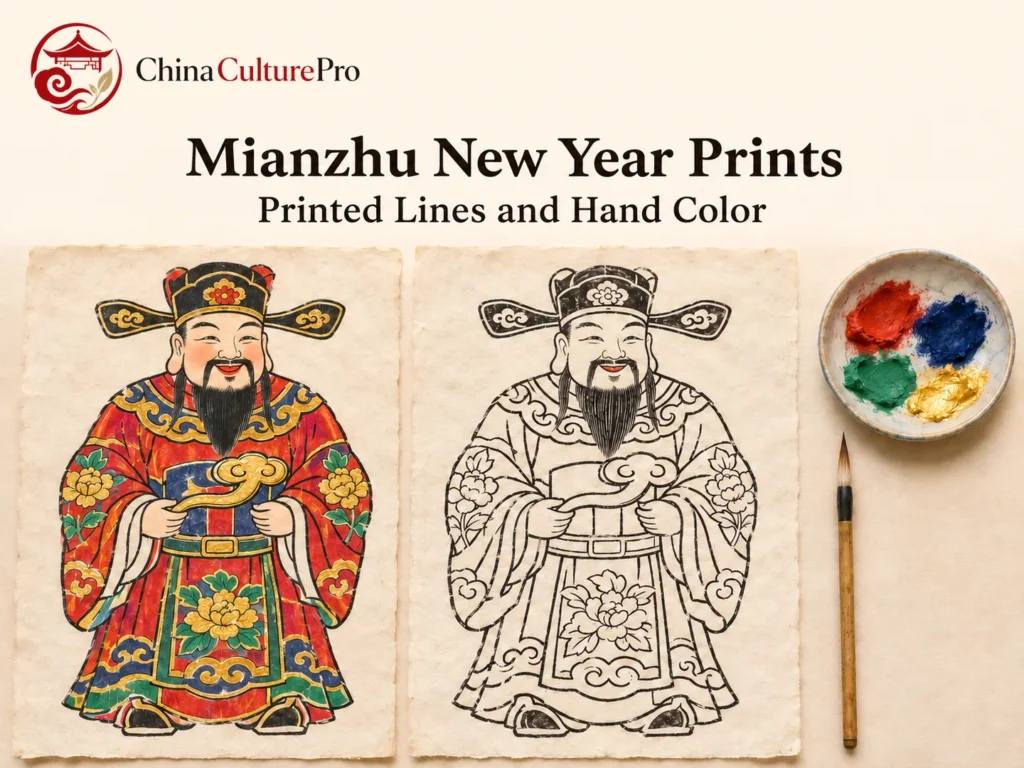
Mianzhu New Year prints (绵竹木版年画, Miánzhú mùbǎn niánhuà) are seasonal pictures made in Mianzhu, Sichuan. For a characteristic colored print, the maker prints an outline from a carved woodblock and paints the color by hand. Subjects include door gods, opera scenes, flowers and images of festive life. [1][2][4]
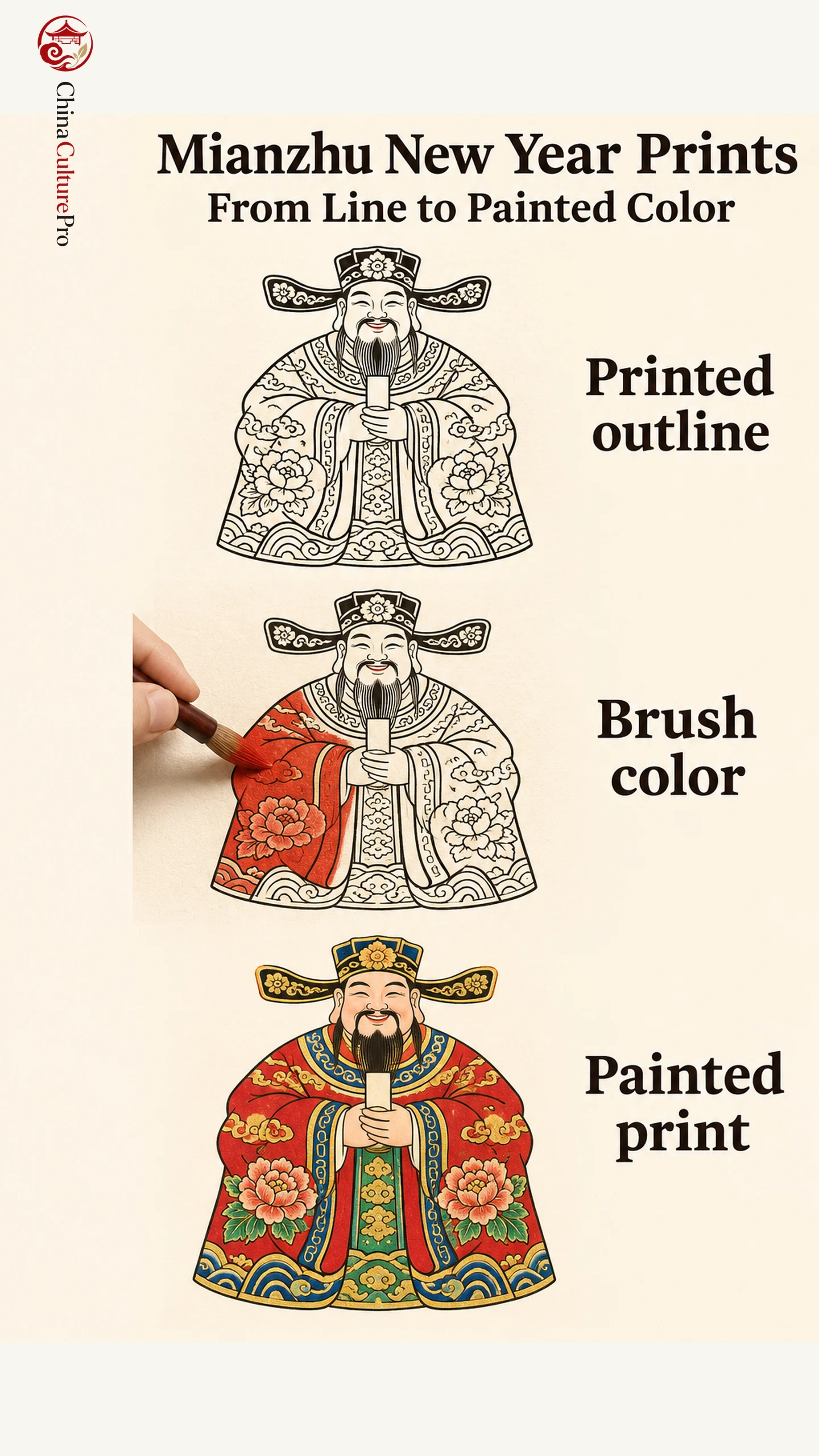
- Woodblock: The printed lines establish the figures and details.
- Brush: Hand-applied colors and accents can vary between sheets.
- Display: Door prints, square pictures and hanging images serve different settings. [1][2][4]
Compare the outline on two sheets from the same block, then look for variations in color and brushwork.
Two impressions can have the same curve at a sleeve and the same curl in a beard. Look inside those outlines and a brush may have left a broader band of color on one copy or a lighter wash on the other. That difference is part of the way Mianzhu’s colored pictures are made.
A Printed Line and a Painted Surface
The maker drafts the image, cuts the line block and inks its raised surface. The inked lines transfer to paper under pressure. A maker can lift the sheet to see which parts of the design have taken. The carved outline can be reused, as in other kinds of Chinese woodblock printing. Here it also gives the painter a guide for adding color. [1][2]
The painter fills large parts of the clothing and picks out smaller patterns with a brush. Color contrasts can make the figure legible at the scale of a door. Some large door pictures use built-up gold accents that add surface texture. The national inventory also records tiánshuǐjiǎo (填水脚), a style of applying leftover pigment with broad strokes. [1][2]
Colored Pictures and Unpainted Impressions
Mianzhu workshops distinguished hónghuò (红货), literally “red goods,” from hēihuò (黑货), or “black goods.” The first category refers to pictures colored by brush. The second refers to impressions taken from carved blocks and left without the added brush color. [1][2]
Black goods could be printed in soot ink or cinnabar, so a red impression can belong to that category. Look for broad brush-painted fields and separate accents when identifying a colored picture. A one-color impression puts the carved lines and textures on view. [1][4]
What Mianzhu Prints Show
A pair shown in a 2026 exhibition depicts Qin Qiong and Yuchi Gong. These military guardians belong to the tradition of paired Chinese door gods. The exhibition also included a civil door god carrying a wish for advancement. The military figures guard an entrance. The civil figure expresses a wish that can be conveyed in the image through auspicious objects and clothing. [2][4]
The woodblock tradition also includes small square pictures called dǒufāng (斗方), such as The Mice Marry Off Their Daughter. At another scale, the exhibition highlighted Welcoming Spring, a panoramic work showing Qing-era seasonal activities in the town. The square gives a single story a compact frame. The panorama lets the eye follow a sequence of seasonal activities across the town. [1][4][5]
From Local Workshops to the 2026 Exhibition
Hong Kong Baptist University Library holds prints acquired from Mianzhu makers and workshops, including door gods by Li Fangfu. In early 2026, Mianzhu New Year Prints Museum helped present a Beijing exhibition that brought together door prints, square pictures and contemporary work. Viewers could see household formats together with modern interpretations. In Mianzhu that February, museum director Li Yue and practitioner Lu Jun spoke at the opening of the city’s 25th New Year Prints Festival. [3][4][6]
FAQs About Mianzhu New Year Prints
Why can two Mianzhu prints from one block look different?
The block can repeat the same line design. Painters may change a color, the width of a brushstroke or a highlight when they finish individual sheets. [1][2]
Is every Mianzhu New Year print painted in color?
The colored pictures are one branch of the tradition. Mianzhu also has one-color impressions, known as black goods, that retain the ink or cinnabar impression without a painted color layer. [1][4]
When were Mianzhu New Year prints nationally listed?
Mianzhu woodblock New Year prints entered China’s first national intangible cultural heritage list in 2006. The register names Mianzhu New Year Prints Museum as the safeguarding institution. [1]
出典
[1] China Intangible Cultural Heritage Network. Mianzhu Woodblock New Year Prints
[2] National Library of China, China Memory Project. Mianzhu Woodblock New Year Prints
[3] Hong Kong Baptist University Library. New Year Woodblock Prints and Paintings
[4] China National Arts and Crafts Museum and China Intangible Cultural Heritage Museum. Welcoming Spring: Mianzhu New Year Prints and New Year Customs
[5] Xiao Ming, China Radio International. Welcoming Spring Exhibition Opens
[6] Tang Ni and Mou Wen, Mianzhu Media Center. 25th Mianzhu New Year Prints Festival