
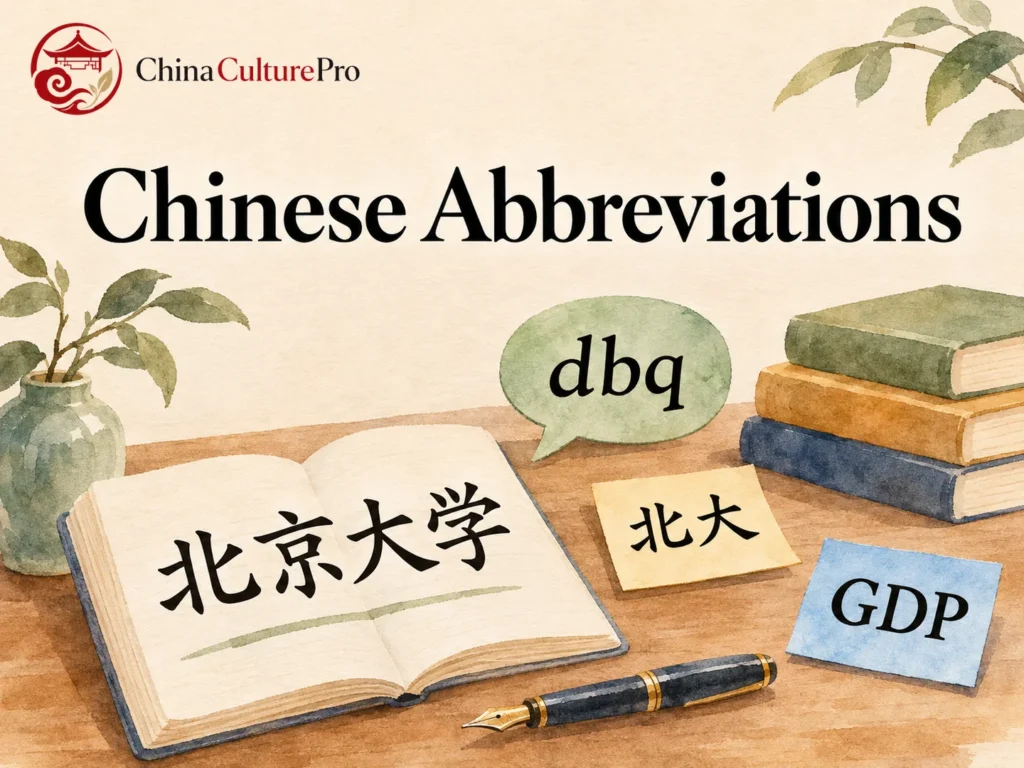

Quick Answer: What Are Chinese Abbreviations?
Chinese abbreviations (缩略语, suōlüèyǔ) are shortened forms of longer expressions, used in headlines, professional communication and everyday language.[1]
- Characters: A short form can retain selected characters or omit part of a longer name.[2]
- Letters: Some represent pinyin syllable initials; others come from English.[3][4]
- Context: Recover the full expression before deciding what a short form means.[2]
A familiar-looking sequence of letters is not enough to establish its meaning in a particular sentence.
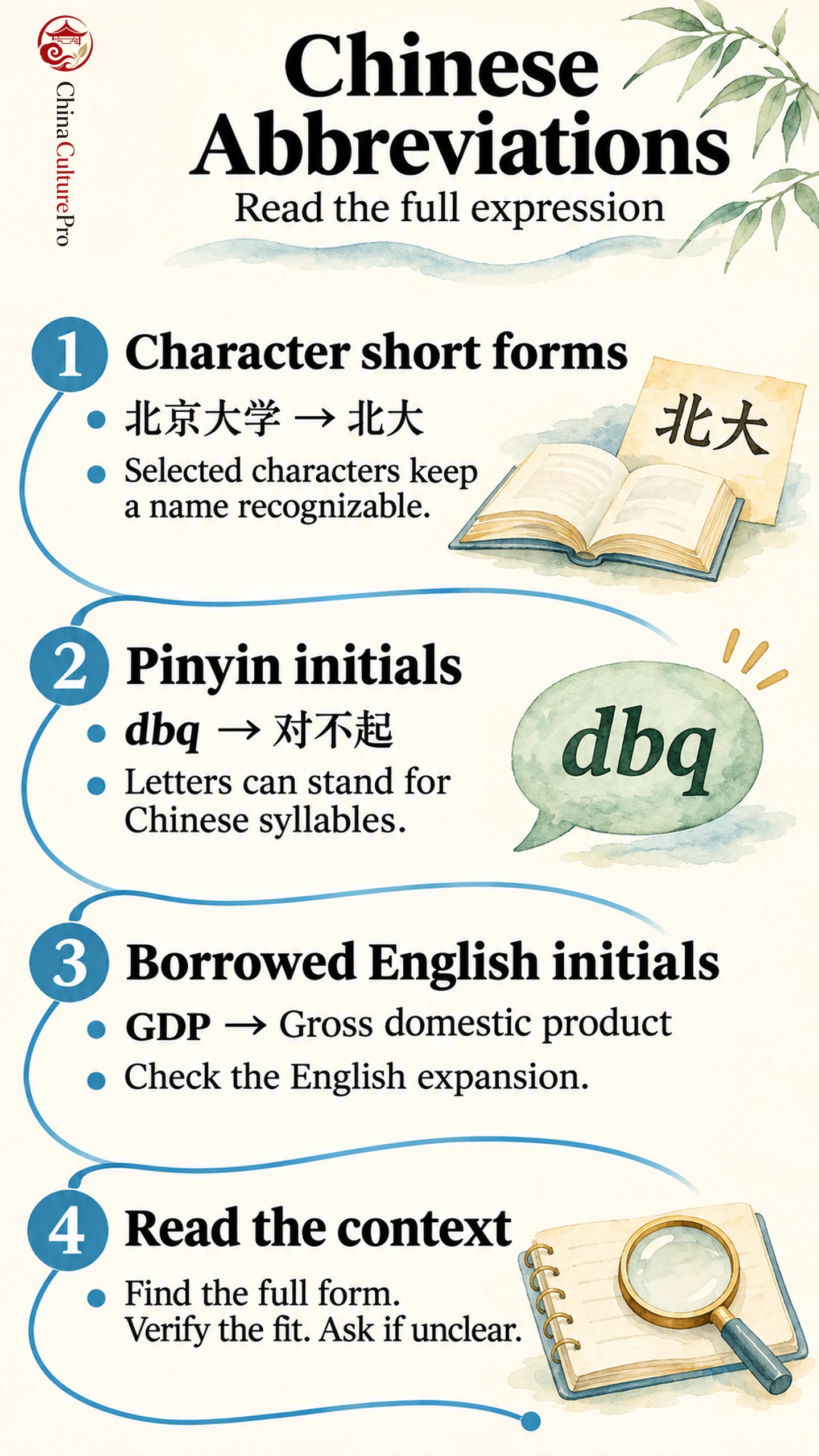
A university name in a headline and a reaction in a chat can both be abbreviated, yet they work differently. Identify both the mechanism and setting before expanding a short form.
Several Ways to Make a Short Form
Character-based abbreviation does not require Latin letters. 北大, Běidà, selects characters from 北京大学, Běijīng Dàxué. By contrast, 清华, Qīnghuá, keeps the identifying part of 清华大学, Qīnghuá Dàxué, while omitting the word for university.[1][2]
Letter strings such as dbq take the initials of pinyin syllables: 对不起, duìbuqǐ, “sorry”. GDP follows a different route: it retains the initials of the English expression “gross domestic product”, even when used within Chinese text.[3][4]
These are useful reading distinctions, not a rule that every expression can be shortened freely. Established forms and the intended audience matter.
Examples with Their Full Forms
The table distinguishes conventional character forms, informal pinyin-based letters and a borrowed English initialism.
| Short form | Full expression or expansion | 意味 |
|---|---|---|
| 北大, Běidà | 北京大学, Běijīng Dàxué | Peking University.[1][2] |
| 清华, Qīnghuá | 清华大学, Qīnghuá Dàxué | Tsinghua University.[2] |
| 地铁, dìtiě | 地下铁路, dìxià tiělù | Underground railway; metro.[1] |
| dbq | 对不起, duìbuqǐ | Sorry.[3] |
| xswl | 笑死我了, xiào sǐ wǒ le | LOL; laughter.[3] |
| GDP | Gross domestic product | Gross domestic product.[4] |
For more informal expressions, see Chinese internet slang. The emphatic xswl conveys amusement; its word-for-word wording exaggerates the reaction.
How to Read an Unfamiliar Short Form
- Identify the setting. Decide whether you are reading an institution’s name, a technical report or an informal conversation.
- Look for the expansion nearby. Check the first mention, a heading, a glossary or the institution’s own name before guessing from individual characters.
- Compare the mechanism. For a character short form, compare retained characters with the full name; for pinyin initials, compare the initial letters of each syllable; for English initials, check the English expansion.
- Verify the fit. Use a relevant dictionary or original institutional source, then reread the sentence with the full expression. If no expansion fits, leave the meaning unresolved and ask the writer.
Research on abbreviation translation likewise uses full forms as a bridge, because an expansion supplies context that a short form can lack.[2] Our guide to Chinese dictionaries explains useful lookup approaches.
FAQs About Chinese Abbreviations
Are all letter abbreviations based on pinyin?
No. Pinyin initials such as dbq and borrowed English initials such as GDP have different origins. Check the expansion instead of assuming that every Latin letter stands for a Chinese syllable.[3][4]
Can I shorten any phrase in the same way?
Not reliably. Chinese short forms use different selection and omission patterns, and a plausible invented form may not communicate the intended expression.[2]
Should I use chat abbreviations in formal writing?
Use the established name or terminology appropriate to the document, and expand unfamiliar forms for readers. Casual reaction strings belong to a different register from an institutional name or technical initialism.
出典
[1] Ministry of Education, Taiwan. Concised Mandarin Chinese Dictionary: common abbreviations
[2] Zhifei Li and David Yarowsky. Unsupervised Translation Induction for Chinese Abbreviations using Monolingual Corpora
[3] Victor Mair, Language Log. Acronyms in China
[4] Directorate-General of Budget, Accounting and Statistics, Taiwan. National accounts terminology: GDP and GNI