


Quick Answer: Are Cantonese and Taishanese the Same?
Cantonese and Taishanese (台山话, Táishānhuà) are related varieties within Yue Chinese (粤语, Yuèyǔ), but they are not interchangeable names for the same everyday speech.[1][3][4]
- Cantonese here: The Guangzhou–Hong Kong variety, rather than the entire Yue group.[1][4]
- Taishanese: It belongs to the Siyi (四邑, Sìyì) regional cluster in southwestern Guangdong.[2]
- Understanding: Shared ancestry does not guarantee effortless conversation between speakers.[1]
For family conversations, identify the particular variety your relatives use before choosing lessons.
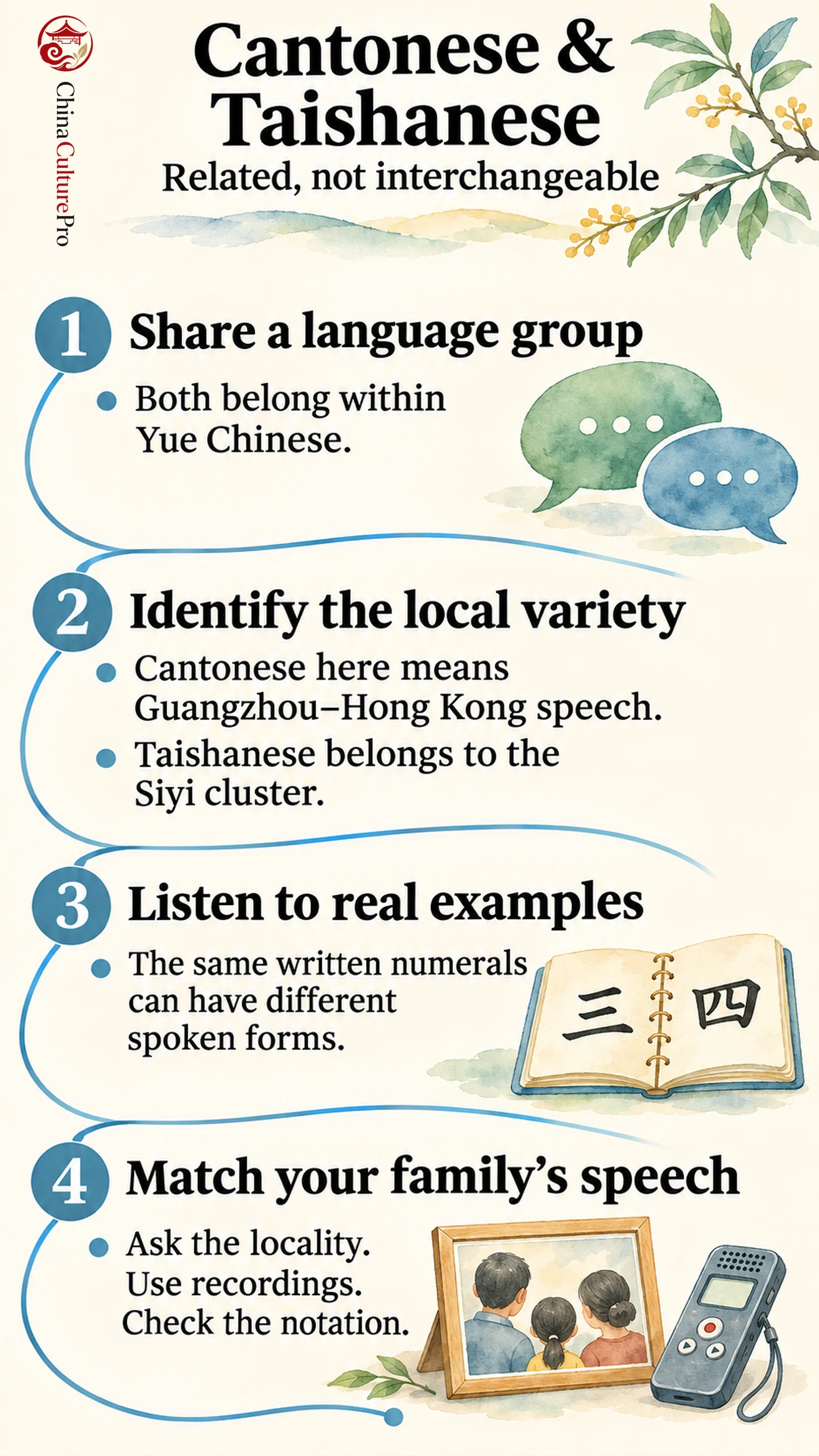
“My family speaks Cantonese” can be a useful introduction without specifying every local speech tradition. A learner needs a narrower answer: Guangzhou-style Cantonese, Taishanese, or another variety within the wider landscape of Chinese languages and dialects?
Related Varieties, Different Local Names
In English, Cantonese can refer narrowly to the prestige Guangzhou-based variety or more broadly to Yue. This article uses the narrower meaning when contrasting it with Taishanese.[1][4] For that broader cultural setting, see Cantonese language and culture.
Siyi, literally “four districts”, historically refers to Taishan, Kaiping, Xinhui and Enping. The speech region also extends beyond those historical boundaries. The name explains a regional relationship; it does not mean that every town or family has identical pronunciation.[2]
Toisanese, Taishanese and Hoisanese are alternative English labels encountered for this speech tradition; Hoisanva is another form appearing in research.[1][5] An old family spelling may reflect a different local pronunciation or transcription convention rather than a different language altogether.
Hear the Difference in Two Numerals
Even basic number words reveal differences. The following forms reproduce the phonetic notation in two published numeral datasets; they are not Mandarin pinyin or a universal Taishanese spelling system.[3][4]
| Meaning and character | Cantonese dataset | Taishanese dataset |
|---|---|---|
| Three, 三 | sam53 | ɬam33 |
| Four, 四 | sei33 | ɬei33 |
The contrasting initial symbols s and ɬ point to a difference in the consonant sound. The following digits indicate pitch values in these transcriptions, not the number of syllables.[3][4] Listen to locally identified recordings rather than reading them as ordinary English spellings.
These two words show why recognizing a written character does not supply the same spoken form in both varieties. They cannot establish a universal rule converting every Cantonese word into Taishanese. For the general role of pitch contrasts, see Chinese tones.
Understanding Speakers and Choosing Resources
Some Siyi speakers also know Guangzhou-style Cantonese. Their ability to switch between varieties reflects learned experience; it should not be mistaken for proof that the varieties are inherently identical.[1]
Siyi’s overseas connections help place a family’s local language history within a wider history of migration.[2] Read this alongside Chinese migration history, while asking relatives for their own place names and recordings.
For a Taishanese family goal, prioritize materials that identify the speaker’s locality and explain their spelling or sound notation. For Hong Kong conversation, choose Cantonese materials. A course comparison such as Mandarin versus Cantonese answers a different question from this within-Yue comparison.
FAQs About Cantonese and Taishanese
Can Cantonese speakers automatically understand Taishanese?
No. Shared Yue ancestry does not guarantee comprehension. Exposure and knowledge of more than one variety affect what a listener understands.[1]
Are Toisanese and Hoisanese different from Taishanese?
These are commonly encountered alternative English names, rather than a reliable list of separate languages. Check the speaker’s own local designation when greater precision matters.[1][5]
Which variety should I learn for my family?
Ask what relatives actually speak with one another and obtain a few recordings. Match that variety and locality; a broad family identity label alone may not specify the speech you want to understand.
出典
[1] Holman Tse, University of Pittsburgh. Beyond the Monolingual Core and out into the Wild: Toronto Heritage Cantonese
[2] Yutian Tan, Ohio State University. The Origin and Nature of High Rising Diminutive Tone Change in Siyi Dialect
[3] Numeral Systems of the World Languages, Max Planck Institute for Evolutionary Anthropology. Taishan Yue numeral dataset
[4] Numeral Systems of the World Languages, Max Planck Institute for Evolutionary Anthropology. Cantonese numeral dataset
[5] S. Blalock Ng, University of Washington. Acoustic Cues of Morphological Contrast Focus in Taishanese