

Quick Answer: Who Was Chao Cuo?
Chao Cuo (晁错, Cháo Cuò) was a Western Han (西汉, Xī Hàn) official and adviser to Emperor Wen (汉文帝, Hàn Wéndì) and Emperor Jing (汉景帝, Hàn Jǐngdì). He wrote about agriculture and frontier settlement and advocated reducing the territory controlled by regional kings. Emperor Jing had him executed during the Seven States Rebellion (七国之乱, Qīguó zhī Luàn) in 154 BCE.[1][2][6]
- Grain: He wanted the court to encourage farming and store more grain against poor harvests.[3][4]
- Government: He urged the emperor to take districts away from powerful kingdoms.[1][2]
- Outcome: His death failed to end the rebellion, which the Han court defeated later that year.[5][7]
His memorials and the histories that preserve them show different parts of his career.
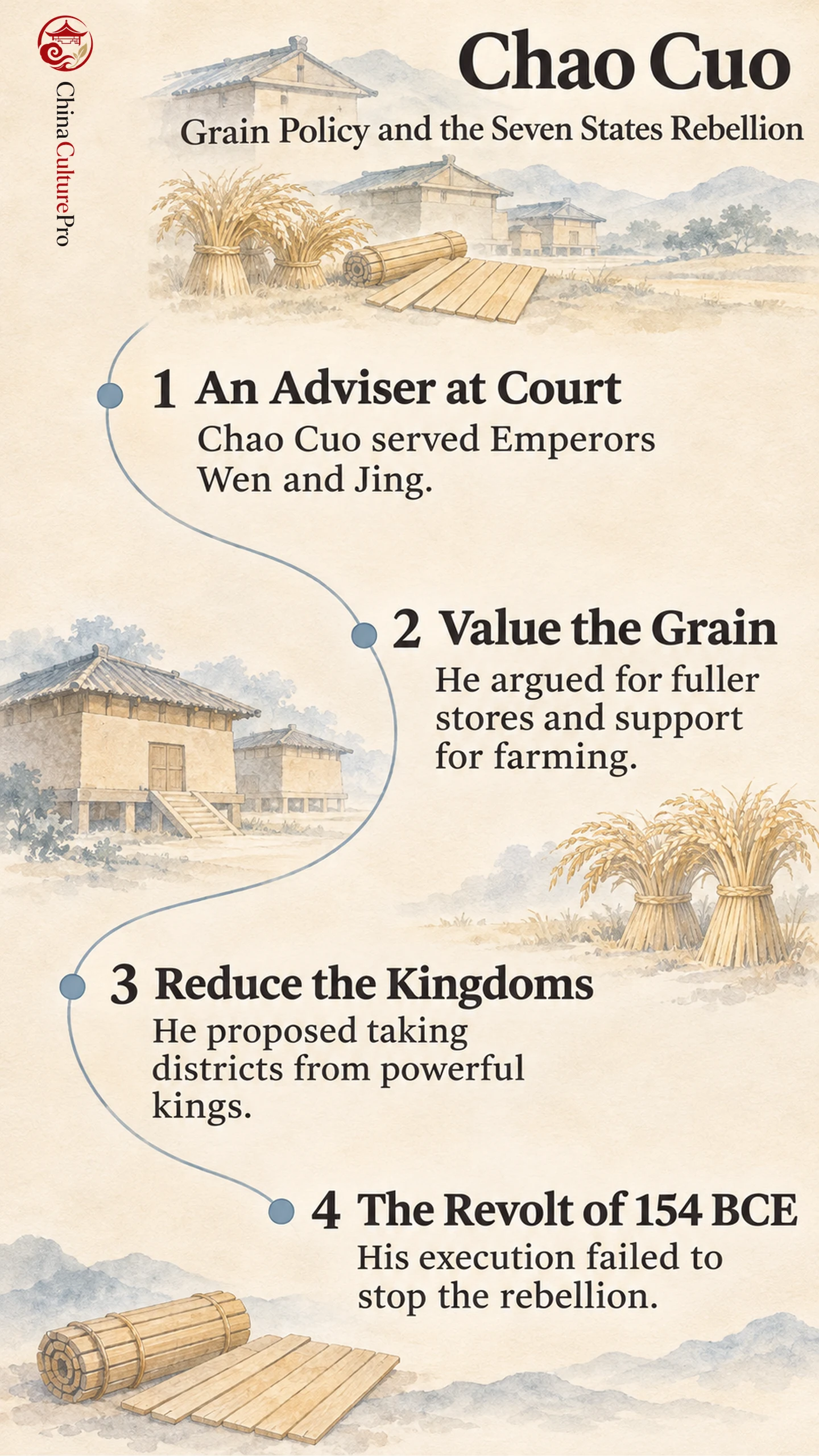
Chao Cuo appears in the histories both as an adviser making a case and as an official other people made a case against. That difference matters. His memorial on grain gives him room to describe farm work, debt and storage. The account of his death records the judgment of rivals, regional kings and an emperor under pressure.
How Chao Cuo Reached the Western Han Court
The Records of the Grand Historian (史记, Shǐjì) and the Book of Han (汉书, Hànshū) identify Chao Cuo as a man from Yingchuan. In Emperor Wen’s reign, he was sent to study with Fu Sheng (伏生, Fú Shēng), a scholar who transmitted the Book of Documents (尚书, Shàngshū). He then served in the household of the crown prince, the future Emperor Jing.[1][2]
While serving Emperor Wen, he submitted advice about the northwestern frontier and the Xiongnu (匈奴, Xiōngnú). One memorial advocated settling people there with support to establish households and cultivate land. The account in the Book of Han says the emperor acted on the proposal by recruiting settlers.[1]
His work belonged to a wider effort to organize the early Han dynasty after the fall of the Qin dynasty. The frontier memorial shows his attention to whether people could live on the land they were expected to occupy.
Why He Asked the Court to Value Grain
The Memorial on the Importance of Grain (论贵粟疏, Lùn Guì Sù Shū) describes farming households as responsible for both cultivation and obligations to the state. If a poor harvest and an urgent tax demand coincided, families could be pressed to sell cheaply or borrow on expensive terms. He urged lighter levies and fuller stores to prepare for drought or flood.[3][4]
He also proposed that people who supplied grain to the government could receive rank or remission of certain penalties. The Book of Han records Emperor Wen’s decision to award rank for grain sent to the frontier. It distinguishes his recommendation from what the court chose to implement.[4]
The memorial’s account of an overburdened farm household is part of an argument addressed to a ruler. It tells us how Chao Cuo wanted the court to see the relationship among farm work, taxes and private debt. Read it for that argument before using it as evidence for the experience of every farm family.
What It Meant to Reduce the Kingdoms
After the crown prince became Emperor Jing, Chao Cuo rose to Grandee Secretary (御史大夫, Yùshǐ Dàfū). He proposed taking districts away from some regional kings. The early Han gave members of the imperial family kingships with substantial territories, and the court’s attempt to reclaim parts of them changed the balance of power within the ruling family.[1][2][5]
The official histories describe objections at court and resentment among the kings. In 154 BCE, Liu Bi (刘濞, Liú Bì), king of Wu, joined with other kings in rebellion. The histories record a public demand for Chao Cuo’s execution. Their stated demand should be read alongside the dispute over land and governing authority.[2][5][7]
The Chinese dynasty timeline places the revolt within the Western Han. The scale that matters for the decision itself is smaller. The court wanted control of particular districts, while the kings had a stake in the power those territories gave them.
Why His Execution Failed to End the Rebellion
Yuan Ang (袁盎, Yuán Àng) argued that the emperor could bring the revolt to an end by executing Chao Cuo and restoring land and offering the kings a pardon. Emperor Jing ordered the execution. The rebels continued fighting, and imperial commanders including Zhou Yafu (周亚夫, Zhōu Yàfū) took part in putting down the revolt.[1][5][7]
In the later history, an official named Deng Gong tells the emperor that the king of Wu had long considered rebellion. He also argues that executing an adviser for offering unwelcome counsel could make other officials reluctant to speak.[1]
The histories record the proposal and its outcome. They do not give us direct access to what every rebel leader intended. The continued fighting is enough to show that the demand for Chao Cuo’s removal could not account for the whole conflict.
Compare the paired lives in the Records of the Grand Historian with the later dynastic history compiled by Ban Gu and continued by Ban Zhao. The biography and the food and money treatise place the same official in different settings. One preserves court disputes and the other shows how a proposal fit into a wider record of state policy.[1][2][4]
FAQs About Chao Cuo
What did Chao Cuo propose about grain?
He wanted fuller grain reserves and suggested rewarding contributions of grain with rank or relief from certain penalties.[3][4]
Did Chao Cuo’s death stop the Seven States Rebellion?
No. The fighting continued after his execution, and Han forces defeated the rebellion in 154 BCE.[5][7]
Where can you read Chao Cuo’s surviving arguments?
Start with the Book of Han. Chapter 49 preserves his biography and memorials, and chapter 24 places his grain proposals in the history of food and money.[1][4]
出典
[1] Book of Han. Volume 49: Yuan Ang and Chao Cuo
[2] Sima Qian. Records of the Grand Historian, Volume 101
[3] Institute for the History of Natural Sciences, Chinese Academy of Sciences. Memorial on the Importance of Grain
[4] Book of Han. Volume 24: Food and Money
[5] Sima Qian, Chinese Text Project. Records of the Grand Historian, Volume 106: The King of Wu
[6] Christian Schwermann. The Ideology of Chao Cuo
[7] Book of Han. Annals of Emperor Jing