
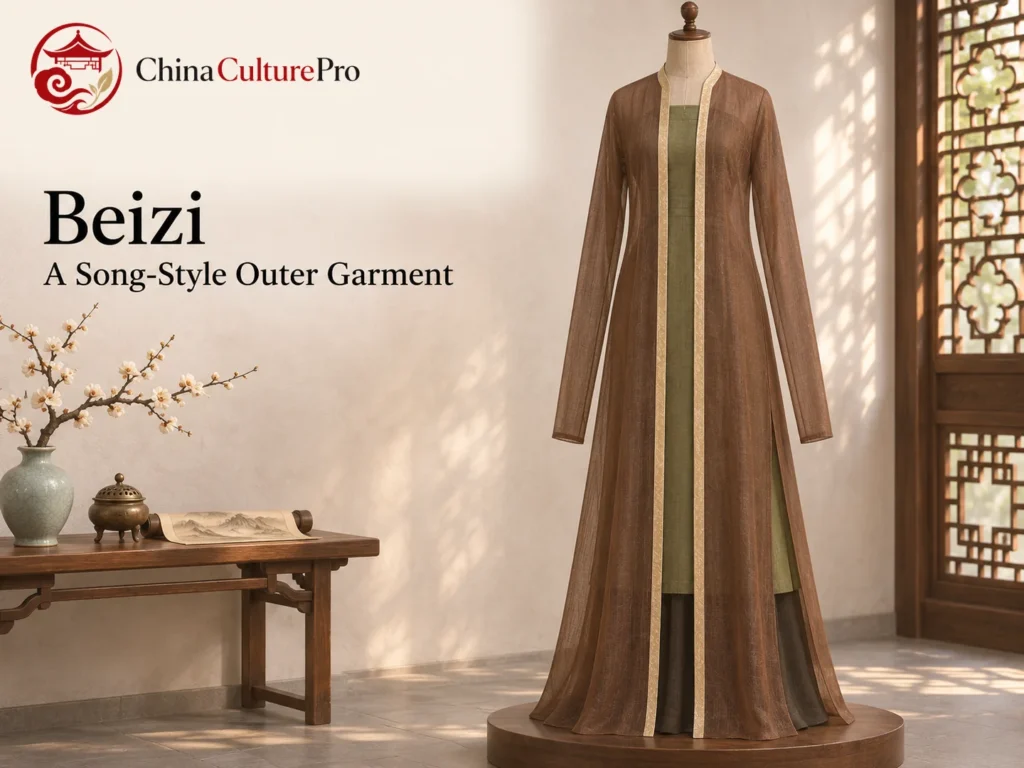

Quick Answer: What Is a Beizi?
A beizi (褙子, bèizi) is a Chinese upper garment commonly associated with Song dynasty dress. Song women’s examples often have a straight collar, facing front edges, narrow sleeves and side slits.[3]
- Front: The opening runs down the front.[3]
- Sides: Long slits separate the lower edges.[3]
- Length: Two Southern Song finds differ substantially in hem length.[1][2]
These clues help distinguish the beizi within the wider history of Chinese clothing.
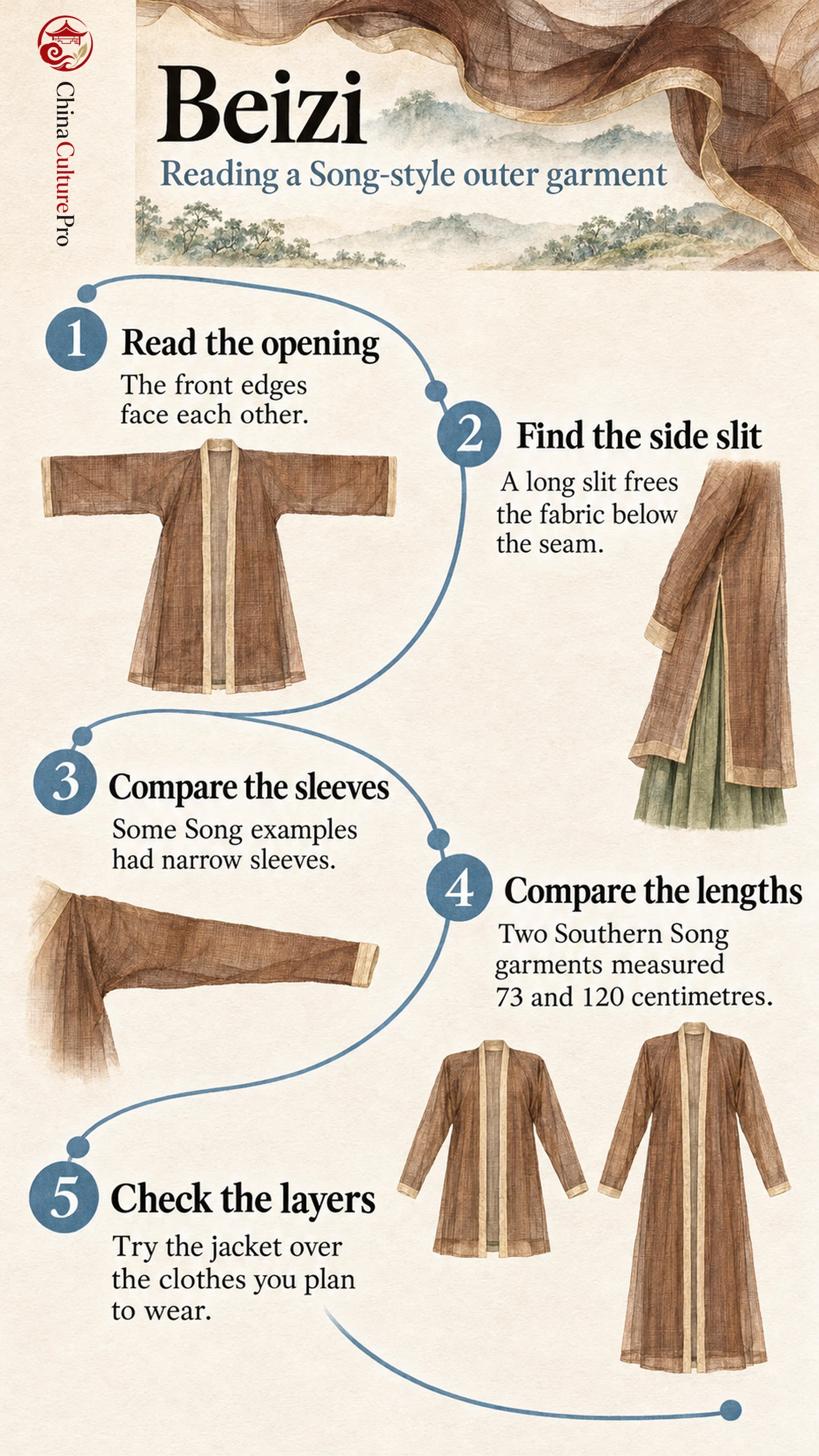
Trace the collar down the front, then look for a break in the side seam. The garment’s front edges and side openings reveal how it hangs over another layer.
How the Front and Side Slits Are Cut
In the women’s examples discussed by the China National Silk Museum, bands can finish the collar, cuffs and edges. The sleeve can narrow toward the wrist. Below the point where a side slit begins, the fabric hangs in separate front and back panels.[3]
The sleeve profile is useful when comparing Chinese sleeve types. A layered outfit needs enough room for both sleeve fabrics to move without snagging at the elbow.
Two Southern Song Garments Compared
An unlined dark gauze garment from the De’an (德安, Dé’ān) tomb of Lady Zhou, dated to 1274, measures 120 centimetres long. It has pale edging, slits and one small fabric fastener at the front. The museum identifies the cut as a possible beizi.[1]
A purple-brown gauze garment from the tomb of Huang Sheng (黄昇, Huáng Shēng) measures 73 centimetres long. The record notes side slits and front edges with neither a tie nor a button loop. Its gold-printed border survives, along with traces of the way the garment was folded in the tomb.[2]
Paintings show how the hem falls relative to a wearer’s body. Palace Museum research identifies changes in the lengths represented in different paintings.[4] Textile conservation preserves a different kind of evidence. For the De’an group, conservators supported fragile gauzes with sheer backing fabric.[5]
Fit and Layering in Modern Wear
Try a beizi over the intended inner shirt and lower garment. Look at the front edges while standing, and check that the back and shoulders stay comfortable when you reach forward. When you sit, the slits should allow the cloth to move around the knees or hips. A lightweight fabric follows the folds of the underlayer. A stiffer cloth can hold its own shape around the openings.
If you are comparing modern hanfu styles (汉服, hànfú), look at finished garment measurements. The historical lengths are measurements of specific objects.
FAQs About Beizi
Does a Beizi Have to Reach Below the Knee?
Hem lengths vary. The tomb examples and Song paintings show more than one length.[2][4]
Did Every Beizi Have a Front Fastener?
The Huang Sheng example has no front loop or tie in the museum record.[2]
Does a Beizi Always Have Wide Sleeves?
Narrow sleeves occur on documented Song women’s examples.[3]
出典
[1] China National Silk Museum. Plain Gauze Garment From De’an
[2] Zheng Jiali, China National Silk Museum. The Huang Sheng Tomb and Its Purple-Brown Gauze Garment
[3] China National Silk Museum. Plain Gauze Garment and the Song Beizi Form
[4] Palace Museum. A Study of the Qingming Scroll
[5] China National Silk Museum. 2021 Annual Report on Textile Conservation