

Quick Answer: What Matters Most in Chinese Etiquette?
Chinese etiquette is best understood through the relationship and occasion, rather than a single national list of prohibitions. A family dinner, a first meeting and a formal banquet call for different degrees of ceremony.
- Show attention: Use appropriate names and titles, acknowledge your host and notice how the gathering is organized.
- Respect others: Handle gifts and shared food thoughtfully, without creating embarrassment or pressure.
- Ask when uncertain: Clarify seating, dietary needs, payment and participation instead of guessing from a stereotype.
Familiar customs can help you prepare, but individuals vary. Courtesy works through the actual interaction, not perfect performance of a supposedly timeless script. [1]
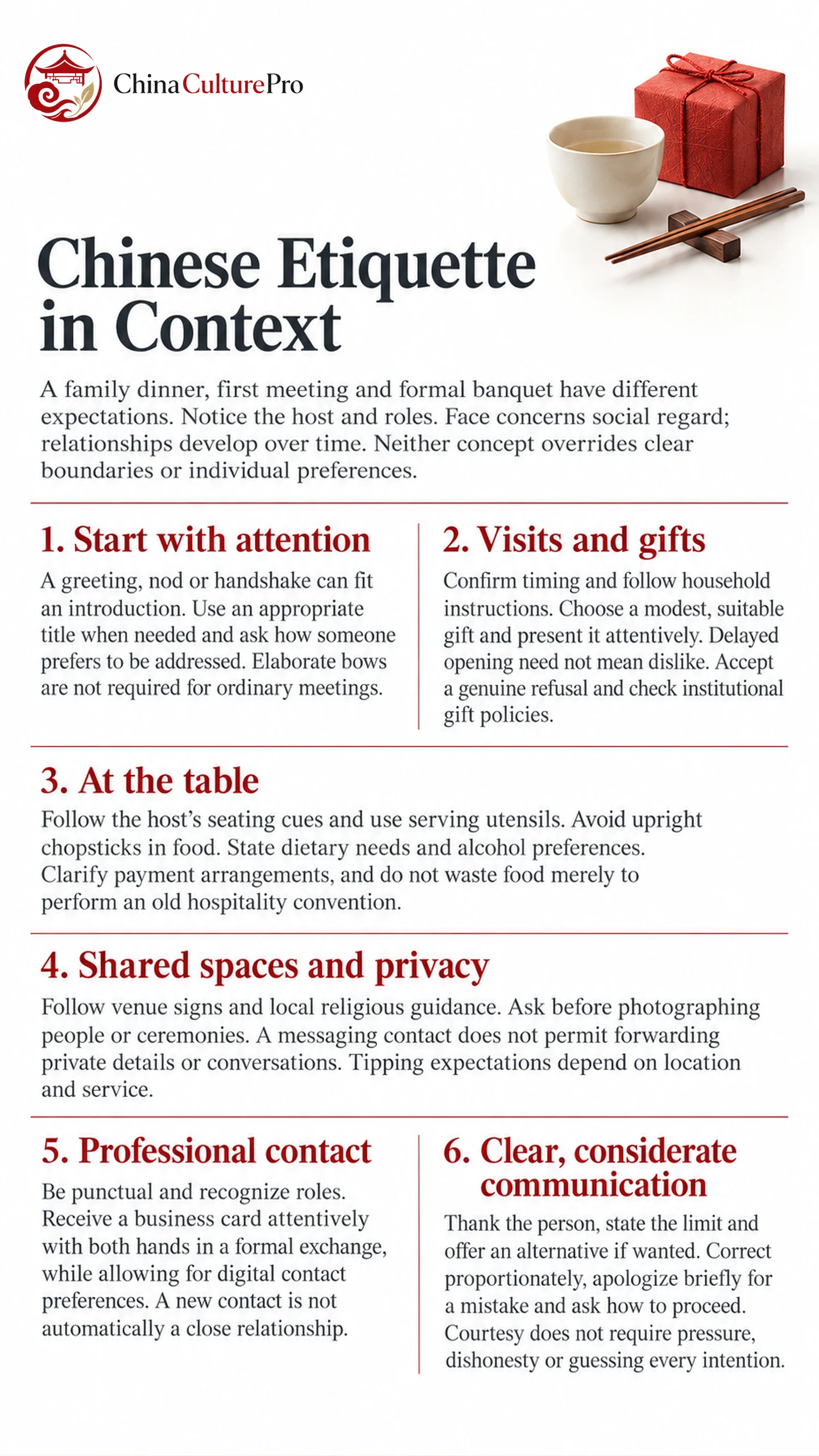
The same gesture can feel warm among friends and too familiar in a professional introduction. That is why useful etiquette starts with the setting. This overview covers everyday encounters and points to the more detailed guides when a particular meal, gift or conversation needs closer attention.
Roles, Relationships and Degrees of Formality
Begin by noticing who is hosting, whether people already know one another and whether the event is ordinary or ceremonial. In a formal gathering, age and professional position may influence introductions and seating. Among close friends, the same group may use nicknames, casual greetings and an agreed split bill.
Mianzi(面子,miànzi), commonly discussed as “face,” concerns social standing and how a person is regarded by others. It helps explain why a tactful correction can work better than a public humiliation. It does not mean that disagreement is impossible or that every awkward exchange is a cultural crisis. [1]
Guanxi(关系,guānxì)means relationships or connections. In social and professional life, introductions and continuing contact can help establish trust. That is a reason to attend to the relationship, not to assume that acquaintances owe unlimited favors. Formal business guidance also emphasizes relationship-building, patience and recognizing the people involved. [2]
The deeper guides to face and guanxi explain those concepts separately. For an immediate encounter, a simpler question is often enough: what would acknowledge this person’s role without making assumptions about their preferences?
Greetings and Forms of Address
A spoken greeting and an attentive manner are a sound start. Handshakes are familiar in formal introductions; a friendly nod can suit a brief or less formal encounter. Follow the other person’s lead rather than immediately moving into a hug or elaborate bow. Titles with a family name can provide a respectful opening when you do not yet know the preferred form of address. [3]
These Mandarin phrases are useful, but they are not a complete code of politeness:
| Ungkapan | Makna | Penggunaan yang sesuai |
|---|---|---|
| Ni hao(你好,nǐ hǎo) | Hello | A neutral greeting when meeting someone |
| Nin hao(您好,nín hǎo) | Respectful hello | A more formal greeting to an elder or someone you wish to address respectfully |
| Xiexie(谢谢,xièxie) | Terima kasih | Acknowledging help, a gift or another considerate act |
Ask how someone would like to be addressed. In a university, a family name with “teacher” may be a locally familiar form even beyond classroom teaching. That does not mean every adult in every setting should receive the same title. Personal introductions and the person’s own usage are better guides than an assumed rule about age or gender. [4]
For more examples, see Chinese greetings and forms of address. If a name’s order is unclear, ask which part to use rather than guessing from the spelling.
Home Visits and Gift Giving
Confirm the time of a home visit and tell your host if you will be delayed. At the door, follow the household’s instructions about shoes and where to put belongings. A host may offer tea or escort a departing guest toward the lift or outside; acknowledge these gestures without assuming every home follows the same routine. [3]
A modest gift can express appreciation for an invitation. Choose it for the recipient: food preferences, allergies, interests and the occasion matter more than price. A specialty from your home region can offer an easy conversation, while a very expensive present can create an unwanted sense of obligation.
Using both hands is a considerate choice for a deliberate gift presentation. Some recipients do not open a gift immediately; delayed opening does not necessarily indicate dislike. Offer the present clearly and accept a genuine refusal. A courtesy convention should not become a reason to keep pressing someone who has said no. [3][4]
Some gifts carry unfavorable associations, including clocks, sharp objects or sets of four in certain settings. These are symbolic conventions, not causes of misfortune. The gift-giving guide explains the associations and their limits. Cash gifts and red envelopes belong to particular relationships and occasions; they are not an automatic choice for every invitation.
If the setting is professional or institutional, check the recipient’s gift policy before buying anything. A thoughtful intention does not override an organization’s restrictions.
Dining, Shared Dishes and Toasts
At a formal meal, let the host indicate your place and the moment to begin. Shared dishes often sit in the center, so use the serving utensils provided and keep them separate from utensils that touch your mouth. Avoid searching through a dish for a preferred piece or reaching across another person’s space. [5]
Chopstick placement has recognizable associations. Upright sticks planted in food can recall offerings for the dead; resting them neatly avoids that reference. The detailed chopstick etiquette guide covers handling and context, while Chinese table manners explains the broader meal. You can ask for another utensil if needed; the aim is considerate eating, not a test of technical skill.
Communicate allergies and dietary restrictions before the meal where possible. A host’s encouragement to try food does not require you to eat something unsuitable. A brief thanks and a clear explanation are more useful than silently accepting a dish you cannot eat.
The same principle applies to alcohol. Formal meals may include toasts, but you can tell the host that you do not drink and ask to participate with a suitable alternative. Do not assume everyone will read a subtle gesture correctly; a calm, explicit preference is legitimate. [2]
Do not feel obliged to leave edible food solely to prove that a host provided enough. Take manageable servings and communicate when you have had enough; an older hospitality convention should not become a requirement to waste food. [3]
Payment depends on the invitation. An explicitly hosted dinner differs from friends meeting for a shared-cost meal. Confirm beforehand when unclear, and avoid turning the bill into a physical contest. Returning hospitality another time can be a more comfortable response than competing to pay at the table. [4]
Public Spaces, Temples and Digital Courtesy
Use the setting’s visible rules. A lively restaurant and a quiet museum gallery are different environments; match your voice and phone use to the space rather than copying a general description of how “Chinese people behave.” Leave room for people to pass, wait your turn and avoid blocking doors for a photograph.
At a temple or other religious site, a visitor and a worshipper may have different roles. Read signs, ask before photographing people or ceremonies, and follow the site’s instructions about dress and access. Do not import a rule from one religious community into every Chinese place of worship. The temple etiquette guide explains why local context matters.
Digital contact requires the same attention as an introduction in person. Ask before adding someone to a group, forwarding their contact details or posting an identifiable photograph. Exchanging a messaging contact is not permission to circulate a private conversation.
For ordinary service in mainland China, a tip is not generally expected in the way it is in some other countries. Particular services or agreed arrangements can differ, so ask about a charge or gratuity when it is relevant. Do not transfer one tipping expectation automatically to Hong Kong, Macao or every international-style venue. [3]
Professional Introductions and Contact Details
A professional meeting usually calls for punctuality, clear introductions and attention to the roles around the table. Introduce yourself with the name and role needed for that encounter, rather than assuming that a lengthy personal history is expected. A host or local colleague can help clarify an unfamiliar title or seating arrangement. [2]
Business cards still have a place, while digital contact exchange is increasingly common. When a card is offered, receive it attentively, use both hands in a formal exchange and take a moment to read it. Be prepared for a contact who prefers to exchange messaging details or does not carry cards. [6]
If you use a digital introduction, confirm the appropriate channel and purpose. A work contact may not want immediate promotional messages or a large group invitation. A short follow-up that identifies where you met is more useful than treating access to a contact account as an established close relationship.
These are social basics, not a promise that one set of gestures will secure a deal. Reliability, clear agreements and professional boundaries still matter.
Saying No and Repairing a Misunderstanding
You can be clear without being humiliating. Thank someone for an offer, state the relevant limit and suggest an alternative if you want one. For example, declining alcohol and joining a toast with tea communicates both the boundary and the wish to participate. No detailed medical explanation is required to justify a personal preference.
When correcting an error, choose a proportionate setting. A private clarification may avoid unnecessary embarrassment, while an urgent practical problem may need a direct response. “Face” should not be used to excuse dishonesty or prevent someone from raising a concern.
If you make a small mistake, a brief apology and a changed action usually help more than a long speech about culture. Ask how to proceed, then continue the interaction. Conversely, do not interpret every refusal, quiet pause or unfamiliar gesture as a coded cultural message. Follow up when the answer matters.
A useful etiquette habit is curiosity directed at the person present. It leaves space for regional custom, family preference and ordinary individual difference.
FAQs About Chinese Etiquette
Do I need to bow when greeting someone in China?
No elaborate bow is required for an ordinary introduction. A greeting, nod or handshake may fit; ceremonial settings can have their own instructions.
Is it rude to refuse food or alcohol?
You can decline politely. Thank the host, state your preference clearly and avoid pressuring others to eat or drink.
Must I give every gift with both hands?
Both hands are a considerate convention for a deliberate or formal presentation. Everyday interactions vary, and the recipient’s wishes still matter.
Is tipping expected in mainland China?
It is not generally expected for ordinary service. Check particular arrangements and distinguish mainland practice from other places and services.
Sumber
[1] Yueguo Gu, Journal of Pragmatics. Politeness phenomena in modern Chinese
[2] Canadian Trade Commissioner Service. Business etiquette in China
[3] Huaqiao University. Etiquette
[4] Peking University International Students Division. Chinese culture and customs
[5] Shanghai International Services. Table etiquette in China
[6] U.S. International Trade Administration. Business customs and contact exchange