


Quick Answer: What Are Wenzhou Diaspora Communities?
Wenzhou (温州, Wēnzhōu) diaspora communities grew from migration out of southern Zhejiang, especially to continental Europe. Relatives and people from the same area shared information and helped newcomers find work. The networks developed differently in each destination. Migration to the Paris region intensified in the 1980s, and Prato became a center of Chinese-run garment production in Italy. [1][2][3][4]
- Origins: The label can refer to Wenzhou itself or to networks linking nearby places such as Qingtian (青田, Qīngtián) County in Lishui. [1]
- Work: In Prato, some Chinese-owned sewing workshops grew into businesses that coordinated clothing production. [3][4]
- Languages: Families can use a hometown variety of Chinese, Mandarin and the local European language in different settings. [5][6]
Paris and Prato show how the same region of origin could give rise to different kinds of community abroad.
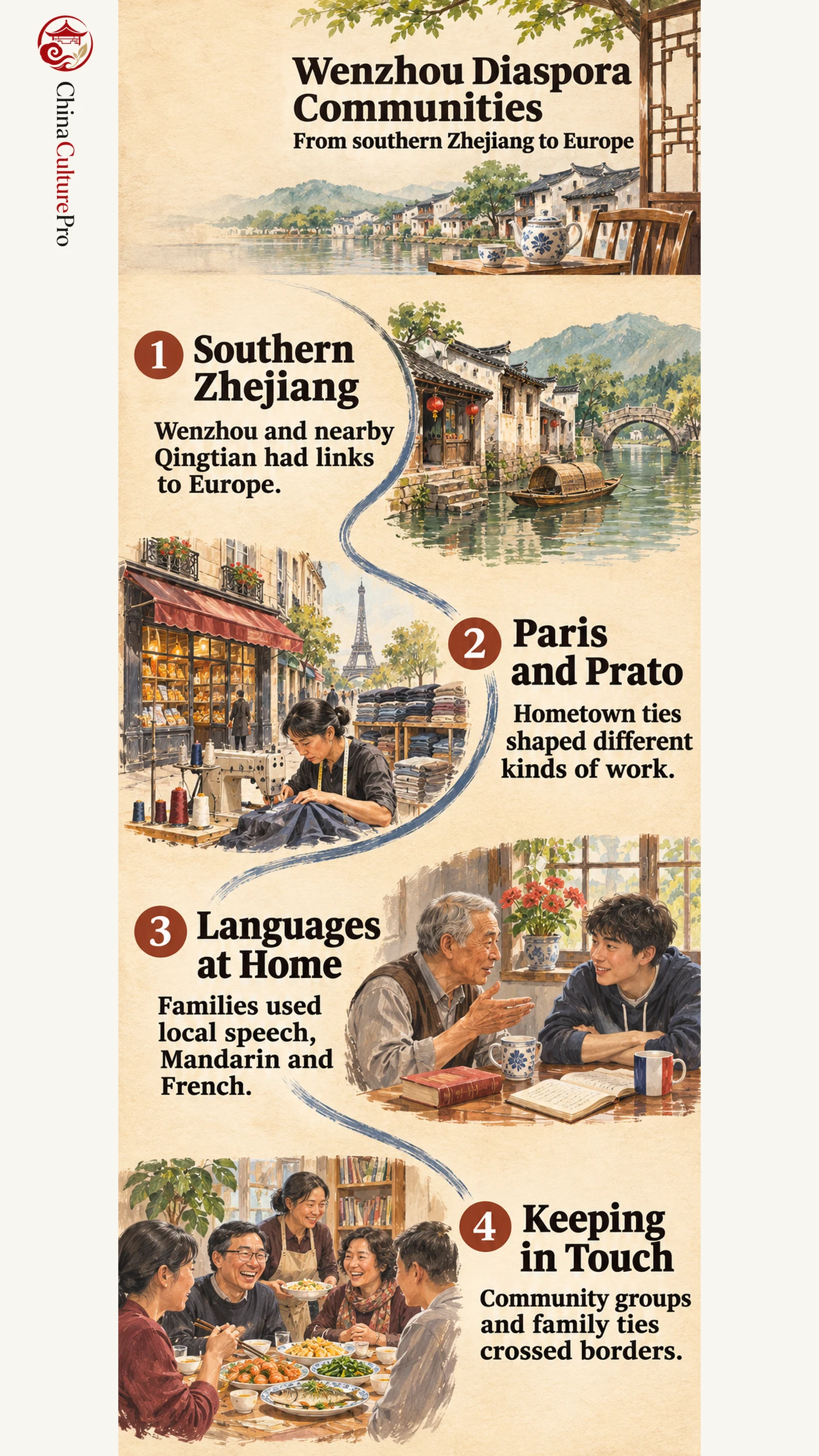
A person described as being from the Wenzhou area in Paris might trace their family to a county outside Wenzhou itself. In Prato, that same regional label may appear in research on garment workshops. Start with where the person came from, then look at the work, languages and institutions that shaped life in the destination. [1][2][3][6]
Where the Migration Networks Began
Wenzhou is a coastal city in southern Zhejiang. Qingtian County lies inland to its west and belongs to neighboring Lishui. European migration histories discuss them together because people left from settlements on both sides of today’s administrative boundary. Mette Thunø’s research uses a Qingtian county gazetteer alongside European sources to recover early migration history. [1]
A village with a long history of overseas emigration may be described as a qiaoxiang (侨乡, qiáoxiāng), or an emigrant hometown. The term points back to the place people left and the ties they kept with it. A Chinatown refers to a place in a destination city. The guide to Chinatowns and qiaoxiang communities explains how to read these place names in a family or local history. [1][2]
Relatives and hometown contacts could share information about jobs and provide help after arrival. Subsequent migration through such contacts is often called chain migration. The idea helps explain why people from nearby villages turn up in the same European cities. A family’s actual journey may still include other stops and connections. [1][2][6]
Why Paris and Prato Developed Differently
| Destination | What Researchers Documented | Ce qu’il aide à expliquer |
|---|---|---|
| Paris region, France | Migration from the Wenzhou area intensified from the 1980s. Zhipeng Li studied economic and social links with southern Zhejiang. [2] | How migrants could build a life in France while keeping ties to a home region. |
| Prato, Italy | Chinese-run sewing workshops expanded into larger production networks from the 1990s. Some businesses developed their own design and marketing. [3][4] | How migrant businesses fit into an existing textile district and developed their own garment production. |
Prato already had a textile industry. Some migrants first worked as sewing machinists. Others opened workshops that took orders from local companies. Later, some firms coordinated more of the work themselves, including producing and selling ready-to-wear clothing. These are documented changes in one industry. Other people in the same community worked as employees, studied or made a living outside garments. [3][4]
Which Languages Did Families Use?
Wenzhounese (温州话, Wēnzhōuhuà) is a variety of Wu Chinese. Southern Zhejiang contains other local varieties, including in areas associated with Wenzhou migration. The guide to Wenzhounese explains the regional speech. Shanghainese and Wu Chinese gives a comparison within the larger language group. [5][6]
Interviews published by France’s Ministry of Culture describe young migrants using a home variety with parents or older relatives and sometimes shifting to Mandarin or French with siblings. One participant from Wencheng spoke French and Mandarin with siblings born in France who had grown up without the same local variety. The siblings’ different upbringings shaped which languages they shared. [6]
What Kept the Hometown Connection Alive?
An ethnographic study of a Wenzhou Protestant church in Paris found that congregants used their regional speech in worship and in discussions over meals. Some families in the study sent children to Sunday Chinese classes to learn Mandarin, and some arranged study trips to Wenzhou. The church served families across generations and helped them maintain ties to southern Zhejiang. [7]
Look for the organization, period and people involved when reading about a diaspora community. A study of worship, a history of a clothing district and an interview about home languages each record a different part of life abroad. The Chinese diaspora culture guide situates hometown connections alongside other institutions and routes. [2][4][6][7]
FAQs About Wenzhou Diaspora Communities
Is Qingtian part of Wenzhou?
Qingtian County is part of Lishui in Zhejiang. Migration histories often discuss it alongside nearby Wenzhou because both were important places of origin for migrants to continental Europe. [1]
Why does Prato appear in Wenzhou migration history?
Prato’s textile district gave some migrants work in sewing and garment workshops. Some Chinese-run firms later organized and sold ready-to-wear production themselves. [3][4]
Do all descendants of Wenzhou migrants speak Wenzhounese?
Language use varies with where people grew up and whom they speak to. Interviews in France document families using a regional variety, Mandarin and French in different combinations. [5][6]
Sources
[1] Mette Thunø, Revue Européenne des Migrations Internationales. Chinese Emigration to Europe: Combining European and Chinese Sources
[2] Zhipeng Li, Université de Poitiers. La diaspora Wenzhou en France et ses relations avec la Chine
[3] Antonella Ceccagno, University of Bologna. New Fashion Scenarios in Prato: Chinese Migrants as Apparel Manufacturers in an Era of Perishable Global Fashion
[4] Tu Lan, Antipode. Industrial District and the Multiplication of Labour: The Chinese Apparel Industry in Prato, Italy
[5] You Rujie, Max Planck Institute linguistic data archive. Wenzhou Wu
[6] French Ministry of Culture. Pratiques langagières de jeunes immigrés chinois
[7] University of Hong Kong research archive. Renegotiating Locality and Morality in a Chinese Migrant Church in Paris