
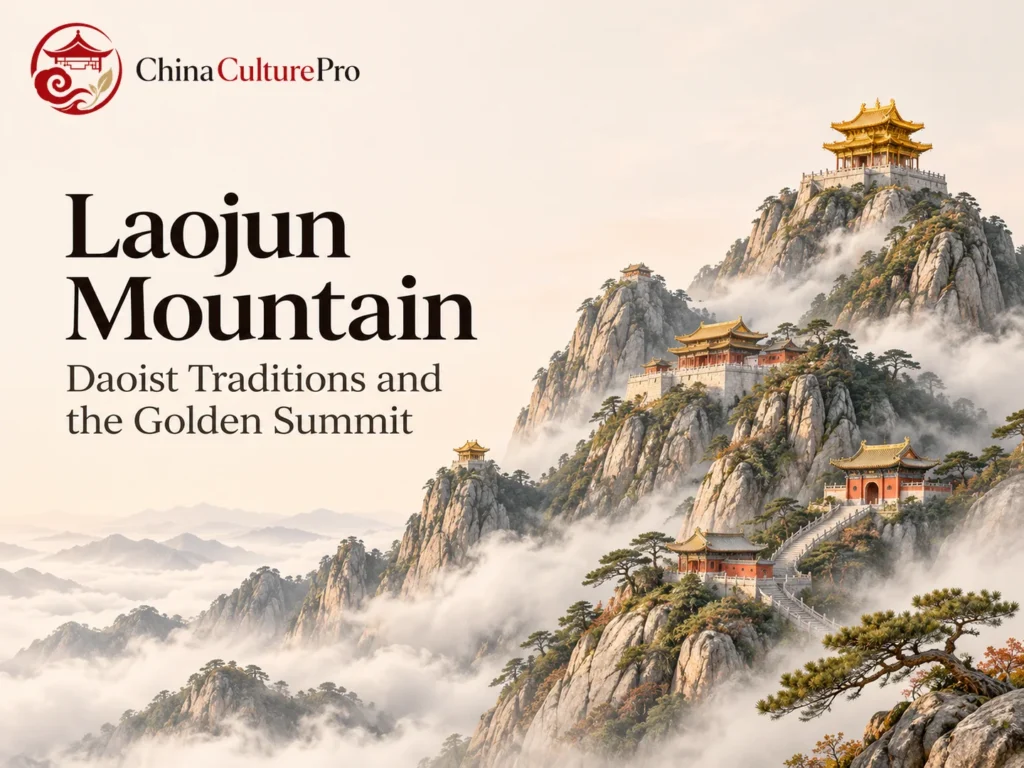

Quick Answer: Why Is Laojun Mountain Sacred in Daoism?
Laojun Mountain (老君山, Lǎojūn Shān) in Luanchuan County, Henan, is a Daoist sacred landscape centered on the worship of Lord Lao. Local tradition remembers Laozi (老子, Lǎozǐ) as retreating to the mountain. The tradition and the site’s building history are different kinds of evidence.[1][2]
- Religious meaning. The mountain’s name refers to Laozi as a Daoist deity.[1][2]
- Earlier temples. Accounts describe a summit temple famous for its iron roof.[1][3]
- The visible skyline. The Golden Summit (金顶, Jīndǐng) group was rebuilt in the early 2010s with roof forms drawn from historical palace architecture.[4][5]
The mountain’s history includes the older shrine tradition and a recent phase in which rebuilding changed the appearance of the ridgeline.[1][4][5]

Photographs often show Laojun Mountain as three gilded roofs rising above the clouds. To understand the site’s history, set the current skyline alongside traditions of Laozi’s retreat, older summit buildings and the shape of the Funiu Mountains.
Laozi, Lord Lao and the Mountain’s Name
Local tradition links the mountain, formerly called Jingshi Mountain, to Laozi’s retirement and religious cultivation. The story explains why a particular peak came to be associated with him. Accounts of Laozi’s life vary, and the retreat belongs to local religious memory rather than to a securely dated biography.[1][2]
In religious Daoism, Laozi is revered as Lord Lao, often called Taishang Laojun (太上老君, Tàishàng Lǎojūn). A temple devoted to him serves religious purposes distinct from the interpretation of the text traditionally attributed to him. The Laozi guide explains why the thinker, the text and the religious figure can be discussed on different kinds of evidence.[2]
From the Iron Roof Tradition to the Golden Summit
| Niveau | Ce qu’elle indique |
|---|---|
| Traditional foundation | Local accounts place early temple building in the Northern Wei period and link later patronage to the Tang |
| Iron-roof shrine | The summit was remembered for iron tiles and fittings, and local records document iron and bronze objects at the older temples |
| Golden Summit reconstruction | Work began in 2011 and the new group was completed in 2013, using historical-looking roofs on the mountain ridge |
The older saying contrasting Wudang’s golden summit with Laojun’s iron summit reflects the reputation of the older shrine. A county court account based on archival records describes metal figures and an iron bell in the summit temple precinct before losses in the 1950s. The reconstructed skyline represents a later layer of this history.[1][3][4][5]
How the Ridge Shapes the Temples
The Golden Summit includes structures such as the Golden Hall, Liangbao Terrace and Jade Emperor Peak. From a broad view, buildings appear to crown several points rather than form one continuous palace. Look along the connecting paths to see how the architecture follows the narrow ridge. The approach shows the changes in level between buildings that appear close together in a distant view.[4]
The mountain’s sacred status draws pilgrims, while the reconstructed group also gives the landscape a widely circulated visual identity. The design differs from the way Mount Tai’s cultural landscape brings together summit rites and inscriptions distributed along a long route. The two places show different ways sacred mountains acquire buildings over time.[1][4][6]
FAQs About Laojun Mountain’s Daoist Culture
Are the visible golden roofs from the Tang dynasty?
The current Golden Summit group dates to the reconstruction begun in 2011. The Tang association refers to an earlier temple and its patronage tradition.[1][4][5]
Does the mountain’s name prove that Laozi lived there?
The name reflects a local tradition honoring Laozi as Lord Lao. Sources about his life leave his biography uncertain.[1][2]
Is this the same place as the Golden Summit of the Wudang Mountains?
Laojun Mountain is in Henan. The older comparison with Wudang sets two distinct sacred mountains alongside one another.[1]
Sources
[1] Ministry of Culture and Tourism of China. Laojun Mountain and the iron-roof shrine tradition
[2] Stanford Encyclopedia of Philosophy. Laozi
[3] Luanchuan County People’s Court. Archival account of the summit temples and metal objects
[4] Culture and Art Network. The 2011 rebuilding of the Golden Summit complex
[5] Henan Broadcasting Network. Golden Summit completion ceremony, September 2013
[6] UNESCO World Heritage Centre. Mount Taishan