
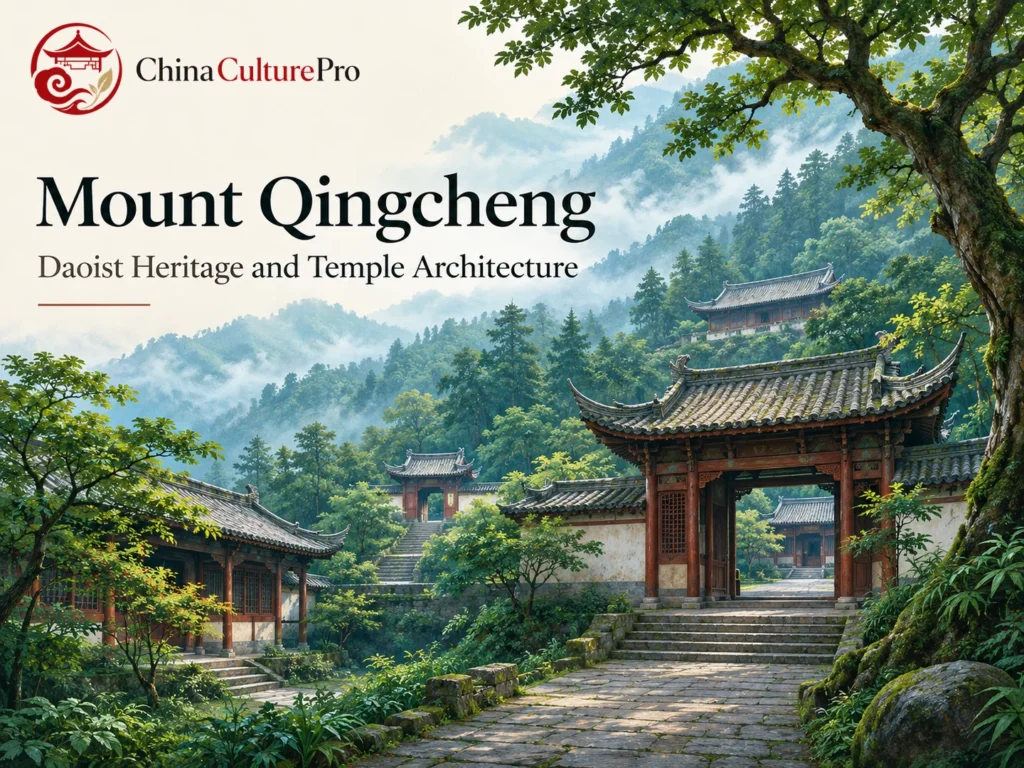

Quick Answer: Why Is Mount Qingcheng Important to Daoism?
Mount Qingcheng (青城山, Qīngchéng Shān) in Sichuan has long been associated with early organized Daoism and Zhang Daoling, the figure also called Zhang Ling. Its temple compounds preserve ways communities marked and used a wooded mountain. Tianshi Cave (天师洞, Tiānshī Dòng) is one focus of that religious memory. [1][2][3]
- Religious history: The mountain is associated with the Celestial Masters tradition and stories of Zhang Daoling’s teaching. [1][3]
- Buildings: Gates, courtyards and halls form a series of compounds set into the slopes. [1][2]
- World Heritage: The mountain and the Dujiangyan Irrigation System form one UNESCO property, with different reasons for recognition. [1][4]
Understanding a temple’s religious association and dating its present buildings are separate tasks.
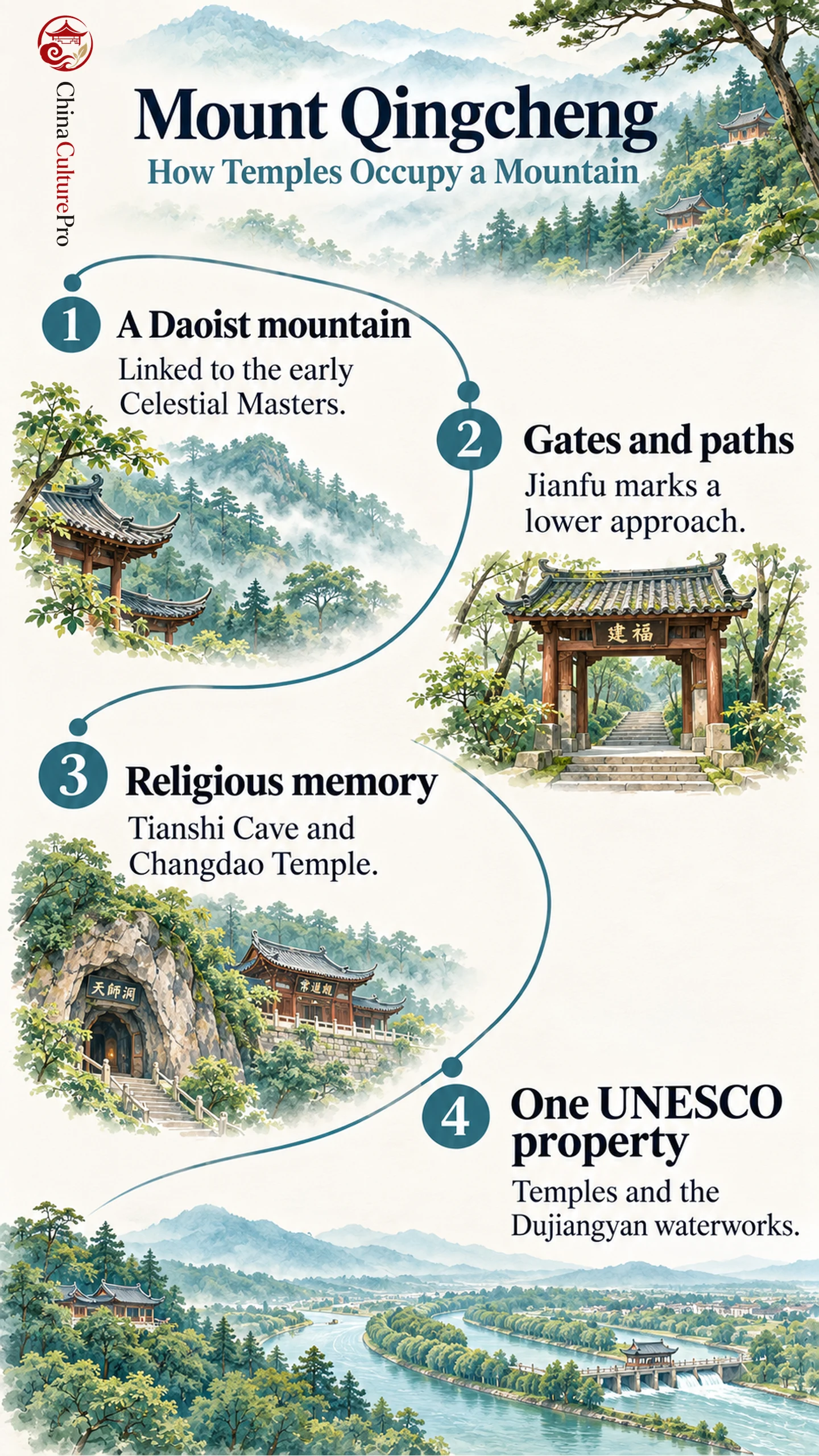
A mountain temple can first appear as a roof between trees. The approach makes the changing terrain part of the experience. Once inside, courtyards and halls mark a transition from the path to a religious space.
Three Places to Read Qingcheng’s Temple Architecture
| Site | Association or position | What the visitor can read in the setting |
|---|---|---|
| Jianfu Palace | A temple near the lower approach, historically called Zhangren Temple. [1][2] | A built threshold between approaches and higher paths. [2] |
| Tianshi Cave and Changdao Temple | The heritage nomination links the temple with the site associated with Zhang Ling’s teaching. [1][2] | Buildings give an enduring form to religious memory attached to the slope. [1][2] |
| Shangqing Palace | A separate upper temple compound in the nomination’s inventory. [2] | A higher setting with its own sequence of enclosed and open spaces. [2] |
UNESCO recognizes the mountain temples’ associations with early Daoism. The traditional date of 142 CE concerns Zhang Daoling’s religious story. The surviving architecture reflects later building and rebuilding. That distinction matters when a story about the founding of a religious community appears alongside a building that visitors can see today. [1][2][3]
What the Mountain Setting Does
Paths connect temples without putting them all on one level. A compound can open suddenly after a confined slope or winding path. Gates frame the approach, court space separates halls, and roofs make parts of an ensemble visible among trees. The designation records their relation to the regional architecture of western Sichuan. [1][2]
Religious meaning comes partly from what the buildings are used to remember. The name Tianshi invokes a Celestial Master. The tradition connects Zhang Daoling to a covenant dated to 142 CE in transmitted accounts. The heritage complex includes buildings around the place linked to his teaching. Different sources describe those associations from different points of view. [1][2][3]
Why Qingcheng and Dujiangyan Share One Inscription
The UNESCO decision identifies the temples with the history of Daoism. It identifies the Dujiangyan irrigation works with advances in water management. The system began centuries before the later temple buildings and has a different function. [1][4]
Sichuan has other religious sites whose physical setting works in another way. The Leshan Giant Buddha was carved into a cliff at a river junction. At Qingcheng, separate compounds distributed over a wooded mountain let the buildings, slopes and paths work together. [1][2][5]
FAQs About Mount Qingcheng
Is Mount Qingcheng considered a birthplace of Daoism?
UNESCO recognizes the temples’ links with early organized Daoism. The mountain is associated with Zhang Daoling and the Celestial Masters tradition. These are specific religious and historical associations within a broader tradition. [1][3][4]
Is Tianshi Cave the same place as Changdao Temple?
The heritage nomination lists Changdao Temple with Tianshi Cave as the associated place name. It identifies the complex with the memory of Zhang Ling’s teaching. [1][2]
Is the mountain itself the Dujiangyan irrigation system?
They are distinct parts of the same World Heritage property. The mountain is recognized for its Daoist temples and the irrigation system for its hydraulic engineering. [1][4]
Sources
[1] UNESCO World Heritage Centre. Mount Qingcheng and the Dujiangyan Irrigation System
[2] UNESCO World Heritage Centre. Mount Qingcheng and Dujiangyan Nomination File
[3] Fabrizio Pregadio. Religious Daoism
[4] World Heritage Committee. Inscription Decision for Mount Qingcheng and Dujiangyan
[5] UNESCO World Heritage Centre. Mount Emei Scenic Area Including Leshan Giant Buddha