

Quick Answer: How Do Xidi and Hongcun Differ?
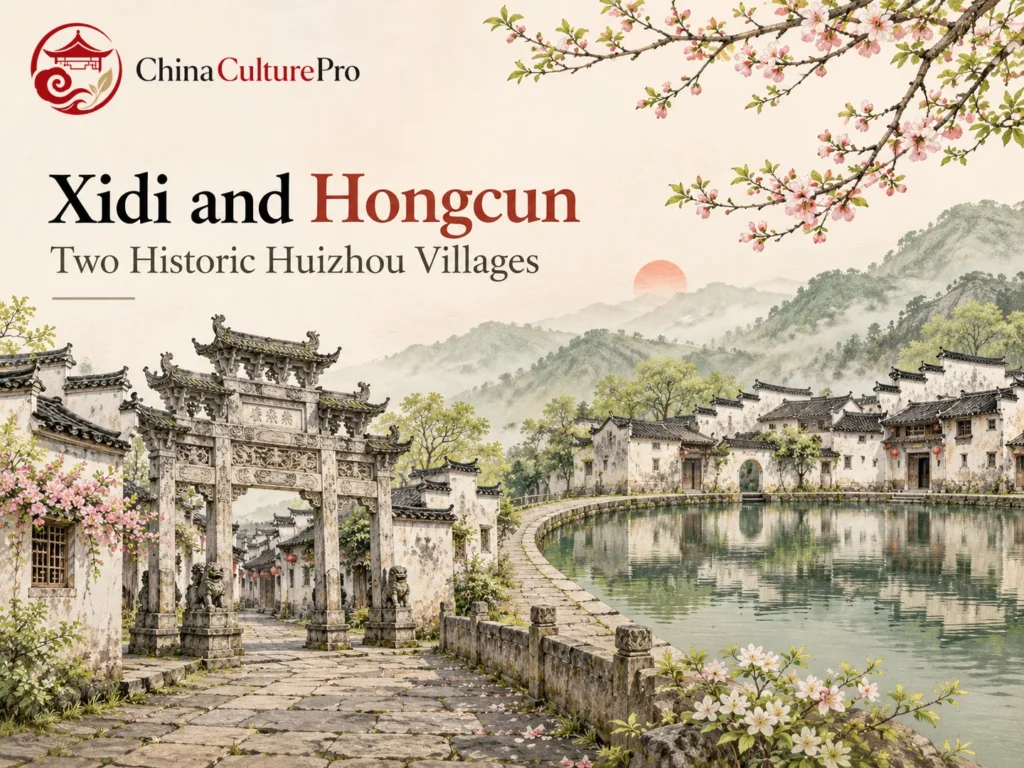
Xidi (西递, Xīdì) and Hongcun (宏村, Hóngcūn) are two villages in southern Anhui that UNESCO listed as a single World Heritage property in 2000. Both preserve houses and lanes shaped by water, trade and family organization. Xidi follows several streams. Hongcun draws attention to its channels and two pools, including central Moon Pond (月沼, Yuèzhǎo). [1][2]
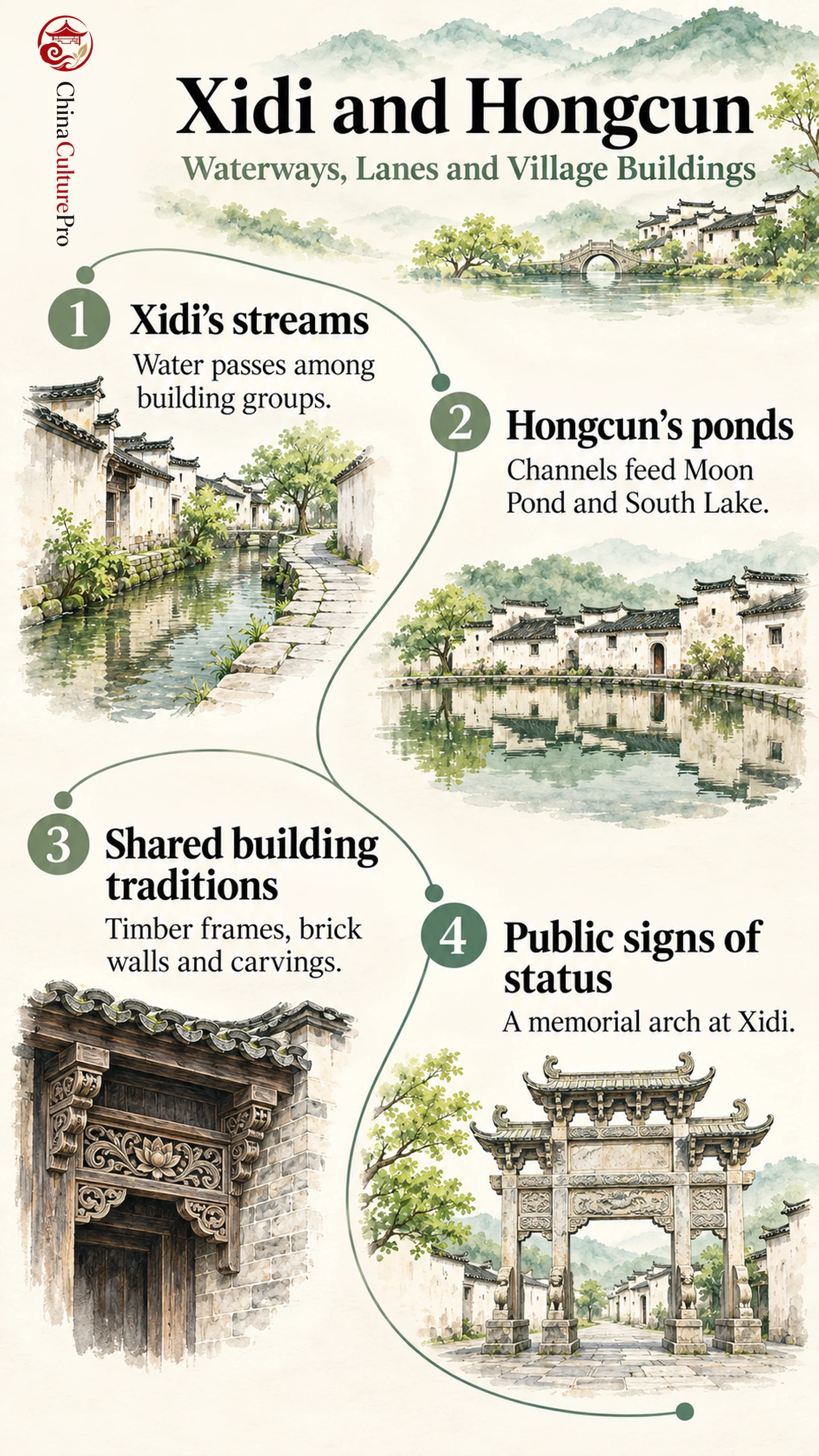
- Xidi: Streams pass between and around groups of buildings, then come together near Huiyuan Bridge. [1][2]
- Hongcun: An engineered network of channels connects the built fabric with Moon Pond and South Lake. [1][2]
- What they share: Brick-walled houses, timber structures and decorative carving reflect the resources and status of officials, merchants and their families. [1][2]
Compare the relationship between water and buildings before judging the villages by their white walls and dark roof tiles alone.
A lane at Xidi can take you toward a crossing. A channel at Hongcun can take you toward a pond framed by houses. The route that water takes gives each village much of its character.
Xidi and Hongcun at a Glance
| Caractéristique | Xidi | Hongcun |
|---|---|---|
| Main water pattern | Three streams in UNESCO’s synthesis, flowing toward Huiyuan Bridge in the south. [1] | Channels, a central pond and a larger southern pool. [1][2] |
| Spatial cue | Follow a lane or crossing to see how groups of houses sit among streams. [1][2] | Notice how water threads through lanes and opens into shared space at Moon Pond. [1][2] |
| Visible architecture | The 1578 Hu Wenguang memorial archway gives the entrance an important public marker. [3] | The houses around Moon Pond frame a central view of water and residential buildings. [1][2] |
How Water Shapes the Streets
Both villages link houses to water, but their lanes offer different ways of seeing how the systems work. At Xidi, the approaches to streams and to the bridge make the spaces between building groups visible. The nomination describes streams reaching the southern crossing. At Hongcun, the narrower channels sometimes run beside building fronts or pave the way to wider bodies of water. [1][2]
At Hongcun, the nomination describes changes to channels and reservoirs over time. An environmental design study compares the villages’ different ways of maintaining access to water, including features that could help with fire response. A village water system can do several jobs and still create a recognizable public space. For a different example of streets organized around waterways, see the Old Town of Lijiang. [1][2][4]
What Houses, Halls and Archways Tell You
Successful officials and merchants invested in their home villages. A timber frame, brick enclosure and richly carved fittings show how building and decorative labor were distributed. The forms are part of a wider Huizhou architectural tradition. [1][2]
At Xidi, the commemorative arch named for Hu Wenguang preserves a public mark of one family’s standing. A residence serves a household. A public arch announces status in shared space. An ancestral hall belongs to the collective life of a lineage, an important part of Huizhou village planning. [1][2][3]
FAQs About Xidi and Hongcun
Are Xidi and Hongcun separate UNESCO properties?
They are separate villages included in one World Heritage property. UNESCO inscribed them together in 2000. [1]
Which village has Moon Pond?
Moon Pond is in Hongcun. Its central location makes it a useful point for reading the village’s water system and adjoining buildings. [1][2]
What does their architecture document?
Dwellings, carved surfaces, streets and collective buildings together preserve evidence of household life, trade wealth and the influence of family organization. [1][2]
Sources
[1] UNESCO World Heritage Centre. Ancient Villages in Southern Anhui Xidi and Hongcun
[2] UNESCO World Heritage Centre. Ancient Villages in Southern Anhui Nomination File
[3] China National Tourist Office in Frankfurt. Xidi and Hongcun Villages
[4] Fire. Fire Prevention Oriented Environmental Design and Governance